




Main dimensions of connecting rod and main journals of the crankshaft and their fillets
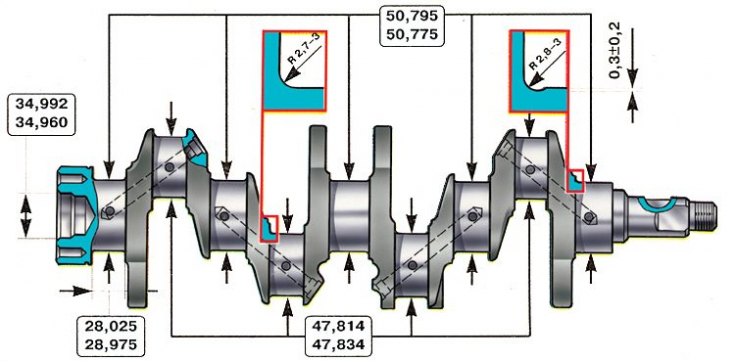
Crankshaft
The crankshaft is a five-bearing, cast iron crankshaft. The surfaces of the shaft journals are hardened by high-frequency currents to a depth of 2–3 mm. At the rear end of the crankshaft, there is a seat for the front bearing of the gearbox drive shaft, along the outer diameter of which the flywheel is centered.
The main dimensions of the crankshaft are shown in the figure.
The connecting rod and main journals of the crankshaft are connected by channels through which oil is supplied to lubricate the connecting rod bearings.
The technological outlets of the channels are closed with cap plugs, which are pressed in and, for reliability, calked at three points.
To extend the service life of the crankshaft, it is possible to regrind the crankshaft journals when their surfaces are worn or damaged. Grinding reduces the journal diameters by 0.25; 0,5; 0.75 and 1.00 mm.
Main and connecting rod bearing shells
The upper shells of the 1st, 2nd, 4th and 5th main bearings have a groove on the inner surface, and the lower ones do not have a groove (until 1987, the lower shells of these bearings were installed with a groove). The liners of the central (3rd) main bearing differ from the others by their greater width and the absence of a groove on the inner surface. All connecting rod bearing liners are grooveless, identical and interchangeable.
Flywheel
The flywheel is cast from cast iron and is equipped with a steel toothed ring for starting the engine with a starter. The flywheel is mounted on the crankshaft so that the mark (cone-shaped depression near the toothed rim) was located opposite the connecting rod journal of the 4th cylinder.
The mark is used to determine TDC in the first and fourth cylinders.