




Crankshaft
Inspect the crankshaft. Cracks in any place of the crankshaft are not allowed. Scratches, nicks and marks are not allowed on the surfaces mating with the working edges of the seals. Install the crankshaft with the outer main journals on two prisms and check the runout with an indicator in the places indicated in Figure 44. The numbers in the figure indicate the permissible runouts and offsets of the journals.
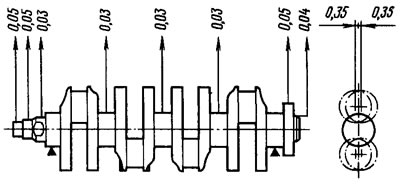
Figure 44. Checking the crankshaft
The diameters of the main and connecting rod journals are measured. The journals should be ground if worn to a diameter 0.005 mm smaller than the minimum for a given crankshaft size, and also if the ovality of the journals is greater than 0.03 mm or there are burrs and scratches on them. The diameters of normal-sized journals are given in table 1. Diameters of necks of repair sizes (reduced by 0.25; 0,5; 0,75; 1.00 mm) are equal respectively for the molars: 50.569-0.02; 50,319-0.02; 50,069-0.02; 49,819-0.02 mm; and for connecting rods: 47.60-0.02; 47,35-0.02; 47,10-0.02; 46,85-0.02 mm.
The journals are ground to the nearest repair size. The distance between the axes of the connecting rod and main journals should be 35.5+0.025-0.05 mm (piston stroke 71+0.05-0.10 mm), and the radii of the neck fillets are 1.8–2.0 mm.
After grinding, the ovality and conicity of the main and connecting rod journals should be no more than 0.005 mm, and the displacement of the axes of the connecting rod journals from the plane passing through the axes of the connecting rod and main journals should be ±0.35 mm (see figure 44). To check, install the shaft with its outer journals on prisms and adjust the shaft so that the axis of the crankpin of the 1st cylinder is in the horizontal plane passing through the axes of the main journals. Then, use an indicator to check the vertical displacement of the crankpins of the 2nd, 3rd and 4th cylinders relative to the crankpin of the 1st cylinder. After grinding the journals, polish them using diamond paste or GOI paste.
After grinding and subsequent finishing of the journals, remove the plugs of the oil channels, and then run through the nests* of the plugs with a cutter A.94016/10, mounted on a spindle A.94016. Thoroughly wash the crankshaft and its channels to remove residual abrasive and blow them out with compressed air. Use a mandrel A.86010 to press in new plugs and hammer each one at three points with a center punch.
* Diameter of sockets for plugs ∅ 10-0.036 mm.
On the first cheek of the crankshaft, the value of reduction of the main and connecting rod journals is marked (for example, K 0.25; W 0.50).
Inserts
No adjustment operations can be performed on the liners. In case of scoring, scratches or delamination of the antifriction layer, they are replaced with new ones. If, when checking the liners, it turns out that they can be used further, then the clearance between them and the crankshaft journals is checked.
The clearance can be determined by calculation, measuring the diameters of the journals, bearing beds and the thickness of the bearings. If the clearance exceeds the maximum allowable (0.1 mm for connecting rod journals and 0.15 mm for main journals), the liners are replaced with others of increased thickness after grinding the journals. A sign of correct assembly and mating of the journals with the corresponding liners is the free rotation of the crankshaft.
Thrust half rings
Just like with liners, no adjustment operations can be performed on half rings. In case of scoring, scratches and delamination, half rings are replaced with new ones. Half rings are also replaced if the axial clearance of the crankshaft exceeds the maximum permissible value of 0.35 mm. New half rings are selected with the nominal thickness or increased by 0.127 mm to obtain an axial clearance of 0.06-0.26 mm.
The crankshaft axial clearance is checked using an indicator as shown infigure 31.
Flywheel
The condition of the toothed rim is checked and if the teeth are damaged, the flywheel is replaced. On the surface 1 (figure 45) flywheel adjacent to the crankshaft flange and on surface 3 under the driven clutch disk, scratches and burrs are not allowed. The non-flatness of surface 3 should not exceed 0.06 mm.
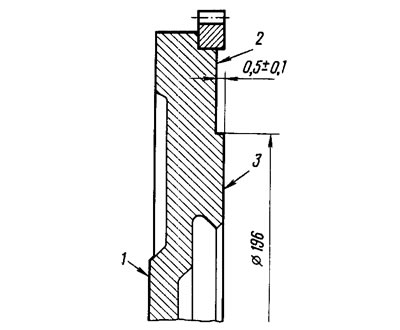
Figure 45. Checking the flywheel
Scratches and burrs on surface 3 are removed by turning, removing a metal layer no more than 1 mm thick. In this case, surface 2 is also turned, without affecting the toothed rim and maintaining the size of (0.5±0.1) mm. When turning, it is necessary to ensure the parallelism of surfaces 2 and 3 relative to surface 1. The permissible non-parallelism is no more than 0.1 mm.
The flywheel is installed on the mandrel, centering it on the mounting hole with a stop on surface 1, and the runout of planes 2 and 3 is checked. In the places indicated by the arrows in Figure 45, the indicator should not show runouts exceeding 0.1 mm.
When replacing the flywheel, it is not necessary to balance it.