




Measuring the width of the calibrated wire after flattening using a scale
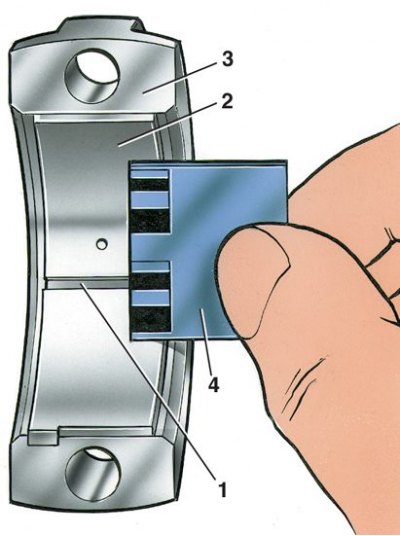
1 – calibrated wire; 2 – insert; 3 – connecting rod bearing cap; 4 – scale for calibrated wire
The clearance between the bearing shells and the crankshaft journal can be checked by calculation, by measuring the parts, or by using a calibrated plastic wire, for which:
- carefully clean the working surface of the liners and the crank pin and install the connecting rod - piston group on the crankshaft pin according to the numbering;
- place a piece of calibrated wire on the surface of the connecting rod, install the cover on the connecting rod and tighten the nuts to a torque of 51 N·m (5.2 kgf·m);
- remove the lid and, using the scale on the packaging and the flattening of the wire, determine the size of the gap.
The nominal calculated gap is 0.036–0.086 mm. If it is less than the limit (0.1 mm), then these liners can be used again.
If the clearance is greater than the maximum, replace the liners on these journals with new ones. If the crankshaft journals are worn and ground to the repair size, replace the liners with repair ones of increased thickness.
Thickness of connecting rod bearing liners, mm
Nominal | Enlarged (repair) | |||
0,25 | 0,50 | 0,75 | 1,0 | |
1,723 | 1,848 | 1,973 | 2,098 | 2,223 |
1,730 | 1,855 | 1,980 | 2,105 | 2,230 |
Numbers 0.25; 0.50, etc. indicate the amount of reduction in the diameter of the crankshaft journals after grinding.
The text is copied from the online portal www.vazbook.ru