




Open large image in new tab »
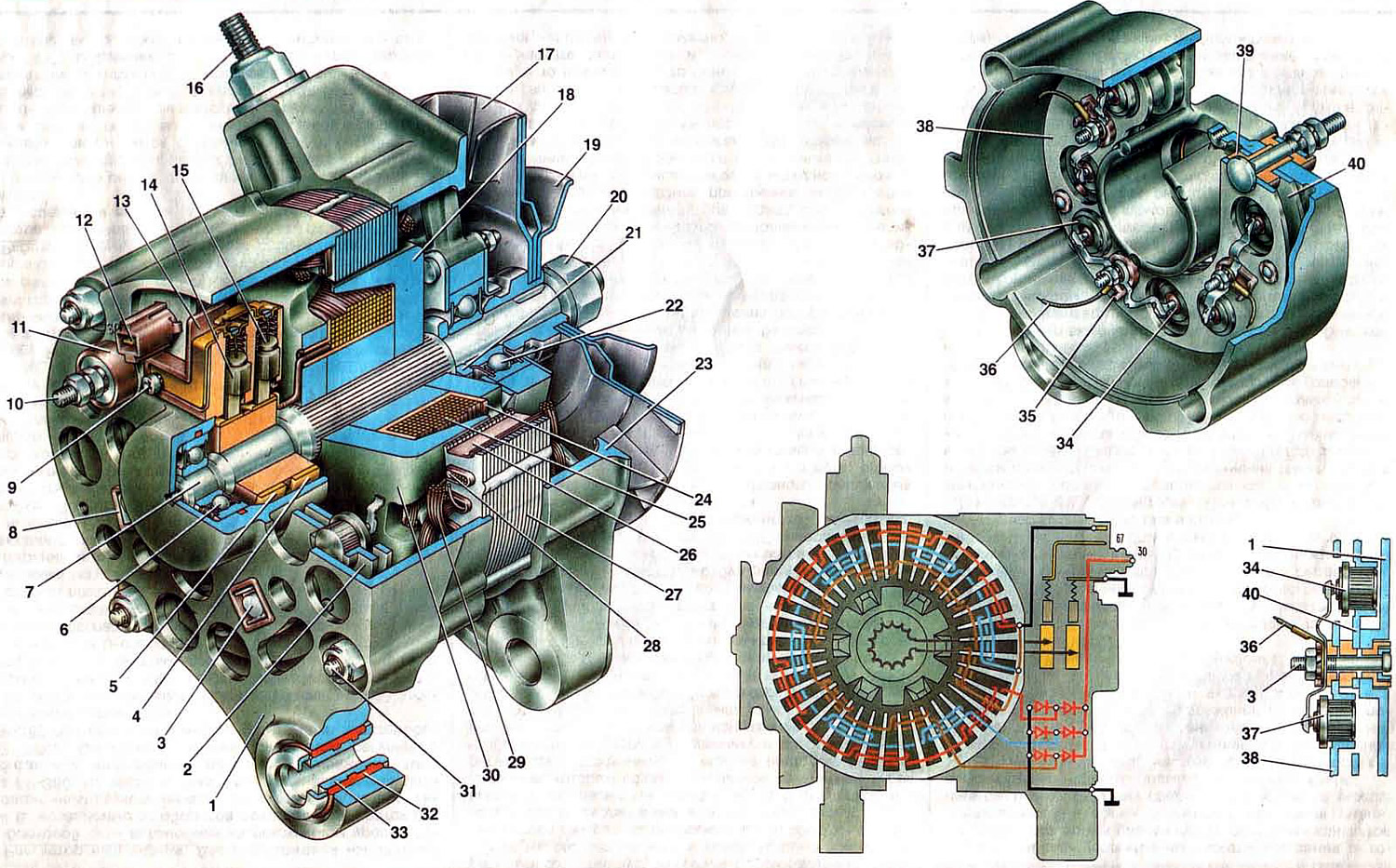
Fig. 28. Generator.
1. Generator cover from the slip ring side; 2. Rectifier block; 3. Bolt for fastening the rectifier block and phase terminals of the stator winding; 4, 5. Slip rings; 6. Rotor shaft ball bearing from the slip ring side; 7. Rotor shaft; 8. Insulating sleeve; 9. Brush holder mounting screw; 10. Positive terminal bolt (terminal "30"); 11. Insulating sleeve of contact bolt; 12. Stator winding central terminal plug; 13. Brush holder; 14. Negative brush; 15. Positive brush; 16. Stud for fastening the generator to the tension bar; 17. Pulley impeller; 18. Beak-shaped rotor pole piece on the drive side; 19. Generator drive pulley; 20. Pulley mounting nut; 21. Bearing spacer ring; 22. Rotor shaft ball bearing on drive side; 23. Generator cover, drive side; 24. Rotor winding frame; 25. Rotor winding; 26. Stator slot insulation; 27. Stator; 28. Stator winding wedge; 29. Stator winding; 30. Beak-shaped rotor pole piece from the slip ring side; 31. Tie bolt; 32. Buffer bushing; 33. Bushing; 34. Negative diode; 35. Insulating plate; 36. Phase terminal wire of the stator winding; 37. Positive diode; 38. Positive diode holder; 39. Insulating sleeve; 40. Negative diode holder.
1. Generator cover from the slip ring side; 2. Rectifier block; 3. Bolt for fastening the rectifier block and phase terminals of the stator winding; 4, 5. Slip rings; 6. Rotor shaft ball bearing from the slip ring side; 7. Rotor shaft; 8. Insulating sleeve; 9. Brush holder mounting screw; 10. Positive terminal bolt (terminal "30"); 11. Insulating sleeve of contact bolt; 12. Stator winding central terminal plug; 13. Brush holder; 14. Negative brush; 15. Positive brush; 16. Stud for fastening the generator to the tension bar; 17. Pulley impeller; 18. Beak-shaped rotor pole piece on the drive side; 19. Generator drive pulley; 20. Pulley mounting nut; 21. Bearing spacer ring; 22. Rotor shaft ball bearing on drive side; 23. Generator cover, drive side; 24. Rotor winding frame; 25. Rotor winding; 26. Stator slot insulation; 27. Stator; 28. Stator winding wedge; 29. Stator winding; 30. Beak-shaped rotor pole piece from the slip ring side; 31. Tie bolt; 32. Buffer bushing; 33. Bushing; 34. Negative diode; 35. Insulating plate; 36. Phase terminal wire of the stator winding; 37. Positive diode; 38. Positive diode holder; 39. Insulating sleeve; 40. Negative diode holder.
The G-221 alternating current generator is used to supply electrical energy consumers and to charge the battery. It is a three-phase synchronous electric machine with electromagnetic excitation of right rotation (from the drive side). To convert alternating current into direct current, a rectifier with six silicon diodes is built into the generator. The maximum output current of the generator is (at 14V and 5000rpm) is 42 A.
The generator is mounted on the engine on the right side and is driven by a V-belt from the crankshaft pulley. Through the holes in the ears of covers 1 and 23, the generator is fastened with a bolt to the engine bracket and a stud to the tension bar. To prevent the ears of the covers from breaking off when tightening the bolt, there is a rubber buffer bushing 32 in the hole in cover 1. Under the action of the tightening force, the pressure steel bushing (in the picture it is located to the left of the buffer) shifts, choosing the gap between the eye and the generator mounting bracket, the buffer bushing 32 is compressed between the steel bushings and the axial tightening force is not transmitted to the eye.
The main parts of the generator are the rotor, stator 27 and covers 1 and 23, cast from aluminum alloy.
The rotor consists of a shaft 7, on the corrugated surface of which a steel bushing and steel beak-shaped poles 18 and 30 are pressed and form, together with the shaft and the bushing, the core of the electromagnet. On the bushing between the beak-shaped poles in a plastic frame, the winding 25 of the rotor, called the excitation winding, is placed. The ends of the winding are brought out through the holes in the pole 30 and soldered to the copper contact rings 4 and 5, installed on the plastic bushing.
The rotor rotates in two closed ball bearings 6 and 22. Lubricant is added to the bearings during manufacture and does not require replenishment during operation. The inner race of the front bearing 25 is loosely mounted on the rotor shaft and, together with the spacer ring 21, is clamped by the pulley fastening nut between the pulley hub and the shaft flange. The outer race of this bearing is pressed into the cover and secured between two steel washers pulled together by four screws. After tightening the nuts, the ends of the screws are punched out to prevent the nuts from loosening themselves. The inner race of the rear bearing 6 is pressed onto the rotor shaft, and the outer race enters the seat of the cover 1 and is pressed by a rubber ring.
A pulley 19 with a fan impeller 17 is fixed to the rotor shaft using a segment key and a nut. The fan impeller serves to cool the rectifier and the internal parts of the generator. Air is sucked into the windows of the cover 1, passes between the stator and the rotor and is thrown out through the windows of the cover 23 by the fan impeller. A spring conical washer is installed between the pulley hub and the nut, with its convex side facing the nut. The pulley and the fan are made of thin sheet steel and are connected by electric welding.
The stator core 27 is assembled from 1 mm thick electrical steel plates. The plates are welded together in four places along the outer surface. On the inner surface of the stator there are 36 semi-closed grooves insulated with cardboard. The three-phase stator winding is laid in the grooves, secured from falling out with wedges 28, which are plastic tubes. Each phase winding consists of six series-connected coils. The phase windings are connected in a star with the zero point output to plug 12 (without marking). This output is used to connect the battery charge indicator relay. To increase the electrical strength and thermal conductivity of the winding, the stator is impregnated with varnish.
On the cover 1 of the generator, the brush holder 13 with brushes 14 and 15 is fixed with a screw. Current is supplied to the excitation winding through the brushes, made of a copper-graphite mixture and pressed by springs to the rotor contact rings. Brush 14 is connected to the generator "ground" via a plate, and brush 15 is connected to plug "67". Rectifier parts are also attached to the cover 1 of the generator. The rectifier converts the alternating current produced by the generator into direct current, which powers the consumers of the car's electrical energy.
The rectifier is assembled using a three-phase bridge circuit from six silicon diodes of the BA-20 type - semiconductor devices that pass current in only one direction. The diodes are located in a special rectifier block consisting of two aluminum holders 38 and 40 with diodes. In order to simplify the rectifier design, three diodes have a "plus" of the rectified current on the body ("positive" diodes). They are pressed into holder 38, connected to terminal "30" of the generator. The other three diodes create a "minus" of the rectified current on the body ("negative" diodes). They are pressed into holder 40 of the rectifier block connected to the "ground", connected to the "ground".
The diodes are pressed into aluminum holders to ensure effective heat dissipation from their housing to the holders, which are cooled by air. If the diodes fail, they cannot be replaced individually - the entire rectifier unit must be replaced.
On generators manufactured before 1977, the negative diodes were pressed into cover 1, and the positive ones into an aluminum holder connected to terminal "30" and attached to cover 1 instead of the rectifier block. On these generators, it was possible to replace individual damaged negative diodes by carefully pressing them in and pressing them in on a press. If a positive diode failed, it was necessary to replace the entire holder with positive diodes.
The generator works as follows. When the ignition switch is in position 1 (ignition), an electric current passes through the excitation winding of the generator, creating a magnetic flux around the rotor poles. As the rotor rotates, the south and north beak-shaped rotor poles pass under each stator tooth, and the magnetic flux passing through the stator winding changes in magnitude and direction. This alternating magnetic flux creates an electromotive force in the stator winding. The beak-shaped shape of the rotor poles is selected in such a way as to obtain a curve of the electromotive force close to sinusoidal.