




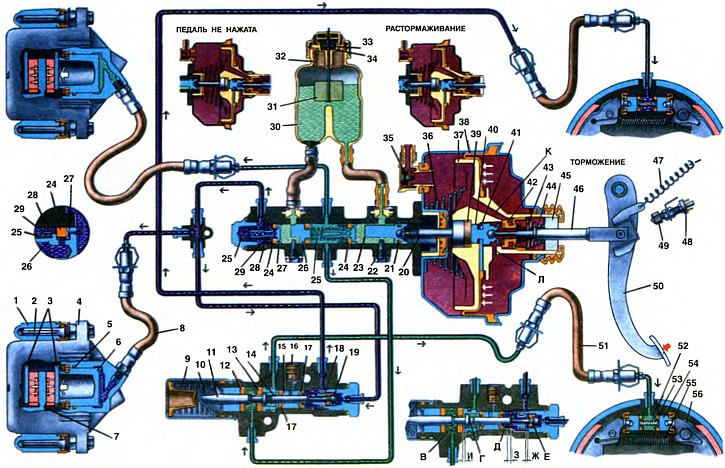
1. Shoe guide. 2. Guide pin. 3. Front brake shoes. 4. Caliper with cylinder. 5. Piston sealing ring. 6. Wheel cylinder piston. 7. Brake disc. 8. Front brake hose. 9. Spring. 10. Spring stop. 11. Pressure regulator piston. 12. Piston sealing ring. 13. Piston head seal. 14. Tappet. 15. Tappet bushing. 16. Plug. 17. Tappet sealing ring. 18. Valve seat. 19. Pressure regulator valve. 20. Vacuum booster rod. 21. Low pressure sealing ring. 22. Limit screw. 23. Piston of the drive of the circuit "right front - left rear brakes". 24. High-pressure sealing ring. 25. Piston return spring. 26. Piston of the drive of the circuit "left front - right rear brakes". 27. Piston spacer ring. 28. Pressure spring of the sealing ring. 29. Cup. 30. Master cylinder reservoir. 31. Float. 32. Reflector. 33. Movable contact. 34. Stationary contact. 35. Vacuum valve. 36. Valve body return spring. 37. Valve body. 38. Diaphragm. 39. Buffer. 40. Vacuum booster piston. 41. Thrust plate. 42. Vacuum booster valve. 43. Valve spring. 44. Valve return spring. 45. Air filter. 46. Push rod. 47. Brake pedal return spring. 48. Brake light switch. 49. Brake light switch tip. 50. Brake pedal. 51. Rear brake hose. 52. Wheel cylinder piston spacer spring. 53. Piston seal. 54. Rear brake wheel cylinder piston. 55. Shoe tension spring. 56. Brake shoe.
A - vacuum cavity
B - atmospheric cavity
K and L - channels
B, G, D and E are pressure regulator chambers
F, 3 and I-gaps
Service brake system
The brake mechanisms of the wheels are activated by a hydraulic drive, which is controlled by the brake pedal. Depending on the position of the pedal, the following components of the working process of the brake system are distinguished: the system is released, braking, releasing the brakes.
(The information is published on the website: VazBook.ru)
The system is released. In the initial position, the brake pedal 50 is pulled by the spring 47 until it stops at the tip 49 of the brake light switch 48, the contacts of which open the signal lamp circuit.
The valve pusher 46, and together with it the valve body 37 with the rod 20, are pressed by the return spring 36 to the extreme rear position (in the direction of the vehicle's movement). Piston 40 is pressed against the end of valve 42, blocking the access of atmospheric air to cavity B. Vacuum cavity A freely communicates with atmospheric cavity B through channels K and L. Therefore, when the engine is running, vacuum is transmitted through vacuum valve 35 to cavity A and through channels K and L to cavity B.
Pistons 23 and 26 of the master cylinder under the action of return springs 25 are pressed to the extreme rear position until they stop against limiting screws 22. Spacer rings 27, resting against the limiting screws, press the seals away from the ends of the grooves, opening passages for the brake fluid. The cavities of the master cylinder freely communicate with the cavities of its reservoir and both circuits of the brake mechanism drive. Thus, there is no fluid pressure in the brake drive.
The pistons of the 6 wheel cylinders of the front brakes are pressed away from the brake pads due to the elastic deformation of the sealing rings 5. The brake pads, not experiencing pressure from the pistons, remain in only light contact with the friction surfaces of the brake disc.
Due to the lack of pressure in the hydraulic drive circuits, the head of the piston 11 of the pressure regulator, under the force of the spring 9, is pressed away from the seal 13 and rests against the pusher 14, moving the valve 19 through it, which moves away from its seat 18. In this case, gaps I and G are formed. Through the resulting gaps, chambers B and E are connected to chambers G and D.
The brake shoes 56 of the rear wheel brake mechanisms are pressed away from the brake drums by the force of the tension springs 55, and under the action of the same force the pistons 54 of the wheel cylinders are pushed into the cylinders.
Braking
When the car is moving with the engine running, a vacuum is created in cavities A and B of the vacuum booster. transmitted from the engine intake pipe through the hose. When the brake pedal 50 is pressed, it moves away from the tip 49 of the brake light switch, and the circuit of the control lamps is closed. At the same time, the pusher 46 moves together with the piston 41 of the vacuum booster. Following the piston, the valve 42 moves under the force of the spring 43 until it stops in its seat; in this position, cavities A and B of the booster are disconnected. Piston 40 of the valve, moving forward, moves away from valve 42, and a gap is formed between the piston and the end of the valve, through which cavity B is connected to the atmosphere. Filling the vacuum, outside air enters through channel L into cavity B, creating pressure on valve body 37 through diaphragm 38. This reduces the force required for braking on the brake pedal from the driver's side.
The pressure developed on the valve body depends on the vacuum in the engine intake pipe and on the force applied to the brake pedal.
Together with the body 37 of the valve, the rod 20 also moves. Initially, the gap between the piston 23 and the adjusting bolt of the rod is selected. Its value corresponds to the free travel of the brake pedal of 3... 5 mm. After selecting the gap, the rod moves the piston 23 forward. The spacer ring 27 moves away from the limiting screw 22, and the seal is pressed against the end of the piston groove, i.e. the cavities of the main cylinder and the reservoir are disconnected. From this moment, with further advancement of the piston of the drive circuit of the "right front and left rear" brake mechanisms, the fluid pressure increases. At the same time, under the pressure of the fluid in this circuit, the piston 26 of the drive circuit of the "left front - right rear" brake begins to move. Under the increasing pressure of the fluid, the high-pressure rings 24 expand and fit more tightly to the cylinder mirror and the ends of the grooves, which improves the sealing of the pistons in the cylinder.
From the main brake cylinder, the fluid pressure is transmitted to chambers B and E of the pressure regulator and through gaps I and Zh to the wheel cylinders of the rear brake mechanisms. As the fluid pressure increases, the force on piston 11 of the regulator increases, tending to push it out of the housing. When the force from the fluid pressure exceeds the force from spring 9, the piston begins to move out of the housing, and after it, valve 19 and pusher 14 move under the action of the spring. At a pressure of 3.5±0.5 MPa (35±5 kgf/cm²), gaps H and Zh are completely selected. A further increase in pressure in chamber G will occur when throttling the fluid between the flange of piston 11 and seal 13, and in chamber - when sleeve 15 is displaced under the action of the pressure in chamber G. After gaps I and Zh have been selected, the pressure at the outlet of the regulator increases to a lesser extent and is determined by the ratio of the areas of the flange and the piston rod.
In case of failure of the brake drive circuit "left front - right rear", sealing rings 17, bushing 15 under the pressure of the fluid in chamber G will shift towards the plug until the gap 3 is selected. The pressure in the rear brake will be regulated by the part of the pressure regulator, which includes piston 11 with seal 13, piston bushing with a retaining ring, spring 9 with stop 10 and stop cup. In this case, the operation of this part of the regulator in case of failure of the named circuit is the same as with a serviceable system.
If the "right front — left rear" circuit fails, there is no pressure in chamber B. Due to the pressure of the liquid in the chamber D, the pusher 14 and the piston 11 are displaced, overcoming the force of the spring 9. Since the cross-sectional area of the pusher 14 is less than the cross-sectional area of the piston rod 11, the selection of the gap W will occur at a higher pressure than with a serviceable system. The regulator will work as a pressure limiter at the level of 6...7 MPa (60...70 kgf/cm²).
Under the pressure of the brake fluid, overcoming the elastic deformation of the sealing rings 5, the pistons 6 move out of the cylinders and press the internal brake pads 3 to the disk 7, and the wheel cylinders with calipers 4 (movable brackets) move in the opposite direction under the force of the reaction that has arisen. The movable brackets press the outer brake pads 3 against the brake disc.
At the same time, under the pressure of the liquid, the pistons in the wheel cylinders of the rear brake mechanisms move apart, overcoming the resistance of the tension springs of the 55 shoes. The shoes are pressed against the brake drums, creating a braking torque on the wheels. At the moment the shoes touch the drum, they self-install on the supports.
If the driver stops pressing the brake pedal while braking, leaving it pressed in some position, then the vacuum booster valve body will move forward under atmospheric air pressure by the amount of the gap between the thrust plate 41 and the groove of the piston 40. In this case, the released end of the valve 42, having reached the end of the piston 40, will block the flow of atmospheric air into cavity B, and the excess air will pass into the vacuum cavity A through the newly opened gap in the valve seat, channel K and further into the engine intake pipe. The pressure in both cavities will equalize, and the servo action of the booster will stop. The brake mechanisms of the wheels will maintain a constant braking torque on the wheels for some period of time.
Disinhibition
When the brake pedal is released, it returns to its original position by the force of spring 47 and pulls the pusher 46 with piston 40 behind it. The piston, having come into contact with the end of valve 42, closes the access of atmospheric air to cavity B. The end of the valve moves away from its seat in the valve body and opens a passage connecting cavity B with cavity L through channel K. The servo action of the booster stops, and the brake pedal, valve body together with the rod, by the force of return spring 36 return to their original position. Without experiencing pressure from the vacuum booster rod, pistons 23 and 26 of the master cylinder, under the action of return springs 25, move back to their original position until they stop against limit screws 22. When returning, spacer rings 27, resting against the limit screws, move the sealing rings to the front wall of the piston annular groove, and the cavities of the master cylinder and tank communicate with each other.
The front brake pistons are retracted to the non-working position under the action of the elasticity of the sealing rings 5, and the rear brake pistons are retracted by the contraction of the tension springs 55 of the shoes. Excess brake fluid flows through the compensation gaps into the reservoir 30 of the master cylinder.
Due to the drop in fluid pressure in the hydraulic drive, the pressure regulator piston returns to its original position under the action of the spring. In this case, the piston head moves away from the seal, and the valve moves away from its seat. Through the resulting gaps I and G, chambers E and B communicate with chambers G and D.
Parking brake system
The parking brake is activated by moving lever 11 (see chapter 28) upwards. In this case, the latch 12 jumps over the teeth of the sector, and the lever 11 through the rod and equalizer 13 pulls both rear cables 14. The force from the cables is transmitted to the levers 20 (see chapter 27) manual drive of the shoes. The lever 20 presses on the expansion bar 21 and through it presses the brake shoe 17 to the drum. Further rotation of the lever 20 on the axis of the bolt 22 stops, and it begins to rotate relative to the point of contact with the expansion bar 21. In this case, the upper arm of the lever moves the rear brake shoe until it stops in the drum.
When the parking brake lever is raised, its stop moves away from the control lamp switch, and the lamp circuit is closed.
To release the brakes, press the lever button to raise the latch 12 via the rod and disconnect it from the toothed sector, after which the lever is lowered. The lever stop presses the control lamp switch rod, and it goes out. The manual brake shoe drive parts return to their original position, and the rear wheel brake mechanisms are released.