




Fig. 79 shows a diagram of the exhaust gas toxicity reduction system on a vehicle with a variant configuration. The distributor sensor 19 has an electronic-mechanical device that produces a signal that determines the moment of spark formation. This signal controls the switch 16, which interrupts the current in the primary winding of the ignition coil 17, as a result of which a high-voltage pulse is formed in the secondary winding, transmitted through the distributor sensor to the corresponding spark plug.
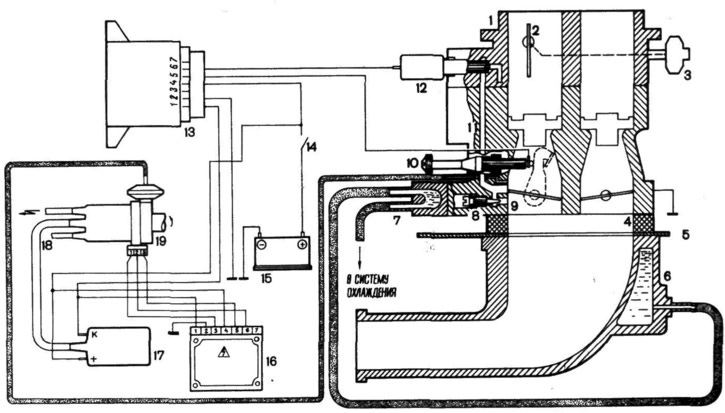
Fig. 79. Diagram of the exhaust gas toxicity reduction system on a vehicle with a variant configuration:
1 - carburetor; 2 - air damper; 3 - starting device; 4 - heat-insulating spacer; 5 - heat shield; 6 - inlet pipe; 7 - idle system heating; 8 - mixture quality screw; 9 - throttle valve drive lever; 10 - throttle stop screw; 11 - idle system channel; 12 - electromagnetic valve; 13 - control unit; 14 - ignition switch; 15 - battery; 16 - electronic switch; 17 - ignition coil; 18 - high voltage wires; 19 - distributor sensor.
Since the BSZ is a high-energy ignition system, it is not allowed to start the engine using a spark gap, and with the engine running, disconnect the high-voltage wires and check the high-voltage circuits for a "spark", as this can lead to burnout of high-voltage components and failure of the ignition system.
Spark plugs used in BSZ are A17DV-10 with a gap between the electrodes of 0.7-0.8 mm. The spark plug replacement frequency is after 20,000 km of run.
The carburetor, unlike the one described in the manual, has:
- idle system with electromagnetic valve 12, heating unit 7 and double float chamber;
- mechanical drive of throttle valves with their sequential opening;
- power mode economizer;
- idle contact on screw 10 for adjusting the mixture quantity.
In the exhaust gas toxicity reduction system, the electronic control unit 13 of the forced idle economizer (EISE) through the electromagnetic valve 12 switches off the idle system at forced idle (engine braking mode), eliminating carbon emissions into the atmosphere. When servicing the carburetor:
1. The fuel level in the carburetor is checked only at the service station by measuring the dimension "A" (Fig. 80), which should be 2±1 mm. The gap is adjusted by bending the tongue 2.
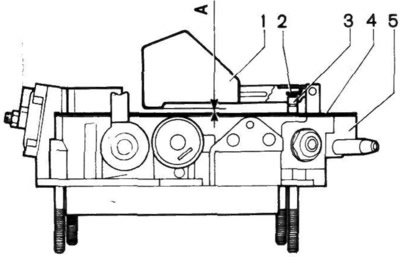
Fig. 80. Setting the fuel level in the carburetor:
1 - float; 2 - tongue; 3 - needle valve; 4 - gasket; 5 - carburetor cover.
2. The crankshaft speed at idle speed of 750-800 min⁻¹ can only be adjusted independently by screw 1 (Fig. 81) of the mixture quantity. Screw 2 of the mixture quality with exhaust gas toxicity control can only be adjusted by the carburetor at a service station. For this purpose, screw 2 is closed with a plastic plug. If this plug is damaged or missing, the plant will not be held liable for excessive fuel consumption and increased CO content in the exhaust gases.
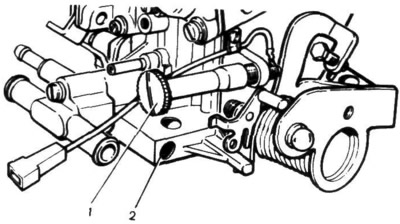
Fig. 81. Carburetor adjusting screws:
1 - mixture quantity screw; 2 - mixture quality screw.
If there is no handle 33 (on the instrument panelfig. 4) carburetor air damper control, the carburetor has a semi-automatic engine start and warm-up. In this case, before starting the engine, press the accelerator pedal and release it, then turn on the starter without pressing the accelerator pedal when starting.
In the variant version, a fine fuel filter is installed in the fuel system before the fuel pump in the section of the supply fuel line. The filter change interval is 20,000 km. Install the new filter so that the arrow on its body is directed towards the fuel pump.