




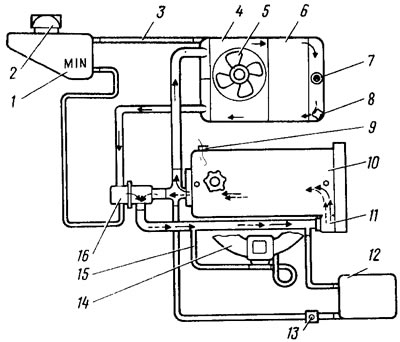
Figure 7. Schematic diagram of the cooling system: 1 - expansion tank; 2 - expansion tank cap; 3 - hose from the expansion tank to the radiator; 4 - fan casing; 5 - electric fan; 6 - radiator; 7 - electric fan switch sensor; 8 - radiator drain plug; 9 - cylinder block drain plug; 10 - engine; 11 - Coolant pump; 12 - radiator of the body interior heater; 13 - heater edge; 14 - inlet manifold; 15 hose for draining liquid from the intake manifold and carburetor; 16 - thermostat. The dashed arrows show the circulation of liquid when the engine is cold (small circle), and with solid arrows - when warmed up (big circle)
Hot liquid is diverted from the cylinder head to the radiator or, bypassing it, (depending on the position of the thermostat valves) enters the pump, from which it is directed to the engine cylinder block.
The engine cooling system includes a heater 12 for the body interior, into which liquid enters from the cylinder head through the outlet pipe and tap 13 of the heater and is diverted to the pump, as well as a carburetor heater, into which liquid enters from the jacket of the intake manifold 14 and is diverted to the pump through a hose 15.
To compensate for changes in the volume and pressure of the coolant, there is an expansion tank 1, which is connected by hoses to the thermostat in the area of the liquid inlet from the radiator and to the radiator
Coolant pump
Centrifugal type, driven by engine toothed belt; installed on cylinder block 3 (figure 8). The roller 5 is placed in the housing 2 on a double-row ball bearing 8, which is locked with a screw 1. The toothed pulley 9 and impeller 4 are pressed onto the roller, which is sealed with a gland 7 and a sealing ring 6 made of graphite composition.
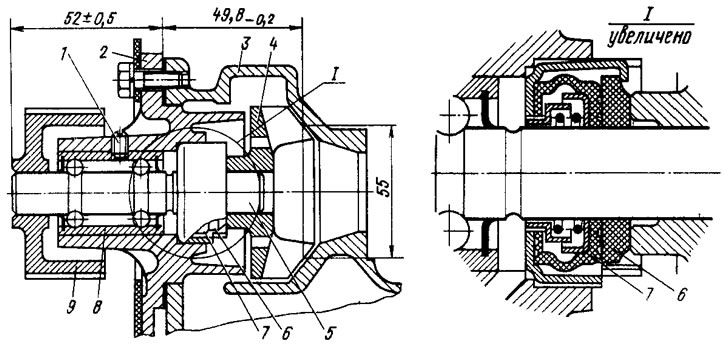
Figure 8. Coolant pump
Electric fan
Interchangeable with the electric fan of the VAZ-2103 engine. The fan is switched on and off depending on the coolant temperature by a sensor screwed into the right radiator tank.
Radiator
Prefabricated, aluminum, with plastic tanks; radiator core — with two rows of horizontal tubes. The radiator is mounted on rubber pads. The left radiator tank is connected by a hose to the expansion tank. The expansion tank is closed by a plug with valves. The pressure at the beginning of opening the outlet valve is not less than 1.2 kgf/cm², the inlet — 0.034-0.13 kgf/cm².
Thermostat
Non-separable, with a solid temperature-sensitive element, with a main 9 (figure 9) and 6 bypass valves operating in the coolant temperature range of 87-102°C.
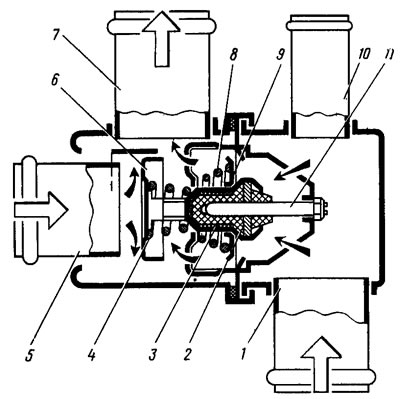
Figure 9. Thermostat: 1 - inlet pipe (from the radiator); 2 - rubber insert; 3 - solid heat-sensitive filler; 4 - additional valve spring; 5 - inlet pipe (from the engine); 6 - bypass valve; 7 - outlet pipe (to the pump); 8 - main valve spring; 9 - main valve; 10 - branch pipe (from the expansion tank); 11 - piston