




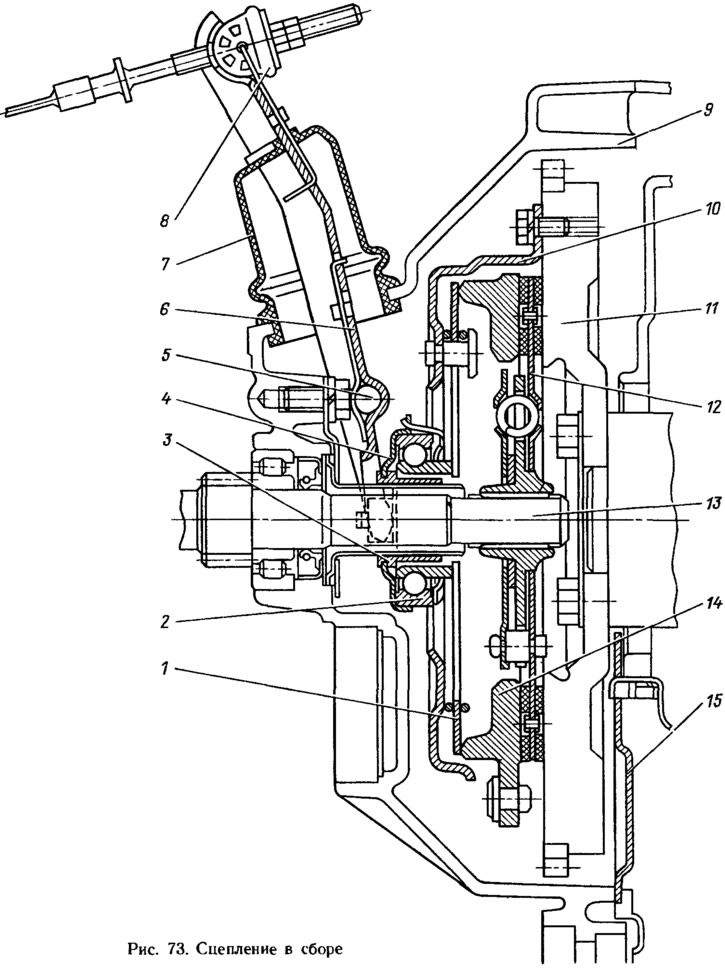
The leading part of the clutch is made as a one-piece unit, which includes the clutch housing 10, the pressure plate 14, the pressure spring 1 and a number of other parts.
The driven disk 12 assembled with the damper is located on the splines of the primary shaft 13 of the gearbox.
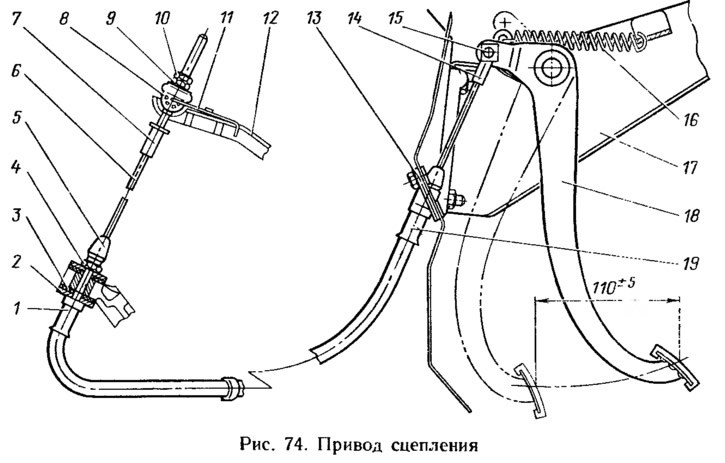
The clutch drive is cable-type with no gap between the clutch release bearing and the pressure spring. There is no free travel or fixed position of the clutch pedal. The main parameter determining the normal operation of the clutch drive is the working stroke of the clutch pedal, which is adjusted from the pedal stop to the body when installing the clutch drive cable. When the driven disk linings wear out, the working stroke of the pedal increases and at a certain point it becomes necessary to adjust the drive.
The drive consists of a pedal 18 (figure 74), mounted on a common axle with the brake pedal on bracket 17, and cable 6 in assembly. Upper end 14 of the cable is connected via a plastic sleeve to the finger of the clutch pedal and is fixed by locking bracket 15, and lower end 7 of the cable via leash 8 is connected to clutch release fork 12. The leash is held on the fork by lock 11 during possible movements of the cable end. The route of the cable in the underhood space is determined by its sheath, the upper end 19 of which is fixed via seal 13 on the body front shield. The lower end 1 of the sheath is installed in the socket of the lug of the gearbox cover with damping bushings 3 and secured through thrust washers 2 with nut 4. To protect the inner cavity of the sheath from contamination, the ends are provided with protective caps 5. The cable sheath is held from sagging by a bracket installed in the opening of the front wing mudguard.
Stamped fork 6 (see figure 73) the clutch release lever rests on the ball joint 5 and is held on it by a wire spring secured to the fork. The inner end of the fork is connected to the flange 4 of the clutch release bearing coupling, and the outer end is connected via the leash 8 to the cable.
(The original is available on the online resource VAZbook)
Bearing 2 is a ball bearing with built-in washers. It is installed with a small radial clearance in the coupling 3 of the clutch release bearing. The bearing is pressed against the coupling flange by a wave washer, which is installed on four flange tabs. Such a connection allows the bearing to "float", that is, to self-install in the coupling, which increases the durability of the contacting pair: the bearing and the pressure spring. The clutch release bearing is constantly pressed against the petals of the pressure spring with a force of 30-70 N (3-7 kgf), which is provided by spring 16 (see figure 74) on the clutch pedal.