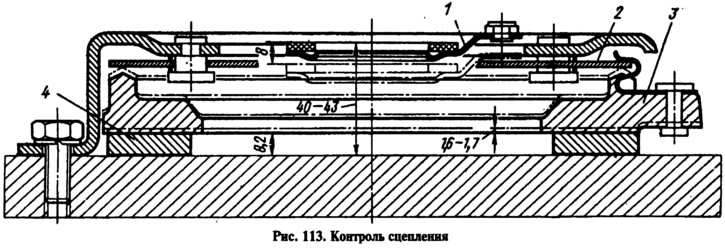
Secure the clutch housing to the base, make 4 disengagement strokes, applying a load of no more than 140 kgf to the thrust flange 1 of the pressure spring 2. The disengagement stroke of 8 mm should correspond to the movement of the pressure plate 3 by 1.6-1.7 mm (the smallest permissible is 1.4 mm).
The distance from the base to the working surface of the friction lining of the thrust flange should be 40-43 mm. During operation, this dimension increases due to wear of the friction surfaces of the clutch discs. If it reaches 48 mm or the movement of the pressure disc is less than 1.4 mm, replace the clutch housing assembly with the pressure disc, pressure spring and thrust flange.
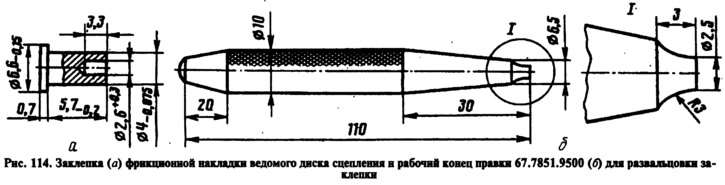
Replace the friction linings of the driven disk if cracks appear, the distance between the rivet and the working surface decreases to 0.2 mm, or if there are one-sided scuffs. In this case, drill out the old rivets with a drill or knock them out with a punch. New rivets (fig. 114, a) are flared with a mandrel 67.7851.9500 (fig. 114, b).
The runout of the working surface of the friction linings of the driven disk should not exceed 0.5 mm. If it is greater, the disk is straightened by bending the part where the runout is detected, or replaced with a new one.
If cracks appear on the driven disk or damper springs or the splines in the hub are worn, replace the driven disk assembly.
The cylinder mirror and the outer surface of the pistons of the master and working cylinders must not have any damage or corrosion; any minor nicks or pitting found can be removed with a fine-grained grinding stone. Check the condition of the master cylinder piston return spring and replace it if it is cracked. Replace the sealing rings regardless of their condition. Check the protective caps; if they are damaged, replace them with new ones. Deformation of the tappets is not allowed.
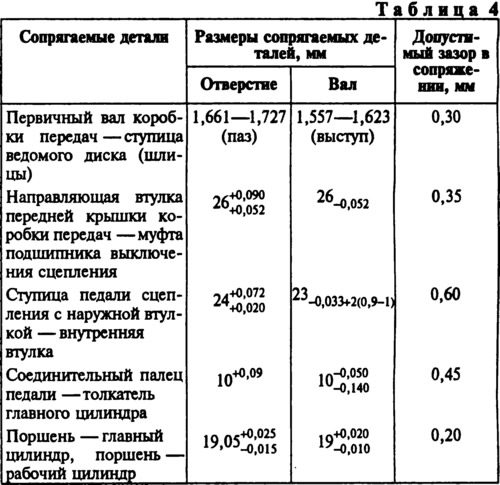
The dimensions of the main mating parts of the clutch and the limits of permissible wear are given in Table 4.