




Clutch assembly
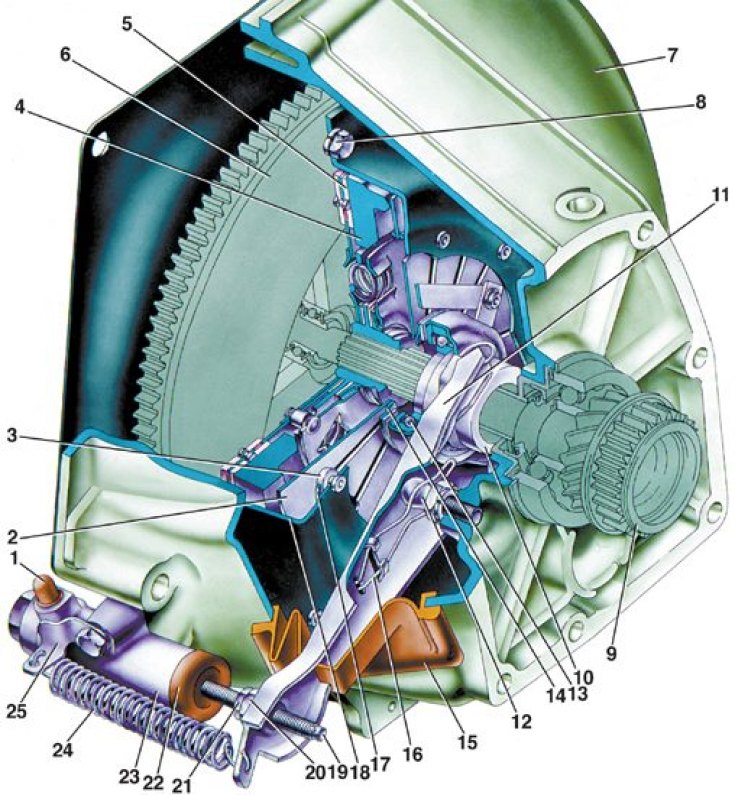
1 – bleed nipple; 2 – clutch pressure spring; 3-step pressure spring rivet; 4 – pressure plate; 5 – driven disk; 6 – flywheel; 7 – clutch housing; 8 – bolt securing the clutch housing to the flywheel; 9 – primary shaft of the gearbox; 10 – clutch release bearing sleeve; 11 – clutch release fork; 12 – ball joint of the clutch release fork; 13 – clutch release bearing; 14 – thrust flange of the pressure spring; 15 – clutch release fork boot; 16 – fork spring; 17 – support ring of the pressure spring; 18 – clutch housing; 19 – Clutch release fork pusher; 20 – adjusting nut; 21 – lock nut; 22 – protective cap; 23 – Clutch release cylinder (slave cylinder); 24 – fork release spring; 25 – return spring bracket
Slave cylinder and clutch release fork
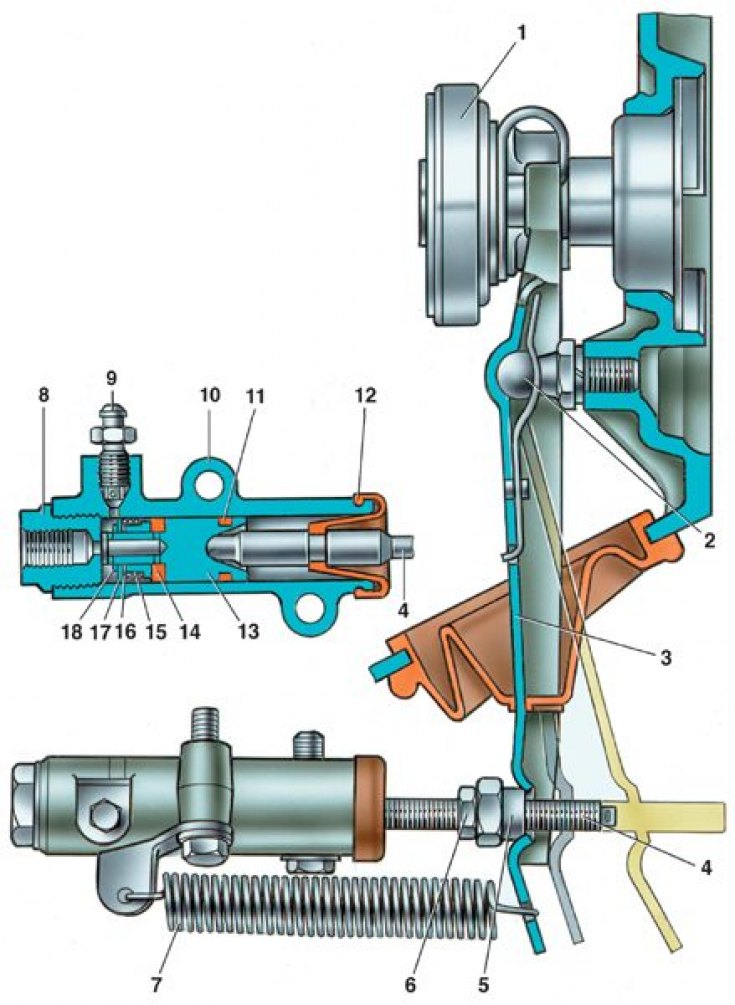
1 – clutch release bearing; 2 – ball joint; 3 – clutch release fork; 4 – pusher; 5 – adjusting nut; 6 – lock nut; 7 – release spring; 8 – body plug; 9 – bleed nipple; 10 – cylinder body; 11 – sealing ring; 12 – protective cap; 13 – piston; 14 – seal; 15 – plate; 16 – spring; 17 – support washer; 18 – retaining ring
The vehicle is equipped with a single-plate, dry, permanently closed clutch with a central pressure spring and a torsional vibration damper on the driven disk.
The leading part of the clutch is a non-separable unit, includes a casing 18 (see fig. Clutch assembly) clutch, pressure plate 4 and diaphragm pressure spring 2. The clutch housing is secured to flywheel 6 with mounting pins and bolts 8. Pressure plate 4 is connected to housing 18 by three pairs of steel plates, each of which is riveted at one end to the housing and at the other to the pressure plate. Through clamps, the pressure plate is connected to the outer edge of diaphragm spring 2, which rests on two rings 17 of circular cross-section, fixedly secured to the housing by stepped rivets 3.
Driven disk 5 is steel and has slots that divide it into twelve sectors bent in different directions. Friction linings are riveted to the disk sectors independently of each other. To dampen torsional vibrations, the driven disk is connected to the hub using a torsional vibration damper (damper).
The clutch release drive is hydraulic. It consists of the master cylinder 1 (see Fig. Clutch pedal and master cylinder), clutch release cylinder 10 (see fig. Slave cylinder and clutch release fork), forks 3 and bearing 1 for disengaging the clutch, reserve tank and clutch pedal with servo spring. The tank and drive cylinders are connected to each other by pipelines.