




Open large image in new tab »
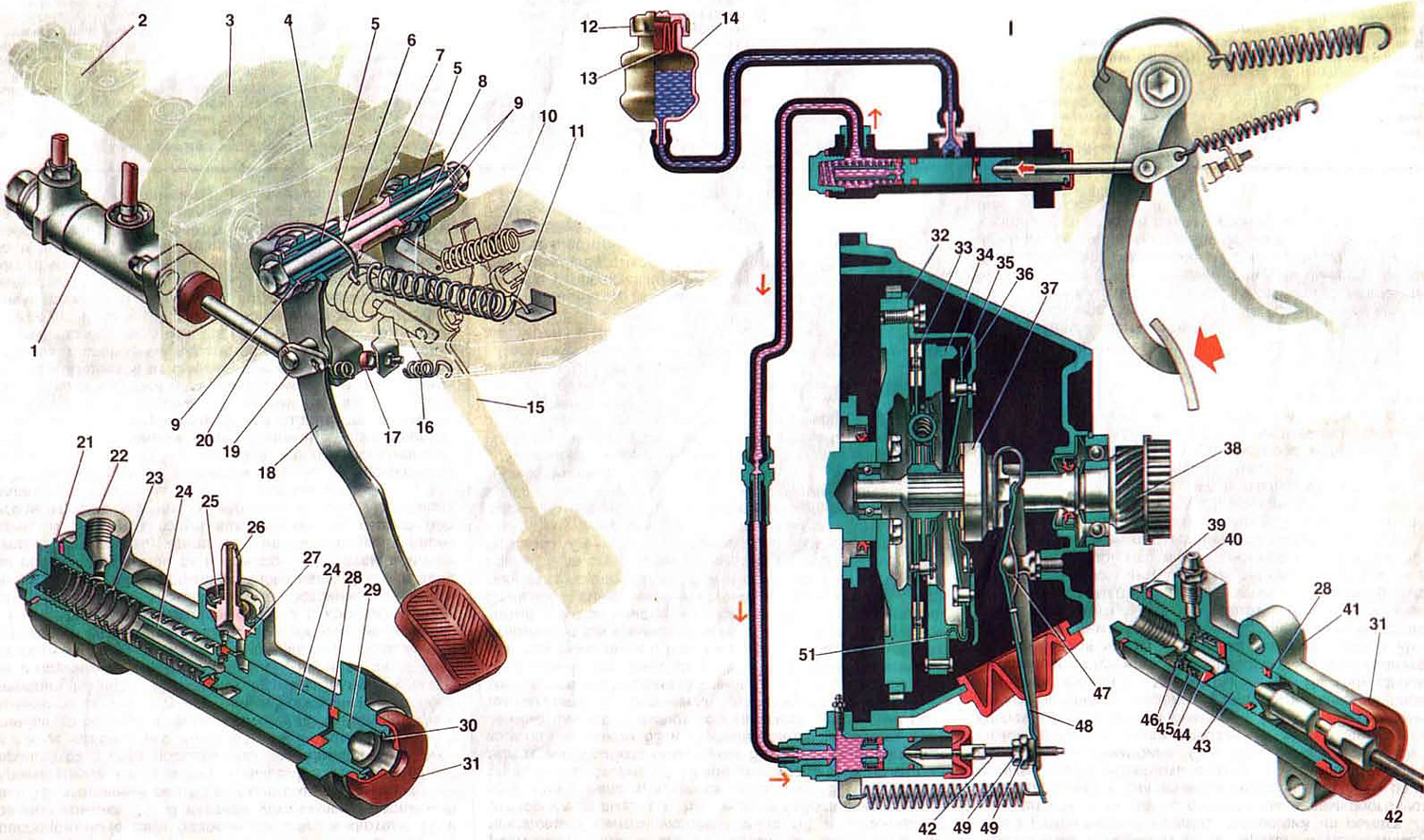
Fig. 14. Clutch release drive.
1. Clutch release master cylinder; 2. Brake master cylinder; 3. Vacuum booster; 4. Clutch and brake pedal bracket; 5. Inner bushings of clutch and brake pedals; 6. Servo spring hook; 7. Spacer sleeve; 8. Pedal axle; 9. Outer bushings of clutch and brake pedals; 10. Brake pedal release spring; 11. Servo spring; 12. Tank cap; 13. Cork reflector; 14. Master cylinder reservoir; 15. Brake pedal; 16. Clutch pedal release spring; 17. Clutch pedal travel limiting screw; 18. Clutch pedal; 19. Clutch pedal release spring plate; 20. Pusher; 21. Master cylinder housing plug; 22. Master cylinder body; 23. Piston spring; 24. Master cylinder piston; 25. Lock washer; 26. Fitting; 27. Gasket of the nipple; 28. Seal; 29. Pusher piston; 30. Retaining ring; 31. Protective cap; 32. Flywheel; 33. Slave disk; 34. Pressure plate; 35. Pressure spring; 36. Clutch housing; 37. Clutch release bearing; 38. Primary shaft of the gearbox; 39. Plug of the working cylinder housing; 40. Nipple; 41. Working cylinder housing; 42. Clutch release fork pusher; 43. Piston; 44. Piston spring support plate; 45. Spring; 46. Spring support washer; 47. Clutch release fork ball joint; 48. Clutch release fork; 49. Adjusting nut; 50. Lock nut; 51. Pressure spring retainer; I. Scheme of operation of the hydraulic clutch drive.
1. Clutch release master cylinder; 2. Brake master cylinder; 3. Vacuum booster; 4. Clutch and brake pedal bracket; 5. Inner bushings of clutch and brake pedals; 6. Servo spring hook; 7. Spacer sleeve; 8. Pedal axle; 9. Outer bushings of clutch and brake pedals; 10. Brake pedal release spring; 11. Servo spring; 12. Tank cap; 13. Cork reflector; 14. Master cylinder reservoir; 15. Brake pedal; 16. Clutch pedal release spring; 17. Clutch pedal travel limiting screw; 18. Clutch pedal; 19. Clutch pedal release spring plate; 20. Pusher; 21. Master cylinder housing plug; 22. Master cylinder body; 23. Piston spring; 24. Master cylinder piston; 25. Lock washer; 26. Fitting; 27. Gasket of the nipple; 28. Seal; 29. Pusher piston; 30. Retaining ring; 31. Protective cap; 32. Flywheel; 33. Slave disk; 34. Pressure plate; 35. Pressure spring; 36. Clutch housing; 37. Clutch release bearing; 38. Primary shaft of the gearbox; 39. Plug of the working cylinder housing; 40. Nipple; 41. Working cylinder housing; 42. Clutch release fork pusher; 43. Piston; 44. Piston spring support plate; 45. Spring; 46. Spring support washer; 47. Clutch release fork ball joint; 48. Clutch release fork; 49. Adjusting nut; 50. Lock nut; 51. Pressure spring retainer; I. Scheme of operation of the hydraulic clutch drive.
The clutch and brake pedals are suspended from bracket 4 on one axis 8, made in the form of a bolt. A thrust washer is installed under its head, and a nut with a spring washer is screwed onto its end. External plastic bushings 9 are installed in the pedal hubs.
The pedals rotate on internal metal bushings 5, mounted on the axle. A spacer plastic bushing 7 is installed between the brake pedal and the bracket cheek.
The clutch pedal is pivotally connected to the pusher 20 and the plate 19 of the release spring. They are held on the pin by a cotter pin. The release spring 16 holds the clutch pedal in the initial position, in which the pedal rests against the cap of the pedal travel limiter 17. The other end of the pusher enters the socket of the piston 29 of the master cylinder. The pedal travel limiter regulates the gap between the hemispherical end of the pusher and the piston 29. A bracket is welded to the upper end of the pedal, into the cutout of which the hook 6 enters; the other end of the hook is connected to the servo spring 11. The servo spring tends to turn the upper part of the pedal towards the clutch release, which significantly reduces the force applied to the clutch pedal.
The master cylinder 1 of the clutch release drive is attached to the end plate of the pedal bracket with two studs. The vacuum booster 3 with the master cylinder 2 of the brake drive are also attached to this plate. Two pistons 24 and 29 and a return spring 23 are installed in the cavity of the master cylinder. One end of it rests against the plug 21, the other against the flange of the piston 24 and serves to return the pistons to their original position. Due to the installation of two pistons, the radial loads on the piston 24 are reduced when the pusher 20 acts on the piston 29, and the sealing of the pistons is improved, since the sealing ring 28 is compressed between them. The piston of the master cylinder is sealed with a rubber ring, which is located in the piston groove and creates a tight seal in the working cavity of the cylinder. In order to simultaneously improve the piston seal as the pressure in the working cavity increases, an axial channel is made in its tailpiece, connecting with radial holes that open into the groove of the sealing ring. When the pressure in the working cavity of the cylinder increases, under its influence the sealing ring expands along the radius, i.e. fits more tightly to the cylinder mirror. At the same time, the sealing ring is a valve through which the cylinder cavity communicates with the tank 14. This occurs at the extreme rear position of the piston, when the sealing ring does not block the compensation hole in the cylinder body. All parts are held in the cylinder cavity by a retaining ring 30. A protective cap 31 protects the cylinder cavity from contamination. A pipeline draining liquid from the master cylinder to the working cylinder and a nipple 26 connected by a hose to the hydraulic drive tank are fixed in the holes of the cylinder body. The nipple 26 in the housing socket is sealed with a rubber gasket 27 and secured with a lock washer 25.
Working cylinder 32 (see fig. 13) the clutch release drive is secured with two bolts to the clutch housing 13. The upper bolt simultaneously secures the plate of the release spring 33, which returns the clutch release fork to its original position. The piston 43 is located in the cylinder body (see fig. 14) with two sealing rings. The rear ring 28 is installed in the piston groove, the front one is constantly pressed through the support plate 44 by the spring 45 to the end surface of the piston. The other end of the spring rests against the support washer 46, which is held on the piston tail by a retaining ring. The working cavity of the cylinder communicates with the groove of the sealing ring through the axial channel and radial holes, which ensures a tighter fit of the ring to the cylinder mirror when the clutch is disengaged, when fluid pressure is created in the working cavity. A plug 39 is screwed into the housing, into the hole of which a hose tip is screwed. A nipple 40 for bleeding the clutch drive is screwed into the lug of the housing.
Tank 14 is fixed to the bracket of the front shield of the body. It is made of translucent plastic, which makes it easier to check the fluid level in it. Cap 12 of the tank has a corrugated rubber deflector 13, which protects the tank cavity from contamination and acts as a fluid damper. In addition, the deflector does not allow direct contact of the fluid with air, which increases its service life. The tank cavity is connected to the atmosphere through an opening in the cap. When the fluid level in the tank decreases, the air pressure above the deflector eliminates the vacuum that occurs in the tank. At the bottom of the tank there is a nipple on which a hose is fixed for supplying fluid to the cavity of the master cylinder.
When the clutch is engaged and the driver does not act on the clutch pedal, there is a gap of 1.5-2 mm between the clutch release bearing and the thrust flange lining. The pressure spring 35, due to its elasticity, presses the annular projection of the pressure plate and presses it against the driven disk 33, which is pressed against the flywheel surface. Due to the friction forces between the disks, the torque is transmitted through the transmission units to the driving wheels of the car.
When the clutch is disengaged, the force from the pedal is transmitted through the pusher to pistons 29 and 24, which, moving, create pressure, and the liquid enters the cavity of the working cylinder through the tube and hose, creating pressure on piston 43. The piston transmits the force to the fork 48 through the pusher and the adjusting nut 49. Turning on the ball joint 47, the fork moves the sleeve of the bearing 37 for disengaging the clutch. Initially, the gap between the bearing and the friction ring of the thrust flange is selected. This is where the free travel of the clutch pedal ends, equal to 25-35 mm. With further pedal travel, the thrust flange presses on the petals of the pressure spring, which, bending on the support rings, pulls the pressure disk 34 away from the driven disk 33 through the clamps 51, after which the transmission of torque to the primary shaft of the gearbox stops.
When the clutch pedal is released, the parts of the master and slave cylinders and the pedal itself return to their original position under the action of the return springs. The pressure in the drive system drops, and the pressure plate, under the action of the elasticity of the pressure spring, presses the driven disk to the flywheel surface.