




Open large image in new tab »
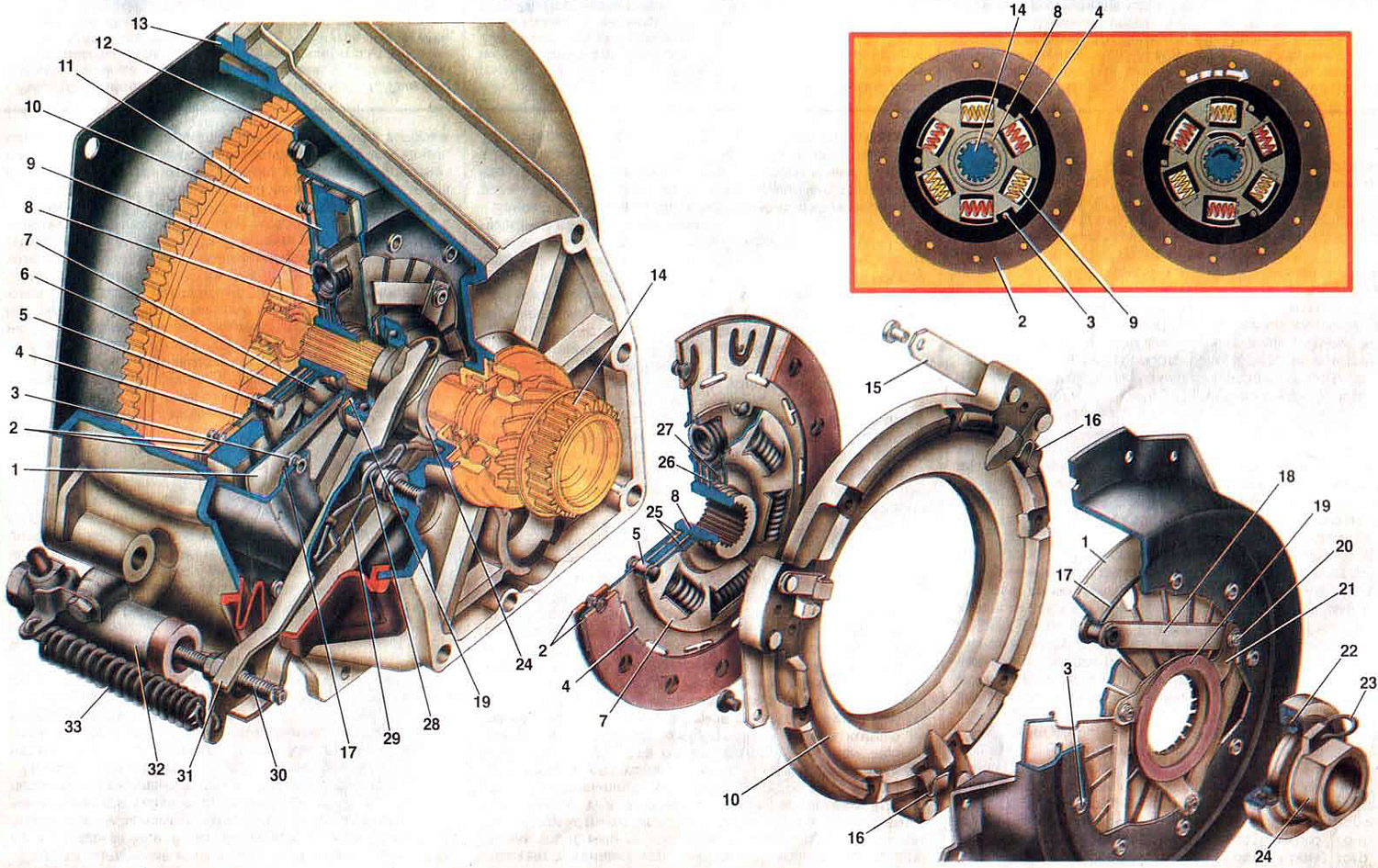
Fig. 13. Clutch.
1. Pressure spring; 2. Friction linings of the driven disk; 3. Rivet of the pressure spring; 4. Slave disk; 5. Torsional vibration damper stop rivet; 6. Front damper plate; 7. Rear damper plate; 8. Driven disk hub; 9. Damper spring; 10. Pressure plate; 11. Flywheel; 12. Clutch housing; 13. Clutch housing; 14. Primary shaft of the gearbox; 15. Plate connecting the pressure plate to the clutch housing; 16. Pressure spring retainer; 17. Pressure spring ring; 18. Connecting plate of thrust flange and clutch housing; 19. Thrust flange friction ring; 20. Rivet of connecting plate; 21. Thrust flange of the pressure spring; 22. Clutch release bearing; 23. Connecting spring of the fork and bearing clutch; 24. Clutch release bearing sleeve; 25. Damper friction rings; 26. Spring washer support ring; 27. Damper spring washer; 28. Clutch release fork ball joint; 29. Clutch release fork spring; 30. Clutch release fork pusher; 31. Clutch release fork; 32. Clutch release slave cylinder; 33. Clutch release fork release spring.
1. Pressure spring; 2. Friction linings of the driven disk; 3. Rivet of the pressure spring; 4. Slave disk; 5. Torsional vibration damper stop rivet; 6. Front damper plate; 7. Rear damper plate; 8. Driven disk hub; 9. Damper spring; 10. Pressure plate; 11. Flywheel; 12. Clutch housing; 13. Clutch housing; 14. Primary shaft of the gearbox; 15. Plate connecting the pressure plate to the clutch housing; 16. Pressure spring retainer; 17. Pressure spring ring; 18. Connecting plate of thrust flange and clutch housing; 19. Thrust flange friction ring; 20. Rivet of connecting plate; 21. Thrust flange of the pressure spring; 22. Clutch release bearing; 23. Connecting spring of the fork and bearing clutch; 24. Clutch release bearing sleeve; 25. Damper friction rings; 26. Spring washer support ring; 27. Damper spring washer; 28. Clutch release fork ball joint; 29. Clutch release fork spring; 30. Clutch release fork pusher; 31. Clutch release fork; 32. Clutch release slave cylinder; 33. Clutch release fork release spring.
The clutch ensures smooth starting of the car and silent gear shifting. Its operating principle is based on the transmission of torque from the flywheel to the primary shaft of the gearbox due to the friction forces that arise between the surfaces of the flywheel 11, driven 4 and pressure 10 disks when they are compressed. The driven disk is located on the splines of the primary shaft of the gearbox, is clamped between the flywheel and the pressure disk by the force of spring 1. And the pressure disk 10 together with the casing 12 are fastened with bolts to the flywheel. Thus, some parts have a permanent connection with the flywheel, others - temporary, due to friction forces when the clutch is engaged. The first parts make up the leading part of the clutch, the second - the driven one. The removal of the pressure disk from the driven one, i.e. disengagement of the clutch, is carried out through a hydraulic drive.
The leading part of the clutch is made as a non-detachable unit, which includes the clutch housing 12, the pressure plate 10, the central pressure spring 1 and the parts connecting them. This unit is attached to the flywheel with six bolts and three mounting pins.
The clutch housing has a concave shape, forming a cavity for placing the pressure spring and pressure plate. One support ring 17 is welded inside the housing, on which one side of the pressure spring rests. The pressure spring 1 is attached to the housing with rivets 3. The rivets pass through the oval holes of the pressure spring. Another support ring 17 rests against the heads of these rivets. Such a hinge joint allows the spring to bend relative to the support rings. The pressure spring is stamped from spring steel. Radial slots divide its surface into separate petals, which act as clutch release levers. These petals are affected by the thrust flange 21, which is pressed against them due to the elasticity of the connecting plates 18. The friction ring 19 is glued to the outer surface of the thrust flange. The outer edge of the pressure spring enters the grooves of the clamps 16 riveted to the pressure plate. Through the clamps, when the pressure spring deflects relative to the support rings 17, the pressure plate is moved away from the driven one. The pressure plate 10 is cast iron. It has the shape of a ring with three lugs. It is connected to the clutch casing by three pairs of elastic plates 15, which are riveted at one end to the lugs of the pressure plate, and the other - to the clutch casing. Such a connection ensures the transmission of torque from the casing 12 to the pressure plate and, at the same time, axial movement of the pressure plate inside the clutch casing.
The driven part of the clutch consists of a driven disk 4 with friction linings 2 and a torsional vibration damper (damper). The disk is steel, T-shaped radial slots divide it into twelve petals. Each petal has a flat section and two bends (bulges), due to which the disk surface has a wave-like shape. In order to preserve this shape, friction linings 2 are riveted to each petal independently of each other, one to the convex part of the petal, the other to the flat one. The heads of the rivets are recessed in the holes of the linings, and their rods are riveted from the disk side through the holes in the opposite lining. The driven disk is connected to the hub 8 not rigidly, but elastically through the damper parts. Such an elastic connection ensures the damping of torsional vibrations that occur in the transmission due to uneven engine operation and transmitted dynamic loads. Six windows and three horseshoe-shaped cutouts are made in the hub flange. Thrust pins 5 pass through the cutouts, which connect the front 6 and rear 7 plates of the damper and the driven disk 4. The front and rear plates of the damper and the driven disk have the same windows as in the hub flange. These windows contain springs 9, which are held from falling out by the flanging of the windows in both damper plates. The springs have different elasticity, which expands the damper's operating area. Stiffer springs are painted light. They are installed between springs of lower elasticity. Friction rings 25 are installed on both sides of the hub flange. Plate spring washer 27 creates a constant friction moment between the surfaces of the friction rings and the hub flange through support ring 26. When torsional vibrations occur, with a sharp change in the vehicle's speed or with a sharp engagement of the clutch, the driven disk moves together with the damper plates relative to the hub 8. In this case, the friction element of the damper and the springs are triggered. The resistance they create dampens impact loads and torsional vibrations, protecting transmission parts from breakage and intensive wear. The action of the elastic element is limited by three stop pins 5, which rest against the horseshoe-shaped cutouts of the hub.
The clutch is released via a hydraulic drive controlled by a pedal. The force from the clutch pedal is transmitted via the drive to the clutch release fork 31, and from it to the clutch release bearing sleeve 24. The fork 31 rests on the ball joint 28 and is held on it by a flat spring 29, which is attached to the fork, and the ball joint is screwed into the crankcase opening. A pusher 30 passes through the outer end of the fork, onto which an adjusting nut and a lock nut are screwed. The fork is pressed against the hemispherical surface of the adjusting nut by spring 33. To prevent the fork spring from flying off the pusher when disconnecting, a cotter pin is installed on its end. At the exit from the crankcase, the fork is sealed with a boot.
[The original source is located on the website: VazBook.ru]
The clutch release bearing sleeve 24 is located on the guide sleeve of the front gearbox cover. The clutch release bearing 22 is pressed onto the sleeve. The inner end of the clutch release fork is pressed against the sleeve lugs by the spring 23.
The adjusting nut of the pusher changes the clearance between the clutch release bearing and the thrust flange ring 21, which should be 1.5-2 mm, which corresponds to a free travel of the pusher of 4-5 mm.