




Contents: Removal ↓ Installation ↓
Warnings:
- Disconnect the battery only when necessary. Disconnecting the battery clears the ECU memory of fault codes and all settings generated by the engine management system.
- When removing the battery, always disconnect the negative terminal first, and when reconnecting the battery, always connect the positive terminal first.
- Never disconnect the power cables from the battery terminals while the engine is running. The resulting voltage surges will damage the electronic equipment.
- If the car is equipped with an alarm system and central locking, never leave the ignition key in the car when disconnecting the battery. Some alarm systems may cause the car doors to lock spontaneously when the battery is connected.
Removal
1. Prepare the car for repair work.
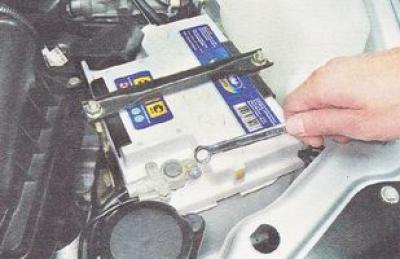
2. Using a 10 mm open-end wrench, loosen the nut securing the wire terminal to the negative battery terminal. Remove the terminal from the battery terminal.
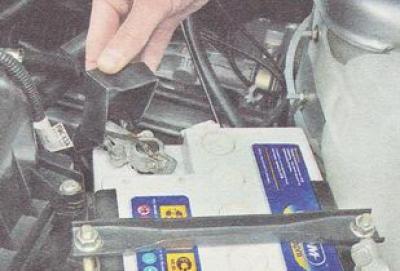
3. Remove the protective rubber cover from the positive terminal of the battery.
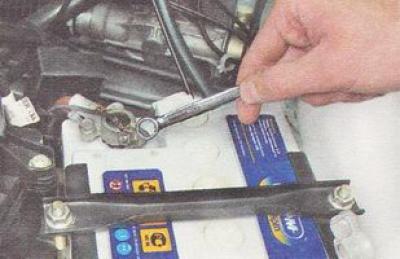
4. Using a 10 mm open-end wrench, loosen the nut securing the wire terminal to the positive battery terminal and remove the terminal from the battery terminal.
5. Using a 13 mm socket wrench, unscrew the two nuts of the upper battery mount, remove the pressure plate and both mounting studs.
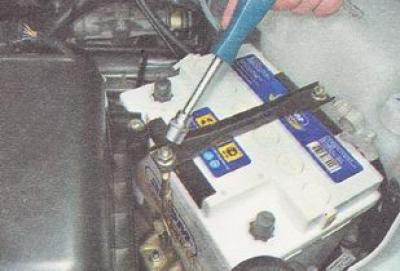
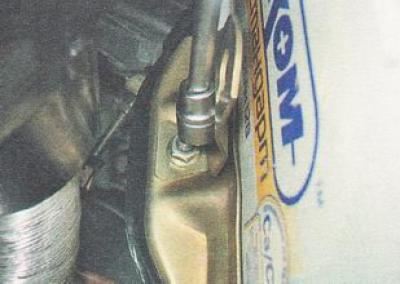
6. Using a 13 mm socket wrench with an extension and a ratchet, unscrew the nut of the lower battery mount and remove the pressure plate.
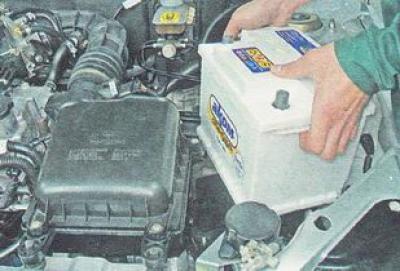
7. Remove the battery from the car.
Installation
We install the battery on the car in the reverse order.
Warning. The battery terminals are different, the positive terminal has a larger diameter. Reversing the polarity when connecting the battery will cause damage to the vehicle's electronic equipment.