




Warning: When servicing the battery, it is necessary to follow safety precautions.
To complete the work you will need:
- hydrometer;
- voltmeter.
Sequence of execution of the check
1. Disconnect both wire terminals from the battery terminals.
2. Using a voltmeter, measure the voltage at the battery terminals. Comparing the result with the values indicated in the table, we determine the battery charge.
Table 13.1
| Voltage at battery terminals, V | Battery charge level, % |
| 12,6 12,4 12,2 12,0 |
100 75 50 25 |
3. If the upper battery mounting bar is installed, it must be removed.
4. Unscrew the six battery filler plugs.
5. Using the bulb of the hydrometer, we collect some of the electrolyte into the flask of the device and, without removing the spout of the flask from the filling hole of the battery, we determine the density of the electrolyte in each jar of the battery using the floats. The minimum density at which it floats is written on each float.
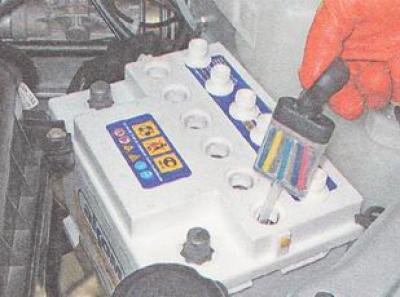
Note: In a hydrometer with one float, the density of the electrolyte is determined from the scale applied to the float and depends on the depth of its immersion.
The density of the electrolyte in a fully charged battery should be close to that indicated in Table 13.2 in accordance with the climatic zone of vehicle operation.
When taking hydrometer readings, it is necessary to take into account the temperature correction. When the electrolyte temperature decreases by one degree, the battery capacity decreases by 1-2%.
Table 13.2
| Climatic conditions of battery operation | Electrolyte density (at +25°C), g/cm.cube. | |||
| poured into the battery when refueling | in a battery, which has a state of charge of batteries | |||
| 100% | 75% | 50% | ||
| Hot climate (all year round) Temperate climate (all year round) Cold climate (all year round) Very cold: in winter in summer |
1,23 1,25 1,27 1,29 1,25 |
1,25 1,27 1,29 1,31 1,27 |
1,21 1,23 1,25 1,27 1,23 |
1,17 1,19 1,21 1,23 1,19 |