




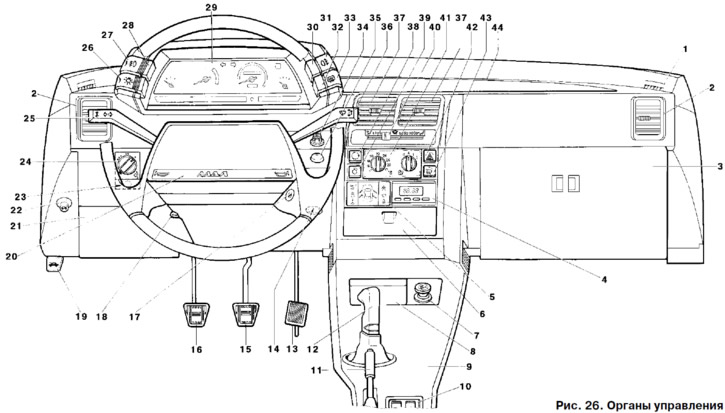
1 - nozzle for blowing the front door glass.
2 - side nozzles of the ventilation and heating system of the passenger compartment.
3 - glove compartment lid (see fig. 12).
4 - hours (see fig. 13) or (in a variant design) trip computer (see fig. 37).
5 - on-board control system indicator unit (see fig. 36).
6 - radio equipment socket cover. Provides for installation of radio equipment that meets international standards in terms of dimensions and mounting method (ISO 7736, DIN 75500). Installation of radio equipment must be carried out only on PCSS certified by the manufacturer with a mandatory note in the service book.
7 - cigarette lighter (works when the ignition is on). To use, press the handle of the movable part until it locks into place. After about 20-27 seconds, the movable part automatically returns to its original position, and the cigarette lighter is ready for use.
8 - front ashtray.
9 - floor tunnel lining.
10 - control units (see fig. 34). Installed in a variant design.
11 - Parking brake lever. By moving the lever up, the brake shoes of the rear wheels are activated. To return the lever to its original position, press the button on the end of the lever handle. In case of emergency, the parking brake can be used while driving to slow down the car or used simultaneously with the service brakes.
12 - gear shift lever. The gear shift diagram is applied to the lever handle.
13 - accelerator pedal.
14 - socket for connecting a portable lamp. Installed in a variant design.
15 - brake pedal.
16 - clutch pedal.
17 - ignition switch (see fig. 31).
18 - Steering column tilt adjustment handle. To set the steering wheel to a comfortable position for control, lower the handle down and after the desired adjustment, tighten the handle, lifting it to its original position.
19 - hood lock drive handle (see fig. 14).
20 - horn switch. In the variant version, when the car is equipped with the airbag system, the horn is used by pressing the movable part of the airbag module without applying impact loads.
21 - mounting block cover.
22 - Electric trunk or tailgate lock switch (in a variant design). To unlock the lock, press the button.
23 - mounting block cover lock button.
24 - headlight hydraulic corrector drive handle. A device that allows the headlight beam angle to be adjusted by rotating the handle depending on the vehicle load so that oncoming drivers are not blinded when the headlights are on low beam.
25 - direction indicator and headlight switch lever (see fig. 33).
26 - External lighting switch. When the button is pressed to the first fixed position, the side lights are turned on; when pressed to the second fixed position, the low beam headlights are additionally turned on when the ignition is on. The symbol on the button is illuminated if the instrument lighting is on.
27 - Front fog light switch. Installed on the vehicle instead of the plug if it is equipped with fog lights. The fog lights are turned on and off by pressing the button when the parking lights are on. The symbol on the button is illuminated if the instrument lighting is on.
28 - Front fog lights indicator lamp. The lamp lights up green when the front fog lights are on.
29 - instrument cluster (see fig. 28).
30 - Rear fog light indicator lamp. Lights up orange when the rear fog light is on.
31 - Rear fog light switch. The rear fog lights are switched on and off by pressing the button. The symbol on the button lights up if the instrument lighting is on. In the variant version, the rear fog lights are switched off automatically when the ignition is switched off. To switch them on again with the headlights on, press the button again.
32 - Rear window heating indicator lamp. Lights up orange when the rear window heating is turned on.
33 - rear window heating switch (see fig. 38).
34 - Instrument lighting regulator. By turning the handle, the brightness of the instrument lighting and symbol illumination is adjusted when the external lighting is on.
35 - immobilizer status indicator. It is installed on cars equipped with an electronic anti-theft system and is designed to read the code from the code keys.
36 - windshield wiper and washer switch lever (see fig. 33).
37 - central nozzles of the ventilation and heating system of the passenger compartment.
38 - recirculation switch (in a variant design - together with air conditioning) (see fig. 38).
39 - Air conditioning switch (in a variant design) (see fig. 38).
40 - air flow control lever for the interior heating and ventilation system (see fig. 38).
41 - block of the automatic heating control system (see fig. 38).
42 - Hazard warning light switch. When the button is pressed, the flashing light of all direction indicators and the corresponding control lamps in the instrument cluster is switched on. The hazard warning light is switched off by pressing the button again. The symbol on the button is illuminated if the instrument lighting is switched on.
43 - Headlight wiper and washer switch (in a variant design). The headlight wipers and washers are turned on by pressing the switch button when the headlights are on, and are turned off when the button is released. The symbol on the button is illuminated when the instrument lighting is on.
44 - windshield blower nozzle.