




1. Car wash. If possible, it is advisable to wash the outside of the car, including the bottom, before work. Moreover, if the work is to be done in the engine compartment, then it should be washed there too.
Warning.
- When washing the engine compartment, avoid getting water on the connectors, sensors and actuators of the fuel injection system. Also avoid getting water on the generator and starter.
- In any case, washing the engine compartment must be done with the mandatory disconnection of the wire from the negative terminal of the battery.
- After washing, the above parts and units must be thoroughly dried by blowing with a stream of compressed air.
It is better to wash the engine at a non-automatic car wash. Here the car will be washed manually, after having treated the outer surface of the body and the engine compartment with special cleaning compounds, dirt will be removed from the wheel arches and from the bottom of the body with a jet of water under high pressure, followed by drying.
2. Parking the car:
a) placing the vehicle on a level horizontal surface. This could be a garage with a concrete floor or other solid and level surface, a horizontal area with a hard surface indoors or outdoors (asphalt, concrete, wood flooring). A hard and level surface allows, if necessary, to lift any part of the car with a jack and securely install it on a stand (see point 3).
To perform work without hanging the wheels, it is enough:
- turn off the ignition;
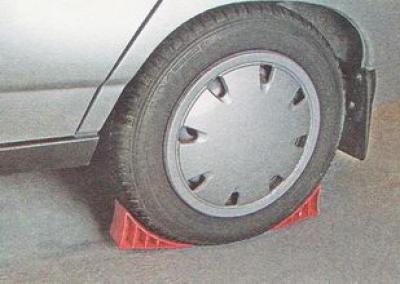
- secure the vehicle with the handbrake to prevent it from moving on its own. If the handbrake is faulty, or before repairing the brake system, use wheel chocks to secure the vehicle (see Special tools and devices p. 3).
Warning.
- Leaving the gear engaged should only be done if the repair will not require starting the engine or turning the engine crankshaft. In any case, before starting the engine, by pressing the clutch pedal all the way down, be sure that the gearshift lever is in neutral.
- Do not leave the ignition key in the car, as it is possible that the security system installed on the car (signaling) will spontaneously "stand" on guard and block the door locks. If there is a need to leave the key in the ignition during operation, then first lower the window of one of the doors.
b) placing the vehicle on an inspection pit or overpass. If some of the repair work has to be done from underneath the vehicle, then in many cases the ideal place to work is (from those available to a private car owner) there will be a garage with an inspection pit and a concrete floor. Before driving into such a garage, the pit should be covered with wooden or steel shields that can withstand a car in the event of a collision. The remaining recommendations are the same as when installing a car on a flat horizontal platform (see above).
Some garage cooperatives have a repair overpass welded from metal structures on their territory. As a rule, it is impossible to install a jack or car stands on such an overpass without a special flooring made of boards. It is better to drive onto the overpass under the supervision of an assistant.
c) parking the vehicle on a slope or uneven ground. The need for this may arise when a car malfunction has to be repaired on the road, and there is no possibility to find a more suitable place for repair (see paragraphs 2a and 26). You should not repair your car on grass, loose gravel, sandy soil or rocks. It is better to try to tow or roll the car to another location (for example, it is very difficult to find a nut that has fallen into thick grass). Loose soil should also be avoided, especially if you need to use a jack and stands. If you are forced to stop on a slope, it is better to try to roll the car down the slope, otherwise you need to put wheel chocks under the wheels, and it is advisable to put several under different wheels on the slope side. Otherwise, follow the same recommendations as when installing the car on a level surface (see above).
3. Raising the car on a jack and stands. This type of work must be performed on a flat, horizontal surface with a hard surface. When working on soft or uneven ground, strong flooring of at least 30x30 cm should be placed under the jack and all supports. A thick board is suitable for making flooring.
Warning.
- Use a trolley jack (see Special tools and devices, p. 1) can only be done on a solid base, while the jack must remain mobile.
- Jacking up a vehicle parked on a slope is only permitted to replace a faulty wheel, provided that the vehicle is securely secured against spontaneous movement.
- Before jacking up the vehicle, disembark all passengers. Do not enter the vehicle while it is jacked up or do any loading or unloading.
- Before performing repairs on a vehicle with a wheel suspended (or wheels) be sure to install reliable supports under the body's power elements (see Special tools and devices, p. 2).
- In hot weather, the asphalt heated by the sun becomes soft, it is pressed by the supports of the stands and the base of the jack, as a result of which the car installed on them may fall.
To lift a car with a jack, you need to:
- follow all recommendations in point 2 (see above);
- place wheel chocks under the wheel located diagonally on the opposite side of the vehicle from the wheel being lifted.
- the standard jack is installed under the threshold. Special places are indicated by arrows on the plastic threshold pads (for more details, see. Wheel - replacement, p. 6).
- raise the car by rotating the jack handle (in many cases it is enough for the wheel to just come off the ground surface).
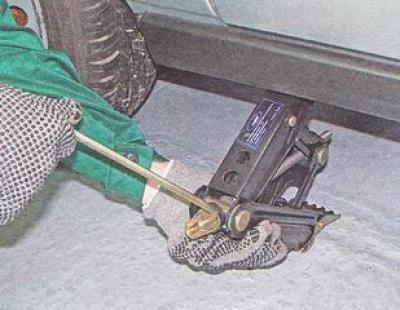
- install under the body's power elements (threshold, side member or cross member of the body) support. Turn the jack handle to lower the car onto the support.
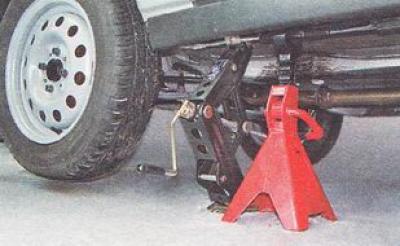
The rest of the car's wheels can be hung up in the same way.
(The original source is located on the website: VAZbook)
4. Cleaning threaded connections on a vehicle. During long-term use, threaded connections tend to "stick" due to corrosion and become covered with a layer of rust. This is especially true for suspension parts, transmission, external elements of the brake system and steering. Therefore, before repair, all disassembled threaded and fastening connections should be cleaned with a metal brush and treated with penetrating lubricant in an aerosol package (see Operating materials, item 5) or, in extreme cases, moisten with kerosene. It is better if such work is done in advance (from several hours to a day), so that the lubricant has time to penetrate into the joint.