
English Русский
Български
Беларускі
Український
Српски
Hrvatski
Română
Polski
Slovenský
Magyar
| Articles | Contacts | Sitemap |   
Repair and maintenance Lada Repair and maintenance Mazda Repair and maintenance Mitsubishi Repair and maintenance Toyota Repair and maintenance Land Rover Repair and maintenance Hyundai Repair and maintenance Nissan
VAZbook.ru


Main     1111   2101   2105   2106   2107   2109   2110   2115   2121  
VAZ-2114 (2004-2013) VAZ-2115 (1997-2012)
  • Main
  • «Samara-2»
  • VAZ-2115
  • General information
  • Vehicle malfunctions
  • Engine misfires

Engine misfires (VAZ-2115)

            0

When interruptions occur, the engine runs unevenly at idle, does not develop sufficient power, and consumes gasoline at an increased rate. Interruptions are usually explained by a malfunction of the injectors or electric fuel pump (for more details, see the section "Power supply system"), spark plugs of one of the cylinders, air suction into one of the cylinders. It is necessary to find the fault and, if possible, eliminate it.

1. Start the engine and let it idle. Go to the exhaust pipe and listen to the sound of the exhaust. You can put your hand to the cut of the exhaust pipe - this way you can feel the interruptions better. The sound should be smooth, "soft", one tone.

Pops from the exhaust pipe at regular intervals indicate that one cylinder is not working due to a faulty spark plug, no spark on it, a failed injector, a strong air leak in one cylinder, or a significant decrease in compression in it.

Popping sounds at irregular intervals are caused by dirty injector nozzles, severe wear or dirty spark plugs.

If the pops are heard at irregular intervals, you can try to replace the entire set of spark plugs yourself, regardless of mileage and appearance, but it is better to do this after contacting a car service for diagnostics and repairs engine management systems.
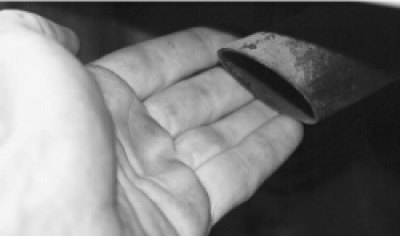
2. If the pops are regular, stop the engine and open the hood. Check the condition of the ignition…


2. If the pops are regular, stop the engine and open the hood. Check the condition of the ignition system wires. The insulation of the high-voltage wires should not be damaged, and the wire tips should not be oxidized. Replace the damaged wire.
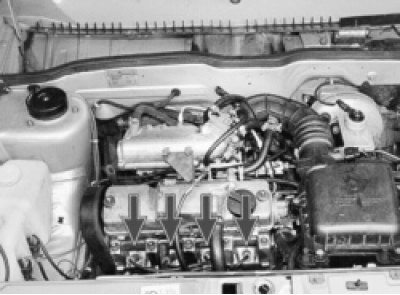


3. Remove the high-voltage wire ends and unscrew the spark plugs with a spark plug wrench.


3. Remove the high-voltage wire ends and unscrew the spark plugs with a spark plug wrench.

Warning! When removing high-voltage wire terminals, never pull on the wire itself. Grasp the terminal directly with your hand and, turning it from side to side, pull to remove.


Carefully examine the spark plugs and compare their appearance with the photographs provided at the end of the subsection. The gap between the spark plug electrodes should be 0.8-0.9 mm. If the spark plug is black and wet, it can be thrown away.

1. If all the spark plugs look OK, reinstall them and connect the high-voltage wires. The firing order of the cylinders is 1-3-4-2, their numbering (1st, 2nd, 3rd, 4th) is driven from the engine crankshaft pulley.
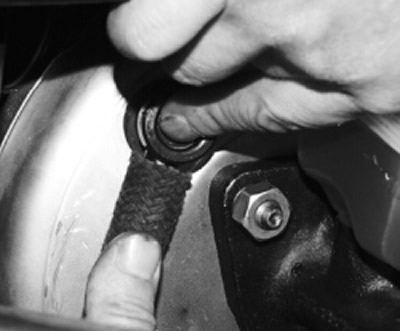
2. Take a spare spark plug. Fix it to the engine in any way.


2. Take a spare spark plug. Fix it to the engine in any way.

Warning! Do not attach the spark plug to the oil filler neck, dipstick, or fuel hoses.


Reliable contact of the spark plug body or threaded part with the "ground" is not necessary, but desirable. Connect the high-voltage wire from the 1st cylinder to the spare spark plug. Start the engine. If the engine misfires do not increase, replace the spark plug in the 1st cylinder with a known good one. Put on the high-voltage wire and start the engine. If the misfires increase, sequentially repeat step 5 with all cylinders to determine the faulty spark plug.

If the engine misfires are not eliminated as a result of the measures taken, contact a car service for diagnostics of the ignition system on a stand or engine (compression measurement). Normal compression is more than 1.1 MPa (11 kgf/cm²), a difference of more than 0.1 MPa (1 kgf/cm²) in one cylinder indicates the need for engine repair.

Helpful tips:
  • If the diagnostics reveal that the 3rd cylinder is faulty, remove the hose connecting the brake booster to the engine, plug it securely and start the engine.
  • If the engine misfires have stopped, diagnostics and replacing the brake booster.
  • If the engine continues to misfire, try spraying the outside of the hose with a liquid such as WD-40.
  • If the engine misfires stop even for a short period of time, try replacing the hose - it may have a rupture.


This article is available at russian, bulgarian, belarusian, ukrainian, serbian, croatian, romanian, polish, slovak, hungarian
The text was reviewed by the specialist: Grigory Vologodtsev

Share with friends:

Previous articles
VAZ-2115: Vehicle malfunctions
Next articles

Idle speed is gone
Fuel injection system faults
Checking the power supply system
Checking the ignition system
Malfunctions in the starting system
Engine diagnostics by the appearance of spark plugs
The car moves in jerks
A jerk at the start of movement
Jerks during acceleration
Jerks during steady motion

More articles from other manuals on VAZ cars:
➠ Engine misfires VAZ-21099 (1990-2004)
➠ The structure of a car engine VAZ-1111 (1988-1996)
➠ General structure of a car engine VAZ-2101 (1970-1983)
➠ The engine structure of VAZ-2104 and VAZ-2105 cars VAZ-2105 (1979-2010)
➠ The engine structure of VAZ-2106 and VAZ-2103 cars VAZ-2106 (1976-2006)
Link in different formats to this page


Visitor comments

No comments yet


How much will 49 + 45 ?


VAZ-2114 (2004-2013) 
  • General information
  • Operation and maintenance
  • Power unit
  • Engine repair
  • Cooling system
  • Supply system
  • Control system
  • Exhaust system
  • Transmission
  • Clutch
  • Car gearbox
  • Front wheel drives
  • Chassis
  • Wheels and tires
  • Front suspension
  • Rear suspension
  • Steering
  • Brake system
  • Body
  • Exterior
  • Interior
  • Doors and glass
  • Tailgate
  • Ventilation and heating
  • Electrical equipment
  • Equipment and devices
  • Headlights and lighting
  • Engine electrics
  • Electrical circuits


VAZ-2115 (1997-2012) 
  • General information
  • Vehicle device
  • Operation manual
  • Vehicle malfunctions
  • Car care
  • Power unit
  • Engine repair
  • Cooling system
  • Supply system
  • Control system
  • Exhaust system
  • Transmission
  • Clutch
  • Car gearbox
  • Front wheel drives
  • Chassis
  • Front suspension
  • Rear suspension
  • Steering
  • Brake system
  • Body
  • Exterior
  • Interior
  • Doors, covers and windows
  • Electrical equipment
  • Equipment and devices
  • Headlights and lighting
  • Engine electrics
  • Anti-theft system


VAZbook.ru © 2017 · Mobile version · Contact with administration · Sitemap: EN BG BY UA RS HR RO PL SK HU · Site search · News and articles VAZ-1111 · VAZ-11113 · VAZ-2101 · VAZ-21011 · VAZ-2104 · VAZ-2105 · VAZ-21051 · VAZ-2106 · VAZ-21061 · VAZ-2107 · VAZ-21099 · VAZ-2109 · VAZ-2108 · VAZ-2110 · VAZ-2112 · VAZ-2114 · VAZ-2115 · VAZ-2121 · VAZ-21213 · VAZ-21214 ·
The site stores technical data using cookies to improve the service.