




There are two types of distributed injection systems - with feedback and without it. Moreover, systems of both types can be with imported components or with domestic ones. Controllers are installed (electronic control units) also of different types. All these systems have their own design, diagnostic and repair features, they are described in detail separately in the corresponding repair manuals for specific fuel injection systems.
The following ECUs can be installed on LADA SAMARA-2 family vehicles, ensuring compliance with toxicity standards.
- 1. ESUD-2111, ensuring compliance with Russian toxicity standards, with the M1.5.4 controller and, more recently, with the "January-5.1.1" controller (these controllers are interchangeable, although they have slight differences in diagnostics). The latter is distinguished by the absence of a fuel vapor adsorber in the engine compartment and a round shape of the mass air flow sensor (bosch company).
- 2. ESUD-2111, ensuring compliance with EURO II toxicity standards, with MP7.0HFM controller.
- 3. ESUD-2111, ensuring compliance with the EURO II toxicity standards, with M1.5.4N and "January-5.1" controllers. The system, designed for equipping cars on the Russian domestic market, is constantly being modernized: diagnostics of output circuits has been introduced for the latest software versions.
If the vehicle is equipped with a feedback system (used mainly on export vehicles), the exhaust system contains a neutralizer and an oxygen concentration sensor, which provides feedback. The sensor monitors the oxygen concentration in the exhaust gases, and the electronic control unit uses its signals to maintain the air-fuel ratio, ensuring the most efficient operation of the neutralizer.
In the injection system without feedback, a neutralizer and an oxygen concentration sensor are not installed, and a CO potentiometer is used to regulate the CO concentration in the exhaust gases. This system does not use a gasoline vapor recovery system either.
It is possible to have an injection system without a CO potentiometer, in which case the CO content is regulated using a diagnostic device.
Warnings:
1. Before removing any injection control system components, disconnect the wire from the "–" terminal of the battery.
2. Do not start the engine if the battery cable terminals are not tightened properly.
3. Never disconnect the battery from the vehicle's electrical system while the engine is running.
4. When charging the battery, disconnect it from the vehicle's electrical system.
5. Do not expose the electronic control unit (ECU) to temperatures above 65°C when operating and above 80°C when not operating (for example, in a drying chamber). It is necessary to remove the ECU from the car if this temperature is exceeded.
6. Do not disconnect or connect the wiring harness connectors to the ECU when the ignition is on.
7. Before performing arc welding on a vehicle, disconnect the wires from the battery and the wire connectors from the ECU.
8. Perform all voltage measurements using a digital voltmeter with an internal resistance of at least 10 MOhm.
9. The electronic components used in the injection system are designed for very low voltage and can therefore be easily damaged by electrostatic discharge. To prevent damage to the ECU by electrostatic discharge:
- do not touch the ECU connectors or electronic components on its boards with your hands;
- when working with EPROM (programmable read-only memory) control unit, do not touch the microcircuit terminals.
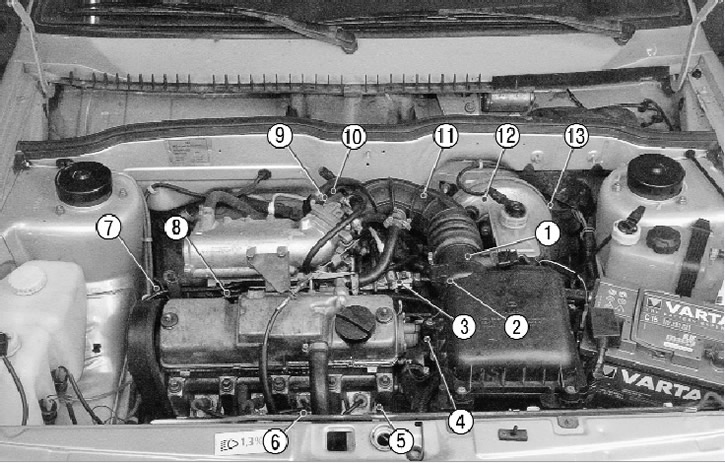
9.12. Location in the engine compartment of the elements of the engine control system with distributed fuel injection without feedback: 1 – mass air flow sensor; 2 – speed sensor (not visible in the photo, located on the gearbox); 3 – pressure regulator; 4 – coolant temperature sensor (not visible in the photo, located on the outlet pipe of the cooling system); 5 – ignition module; 6 – knock sensor; 7 – crankshaft position sensor (not visible in the photo, located in the tide of the oil pump cover); 8 – fuel rail with injectors; 9 – throttle position sensor; 10 – idle speed control (not visible in the photo, located on the throttle assembly); 11 – controller (not visible in the photo, located in the car interior under the dashboard shield on a bracket); 12 – Fuses and relays of the engine management system (not visible in the photo, located in the car interior under the dashboard panel on the right side); 13 – diagnostic connector (not visible in the photo, located in the car interior on the dashboard panel under the ashtray)
The ignition system uses an ignition module 5 (Fig. 9.12), consisting of two ignition coils and high-energy control electronics. The ignition system has no moving parts and therefore does not require maintenance. It also has no adjustments, since the ignition is controlled by the controller 11.
The ignition system uses a spark distribution method called the "idle spark" method. The engine cylinders are paired 1-4 and 2-3, spark formation occurs simultaneously in two cylinders: in the cylinder in which the compression stroke ends (working spark), and in the cylinder in which the exhaust stroke occurs (idle spark). Due to the constant direction of current in the windings of the ignition coils, the spark current of one spark plug always flows from the central electrode to the side electrode, and of the second one - from the side electrode to the central one. Spark plugs of the A17DVRM type are used. Controller 11 controls ignition in the system. Crankshaft position sensor 7 sends a reference signal to the controller, based on which the controller calculates the sequence of operation of the coils in the ignition module. For precise ignition control, the controller uses the following information:
- crankshaft speed;
- engine load (mass air flow);
- coolant temperature;
- crankshaft position;
- presence of detonation.
The engine management system is described in more detail in the special edition "Engine Management Systems" VAZ-2111 (1.5 l, 8 cl.), VAZ-2112 (1.5 l, 16 cl.), VAZ-21214-36 (1.7 l, 8 cl.) with distributed sequential fuel injection (controller MP7.0HFM, toxicity standards Euro-3) cars VAZ-21083, 21093, 21099, 21102, 21103, 2111, 21113, 2112, 21122, 21214. "Guide to diagnostics and repair" (series "Master class"), prepared by the Directorate for technical development of JSC "AVTOVAZ". This guide also describes the methods of diagnosing the system by fault codes using the DST-2 diagnostic device.
The engine management system includes the following elements.
1. Controller 11 (see fig. 9.12) (electronic control unit), located under the instrument panel on a bracket, is the control center of the fuel injection system. It continuously processes information from various sensors and controls systems that affect exhaust toxicity and vehicle performance.
The following information is received by the controller:
- crankshaft position and speed;
- engine mass air flow;
- coolant temperature;
- throttle position;
- oxygen concentration in exhaust gases (in a feedback system);
- presence of detonation in the engine;
- voltage in the vehicle's on-board network;
- car speed;
- camshaft position (in a system with sequential distributed fuel injection);
- request to turn on the air conditioner (if it is installed on the car).
Based on the information received, the controller controls the following systems and devices:
- fuel supply (injectors and electric fuel pump);
- ignition system;
- idle speed control;
- adsorber of the gasoline vapor recovery system (if this system is installed on the vehicle);
- engine cooling system fan;
- air conditioning compressor clutch (if it is installed on the car);
- diagnostic system.
The controller turns on the output circuits (injectors, various relays, etc.) by shorting them to "ground" through the controller's output transistors. The only exception is the fuel pump relay circuit. Only to the winding of this relay does the controller supply +12 V.
The controller has a built-in diagnostic system. It can recognize malfunctions in the system, warning the driver about them through the "Check Engine" indicator lamp. In addition, it stores diagnostic codes indicating the areas of malfunction to help specialists in carrying out repairs. The controller has three types of memory: random access memory (RAM), one-time programmable read-only memory (PROM) and electrically programmable memory (EPROM).
Random access memory is the controller's "notebook". The controller's microprocessor uses it to temporarily store measured parameters for calculations and intermediate information. The microprocessor can enter data into it or read them out as needed. The RAM chip is mounted on the controller's printed circuit board. This memory is volatile and requires uninterruptible power supply to save. When the power supply is interrupted, the diagnostic error codes and calculation data contained in the RAM are erased.
Programmable Read Only Memory (PROM) - It contains a general program that contains a sequence of operating instructions (control algorithms) and various calibration information. This information is the data for controlling injection, ignition, idle speed, etc., which depend on the weight of the car, the type and power of the engine, the gear ratios of the transmission and other factors. The EPROM is also called a calibration memory device. The contents of the EPROM cannot be changed after programming. This memory does not require power to save the information recorded in it, which is not erased when the power is turned off, i.e. this memory is non-volatile. The EPROM is installed in a socket on the controller board and can be removed from the controller and replaced.
The EPROM is individual for each vehicle configuration, although the same unified controller may be used on different vehicle models. Therefore, when replacing the EPROM, it is important to set the correct model number and vehicle configuration. And when replacing a defective controller, it is necessary to leave the previous EPROM (if it is in good working order).
Electrically programmable memory device is used for temporary storage of codes-passwords of the anti-theft system of the car (immobilizer). Codes-passwords received by the controller from the immobilizer control unit (if it is on the car), are compared with the codes stored in the EPROM, and the engine start is either permitted or prohibited. This memory is non-volatile and can be stored without power being supplied to the controller.
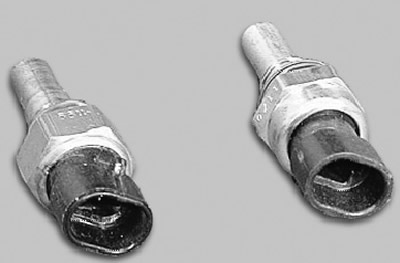
2. Coolant temperature sensor 4 is a thermistor (a resistor whose resistance varies with temperature). The sensor is screwed into the coolant outlet pipe on the cylinder head. At low temperatures, the sensor resistance is high (at –40°C – 100 kOhm), at high temperatures – low (at 100°C – 177 Ohm).
The controller calculates the coolant temperature based on the voltage drop across the sensor. The voltage drop is high when the engine is cold and low when it is warm. The coolant temperature affects most of the characteristics that the controller controls.
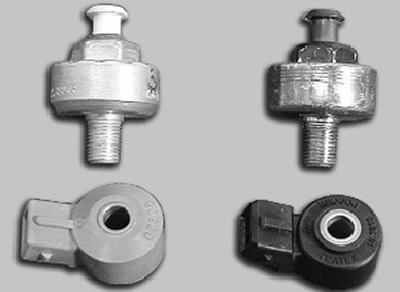
3. Knock sensor 6 is attached to the top of the cylinder block. It catches abnormal vibrations (detonation strikes) in the engine.
The sensor's sensitive element is a piezoelectric crystal plate. During detonation, voltage pulses are generated at the sensor's output, which increase with the intensity of detonation shocks. The controller, based on the sensor's signal, regulates the ignition advance to eliminate detonation flashes of fuel.
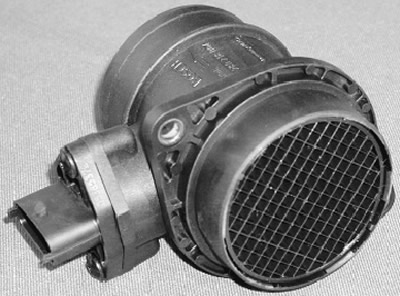
4. Mass air flow sensor 1 Bosch or…
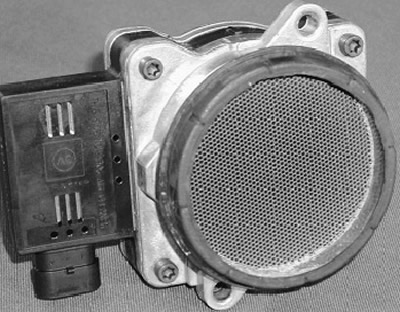
…GM is located between the air filter and the intake manifold hose. It contains temperature sensors and a heating resistor. The passing air cools one of the sensors, and the sensor's electronic circuit converts this temperature difference into an output signal for the electronic control unit. In different versions of fuel injection systems, two types of air mass flow sensors can be used. They differ in their design and the nature of the signal they output, which can be frequency or analog. In the first case, the signal frequency changes depending on the air flow, in the second case, the voltage. The ECU uses information from the air mass flow sensor to determine the duration of the injector opening pulse.
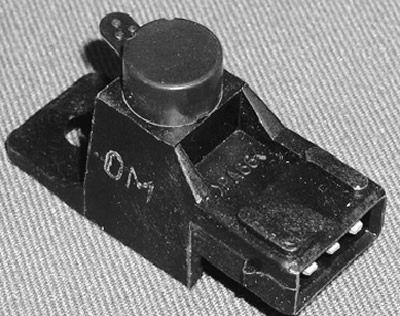
5. CO potentiometer installed on vehicles with a non-feedback injection system (without neutralizer and oxygen concentration sensor) in the engine compartment and is a variable resistor. It sends a signal to the ECU that is used to adjust the air-fuel mixture to obtain a standardized level of carbon monoxide (CO) concentration in the exhaust gases at idle. The CO potentiometer is similar to the mixture quality screw in carburetors. Adjusting the CO content using a CO potentiometer is only performed at a service station using a gas analyzer.
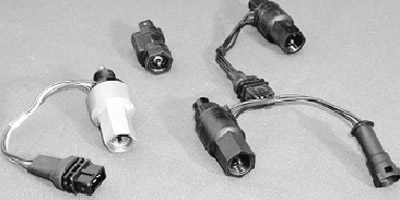
6. Vehicle speed sensor mounted on the gearbox. The sensor operates on the Hall effect. The sensor sends rectangular voltage pulses to the controller, the frequency of which is proportional to the rotation speed of the drive wheels.
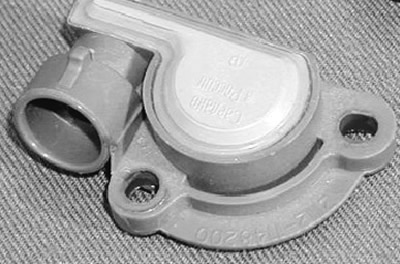
7. Throttle position sensor 9 is installed on the side of the throttle pipe and is connected to the throttle valve axis.
The sensor is a potentiometer, to one end of which the "+" supply voltage (5 V) is supplied, its other end is connected to the "ground". From the third output of the potentiometer (from the slider) the output signal goes to the controller. When the throttle valve is turned (from the impact on the control pedal), the voltage at the sensor output changes. When the throttle valve is closed, it is below 0.7 V. When the valve opens, the voltage at the sensor output increases and when the valve is fully open, it should be more than 4 V. By monitoring the sensor output voltage, the controller adjusts the fuel supply depending on the throttle valve opening angle (i.e. at the driver's discretion).
The throttle position sensor does not require any adjustment, since the controller senses idle speed (i.e. complete closing of the throttle valve) as a zero mark.
8. Idle speed control 10 regulates the crankshaft speed in idle mode, controlling the amount of air supplied bypassing the closed throttle valve. It consists of a two-pole stepper motor and a cone valve connected to it. The valve extends or retracts according to signals from the controller.
Regulator needle fully extended (which corresponds to 0 steps) blocks the air flow. When the needle is pushed in, an air flow is provided proportional to the number of steps the needle moves away from the seat.
[Information taken from the website: VazBook.ru]
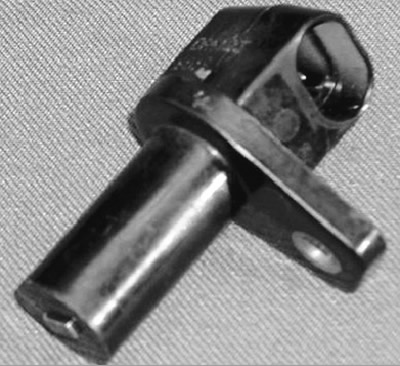
9. Crankshaft position sensor 7 – inductive type, designed to synchronize the controller operation with the TDC of pistons of the 1st and 4th cylinders and the angular position of the crankshaft.
The sensor is mounted on the oil pump cover opposite the timing disk on the generator drive pulley. The timing disk is a toothed wheel with 58 equally spaced (6°) depressions. With this pitch, 60 teeth fit on the disk, but two teeth are cut off to create a synchronization pulse (a "reference" pulse), which is necessary to coordinate the controller's operation with the TDC of the pistons in cylinders 1 and 4. When the crankshaft rotates, the teeth change the magnetic field of the sensor, inducing AC voltage pulses. The installation gap between the sensor core and the disk tooth should be within (1±0.2) mm.
The controller determines the crankshaft rotation speed based on the sensor signals and sends pulses to the injectors.
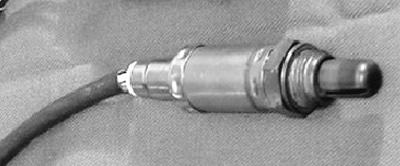
10. Oxygen concentration sensor (lambda probe) are used in a feedback injection system and are installed on the exhaust pipe of the mufflers. The oxygen contained in the exhaust gases reacts with the sensor, creating a potential difference at its output, which varies from approximately 0.1 V (high oxygen content - lean mixture) to 0.9 V (low oxygen - rich mixture).
For normal operation, the sensor temperature must be at least 360°C. Therefore, a heating element is built into the sensor to quickly warm up the engine after it is started.
By monitoring the output voltage of the oxygen concentration sensor, the controller determines which command to send to the injectors to adjust the composition of the working mixture. If the mixture is lean (low potential difference at the sensor output), then a command is given to enrich the mixture. If the mixture is rich (high potential difference), a command is given to lean the mixture.