




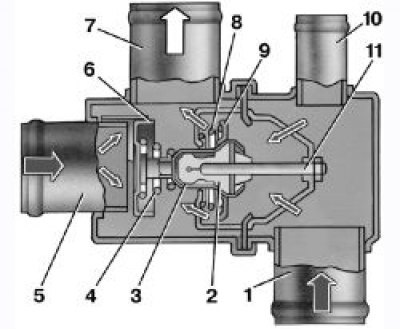
Thermostat: 1 – inlet pipe (from the radiator); 2 – rubber insert; 3 – solid heat-sensitive filler; 4 – bypass valve spring; 5 – inlet pipe (from the engine); 6 – bypass valve; 7 – outlet pipe (to the pump); 8 – main valve spring; 9 – main valve; 10 – branch pipe (from the expansion tank); 11 – piston.
The need to replace the thermostat (see fig.) arises when the engine operating temperature is unstable (engine overheating or insufficient heating).
To check the operation of the thermostat on the car, you need to start the engine and put your hand to the lower radiator hose - it should be cold. When the coolant temperature reaches 80-85°C, the hose should start to heat up. If this does not happen, remove the thermostat and check its functionality.
Warning! The thermostat must only be removed when the engine has completely cooled down.
Helpful Hint: Remove the battery for ease of use.
You will need a screwdriver.
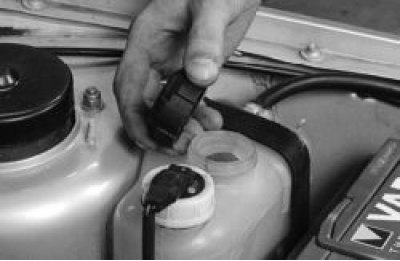
1. Unscrew the expansion tank cap.
2. Place a container under the drain hole, unscrew the radiator drain plug and drain the coolant from the radiator.
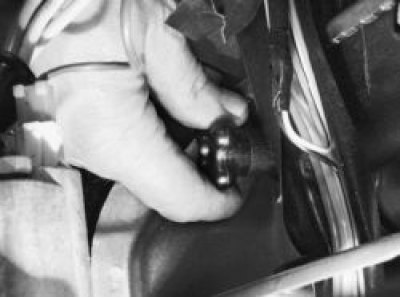
3. Loosen the clamps and disconnect the radiator inlet and outlet hoses from the thermostat housing.
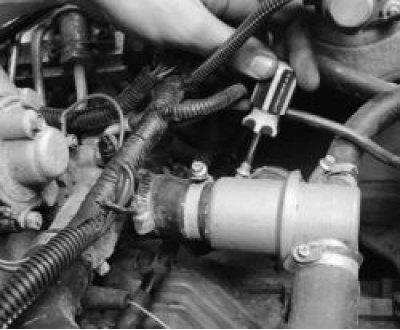
4. Loosen the clamps, disconnect the water pump inlet pipe and inlet pipe hoses from the thermostat and remove the thermostat.
5. Place the thermostat in water heated to 78–80°C. Heat the water, stirring it constantly, to (87±2)°C.
6. At a temperature of (87±2)°C the main thermostat valve should begin to open. If this does not happen, replace the thermostat.
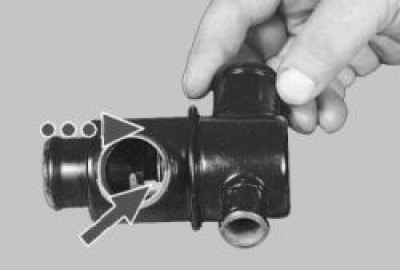
7. Install the thermostat in the reverse order of removal.
8. Fill the cooling system with liquid and check the cooling system for leaks.