




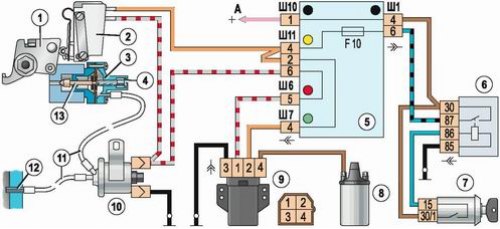
Forced idle economizer system (FIES): 1 - throttle actuator lever; 2 - micro switch; 3 - economizer; 4 - mixture quantity screw; 5 - relay and fuse mounting block; 6 - ignition relay; 7 - ignition switch; 8 - ignition coil; 9 - control unit of the solenoid valve; 10 - electro-pneumatic valve; 11 - hoses; 12 - inlet manifold; 13 - economizer valve needle
The idle system is designed to supply fuel to the primary chamber throttle space and to shut off its supply in the forced idle mode (engine braking). The system consists of an economizer, a microswitch, an electro-pneumatic valve, and an electro-pneumatic valve control unit. The economizer together with the microswitch bracket is attached to the throttle body with two screws. When the ignition is off, the economizer valve needle closes the fuel supply channel. The needle is made integral with the diaphragm rod and when a vacuum is created in the space behind the diaphragm, it moves and opens the channel. The needle stroke and, accordingly, the fuel consumption through the idle system are regulated by the screw ("quantity"). The vacuum is supplied to the economizer from the intake manifold through hoses through the electro-pneumatic valve installed on the right mudguard in the engine compartment of the car. The electro-pneumatic valve is controlled by the control unit and the microswitch. The electro-pneumatic valve control unit is located on the left mudguard in the engine compartment. The control unit, depending on the control pulses coming from the primary winding of the ignition coil, switches off the electro-pneumatic valve when the contacts of the microswitch are open and the engine speed is 1600 rpm, and switches it on again when the speed drops to 1200 rpm. The microswitch opens the voltage supply circuit to the electro-pneumatic valve when the gas pedal is released. When the engine speed is over 1600 rpm and the gas pedal is released, the fuel supply through the idle channel stops.
[The information can be read on the website: vazbook]