




Open large image in new tab »
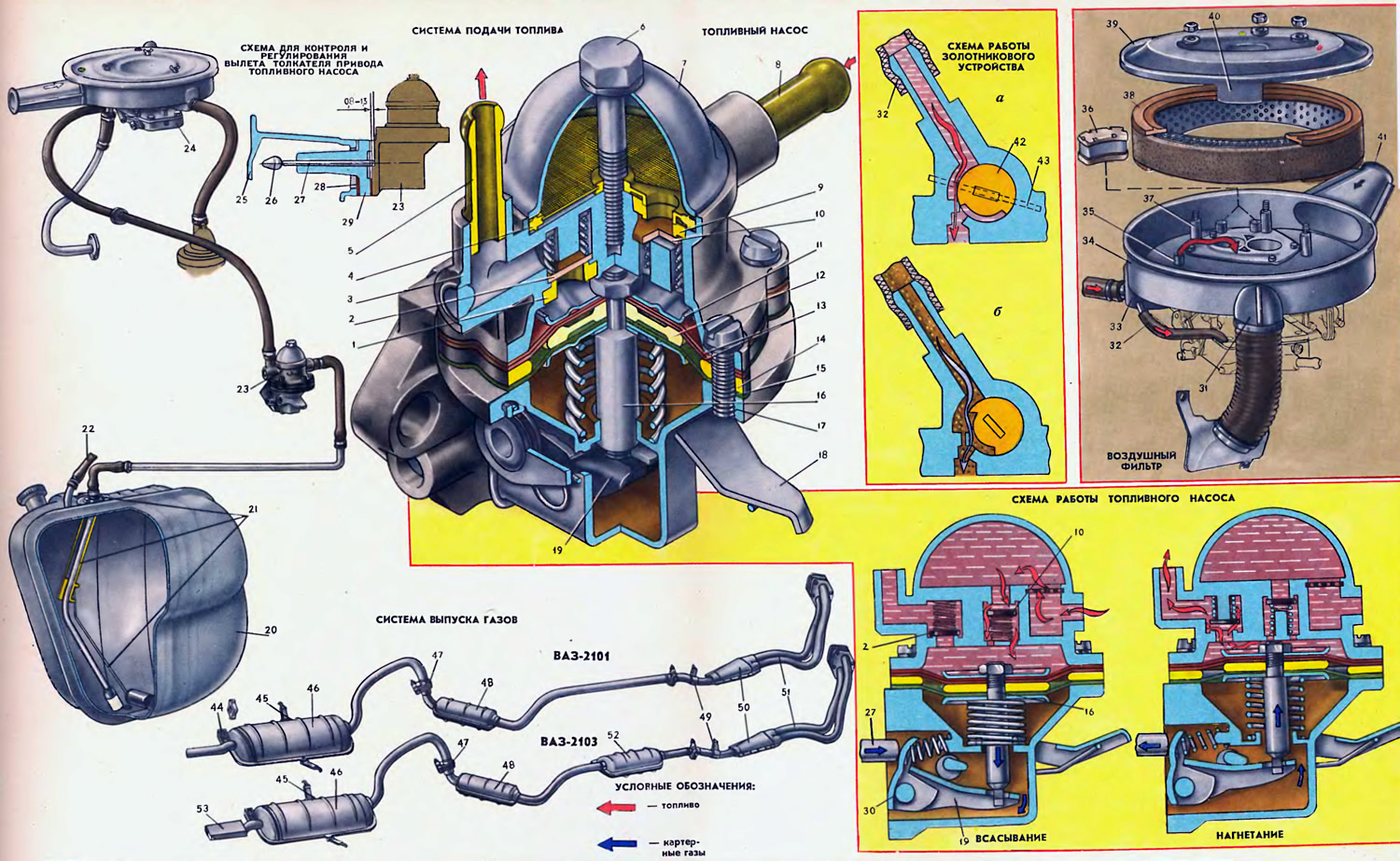
1. Exhaust valve seat. 2. Exhaust valve with spring. 3. Upper fuel pump housing. 4. Filter. 5. Discharge pipe. 6. Bolt. 7. Pump cover. 8. Suction pipe. 9. Inlet valve seat. 10. Inlet valve with spring. 11 Upper diaphragm plate. 12. Inner spacer gasket. 13. Working diaphragms. 14. Outer spacer gasket. 15. Lower diaphragm. 16. Rod with spring. 17. Lower fuel pump housing. 18. Manual priming lever with return spring. 19. Balance beam. 20. Fuel tank. 21. Fuel level indicator sensor. 22. Fuel tank ventilation tube. 23. Fuel pump. 24. Carburetor. 25. Cylinder block. 26. Fuel pump drive eccentric. 27. Pusher. 28. Adjusting lining. 29. Heat-insulating spacer. 30. Mechanical feed lever with return spring. 31. Warm air intake pipe. 32. Blow-by gas supply hose to the valve device. 33. Crankcase ventilation exhaust manifold. 34. Air filter housing. 35. Crankcase ventilation exhaust pipe. 36. Crankcase ventilation filter element. 37. Cover mounting axis. 38. Filter element. 39. Cover. 40. Partition. 41. Cold air intake pipe. 42. Valve. 43. Throttle valve. 44. Exhaust pipe mounting cushion. 45. Main muffler mounting belts. 46. Main muffler. 47. Tightening clamp. 48. Additional muffler. 49. Bracket for mounting the exhaust pipe to the gearbox. 50. Gas receiver. 51. Intake pipe. 52. Additional front muffler. 53. Decorative tip.
Fuel supply system
The fuel supply system consists of a fuel tank, a fuel line and a fuel pump.
Fuel tank 20 — welded, stamped from leaded steel sheet, painted with black enamel. On VAZ-2101 and 2103 cars, the tank is installed in the luggage compartment (on the right as you go) on rubber gaskets and is attached to the body with two clamps, tightened by a central bolt. Rubber gaskets are also installed between the clamp bands and the tank body.
The filler neck is led through a rubber casing-lining to a hatch on the rear right wing and is closed with a blind threaded plug with a plastic lining. A sensor 21 of the fuel level indicator is installed in the tank in assembly with a fuel intake pipe equipped with a mesh filter.
The tank is ventilated through the air tube 22 and a plastic hose placed on it, which is routed under the filler neck hatch. The tank has a ground wire and a drain plug, for access to which there is a hole in the boot floor, closed with a rubber plug. The fuel level indicator sensor is connected to a device installed on the instrument panel and equipped with a red reserve lamp that lights up when 4-6 litres of petrol remain in the tank. Tank capacity (with reserve) 39 y.
On VAZ-2101 cars, all fuel and electrical connections are covered by a shield; on VAZ-2103 vehicles, the fuel tank is covered by the inner lining of the trunk.
On VAZ-2102 cars (station wagon), the fuel tank is located under the trunk floor and has access to the fuel level indicator sensor from the trunk side of the body through a special hatch. Tank capacity (with reserve) 45 l.
The gasoline used is AI-93.
Fuel lines. Fuel from the fuel tank to the fuel pump 23 is supplied through two steel, double-layer tubes connected by rubber hoses, and from the fuel pump 23 to the carburetor 24 - through a rubber hose.
The fuel pump is a diaphragm type and is equipped with a manual pumping lever. The pump consists of the following main parts: the lower housing 17 with drive levers, the upper housing 3 with valves and pipes, the diaphragm unit and the pump cover 7. The lower housing of the fuel pump contains: the manual fuel pumping lever 18 with a return spring and an eccentric equipped with sealing rings, the diaphragm working spring; balancer 19 of the mechanical fuel feed, mounted on the axis together with the lever of the mechanical feed 30 and its return spring. The axis of the balancer and the lever of the mechanical fuel feed are installed in the holes of the lower housing 17, which are punched out from the outside and sealed with sealant.
The outlet 2 and inlet 10 valves with seats 1, 9 are installed in the pump body and the discharge 5 and suction 8 fuel pump pipes are pressed in. The valves are of a non-separable design and are made of textolite and have a hexagonal shape; brass valve seats.
Cover 7 is attached to the fuel pump body with central bolt 6. Between the cover and the body, a plastic mesh filter 4 is installed, which has a special sealing flange, which is inserted into the seat of the inlet valve when installing the filter.
The diaphragm unit consists of two working diaphragms 13, operating in contact with gasoline, and one safety diaphragm 15, operating in contact with crankcase oil. The safety diaphragm prevents crankcase gases from affecting the working diaphragms, as well as gasoline from entering the engine crankcase if the working diaphragms fail.
The diaphragms together with the plates are installed on the rod 16 and are fastened to it with a central nut. Distance gaskets are installed between the working and safety diaphragms - internal 12 and external 14. The external gasket has a through hole through which gasoline flows out when the working diaphragms break. The rod 16 has an L-shaped tailpiece, which is inserted into the slot of the balancer and after turning the diaphragm unit, it engages with it. Such a design allows replacing the diaphragm unit without removing the pump from the engine.
[The article is copied from the website VAZbook]
The pump operates as follows. When the eccentric 26 runs onto the pusher 27, the latter moves in the direction of the arrow (see the "suction" diagram) and acts on the lever 30 of the mechanical fuel supply. The lever 30 turns the balancer 19, which pulls the rod 16 together with the diaphragms down. The diaphragm spring is compressed. As a result, a vacuum is created above the diaphragms, under the action of which the outlet valve 2 closes, and the inlet valve 10 opens and the fuel from the line fills the working cavity above the diaphragms.
When the eccentric runs off the pusher, the lever 30 moves to the left under the action of the return spring (see the diagram "Injection"), releases the balancer 19 and the rod 16, which, together with the diaphragms, moves upward under the action of the spring, and creates pressure in the working chamber. Under the action of this pressure, the inlet valve 10 closes, and the outlet valve 2 opens and fuel enters the carburetor.
The pump is self-regulating - at low fuel consumption the stroke of the diaphragms is underutilized and the stroke of lever 30 and balancer 19 will be partially idle.
The fuel pump is attached to the cylinder block with two studs through a heat-insulating spacer 29 and adjusting linings 28. The linings are made in three types and have a thickness of 0.3, 0.75 and 1.25 mm. When installing the fuel pump, the linings are selected so that the minimum protrusion of the pusher 3 above the mating plane of the spacer (taking into account the gasket between the spacer and the fuel pump) was 0.8-1.3 mm.
Pump capacity is not less than 60 l/h at a pumping frequency of 2000 cycles per minute; the pressure developed with the drain closed is 0.2-0.3 kgf/cm².
Air supply system
Air enters the engine through the air filter, which consists of a housing 34 with a base and pipes, a dry filter element 38 and a cover 39. Three axes 37 for fastening the cover and an exhaust pipe 35 for the engine crankcase ventilation are installed evenly at 120 in the housing base. A pipe 41 for taking in cold air from the underhood space, a pipe 31 for taking in warm air from the deflector located on the exhaust manifold, and an exhaust manifold 33 are welded to the housing. The pipes of the filter element 36 of the engine crankcase ventilation system are installed in the housing.
Crankcase gases are supplied to the exhaust manifold 33 via a hose and are sucked out at high air flow rates through the branch pipe 35 to the carburetor inlet, and in modes when the vacuum at the oblique section of the branch pipe 35 is insufficient, via hose 32 and the nipple through the carburetor spool valve directly into the post-throttle space. If the throttle valve is closed, the crankcase gases are sucked out through a calibrated hole (diagram a), and when the throttle valve is opened, through a groove located in the spool valve (diagram b), which maintains the required intensity of engine crankcase ventilation and prevents excessive reduction in vacuum behind the carburetor throttle valve.
The filter housing is installed directly onto the carburetor housing studs and secured with four self-locking nuts.
The dry filter element has the form of an "accordion", which is made of special filter cardboard and is poured together with perforated tin or mesh shells into elastic covers made of self-hardening sealant. The covers on the outer surfaces have sealing elastic collars. When installing the element in the housing and tightening the nuts, the filter cover is pressed against the remote protrusions of the axes 37 of the fastening, which achieves the elastic deformation of the collars necessary for sealing; this ensures a tight seal between the element, body and cover and prevents deformation of the element or filter cover.
To increase dust capacity, the filter element is equipped with a pre-cleaner lining made of non-woven synthetic material, which acts as an air pre-cleaning element.
The air filter cover has a segment partition 40, which, depending on the location, provides seasonal adjustment of the temperature of the air entering the engine. To control the correct installation of the cover, depending on the season, two marks are applied to the cover: red (winter installation) and blue (summer installation), and an arrow is stamped on the cold air intake pipe.
The filter element replacement period is 10,000 km of run in urban and highway conditions. On dusty country roads, replacement should be more frequent - 3,000-4,000 km.
The factory does not recommend cleaning and restoring the filter element, as this may damage the filter curtain, and therefore, there is a risk of abrasive wear of the engine cylinders.
Exhaust system
The exhaust system consists of three main non-separable units: the inlet pipe 51, the additional 48 (vAZ-2101, 2102 cars) or two additional ones, front and rear (vAZ-2103 cars) mufflers with assembled pipes and the main muffler 46 with assembled pipes. The specified units are connected by pushing the pipes one into the other (where one of the pipes being connected has a flared end with two longitudinal diametrically located slots), and are secured with clamps 47.
The intake pipe consists of a flange, two pipes and a gas receiver 50 welded from two stamped halves and closed on both sides with asbestos heat-insulating gaskets and thin-walled protective casings. All mufflers also have similar heat insulation. The intake pipe is attached to the exhaust manifold with four brass nuts, as well as to bracket 49, fixed to the gearbox. A sealing gasket made of asbestos reinforced with perforated steel tape is installed between the intake pipe and the manifold. The intake pipes of VAZ-2101, 2102 and 2103 cars are unified.
Additional and main mufflers consist of two stamped half-housings, perforated pipes and partitions. The main mufflers of VAZ-2101, 2102 and 2103 cars are unified and differ only in the exhaust pipe; in the VAZ-2103 it has a decorative attachment 53, made of stainless steel tape, in the VAZ-2102 it has a modified configuration associated with changes in the rear part of the body.
Additional muffler 48 of VAZ-2101 and 2102 cars differs from the rear additional muffler of VAZ-2103 car by the presence of a throttling diaphragm in its internal pipe, therefore, during repair, its installation on VAZ-2103 car is not recommended due to the inevitable loss of power.