




Open large image in new tab »
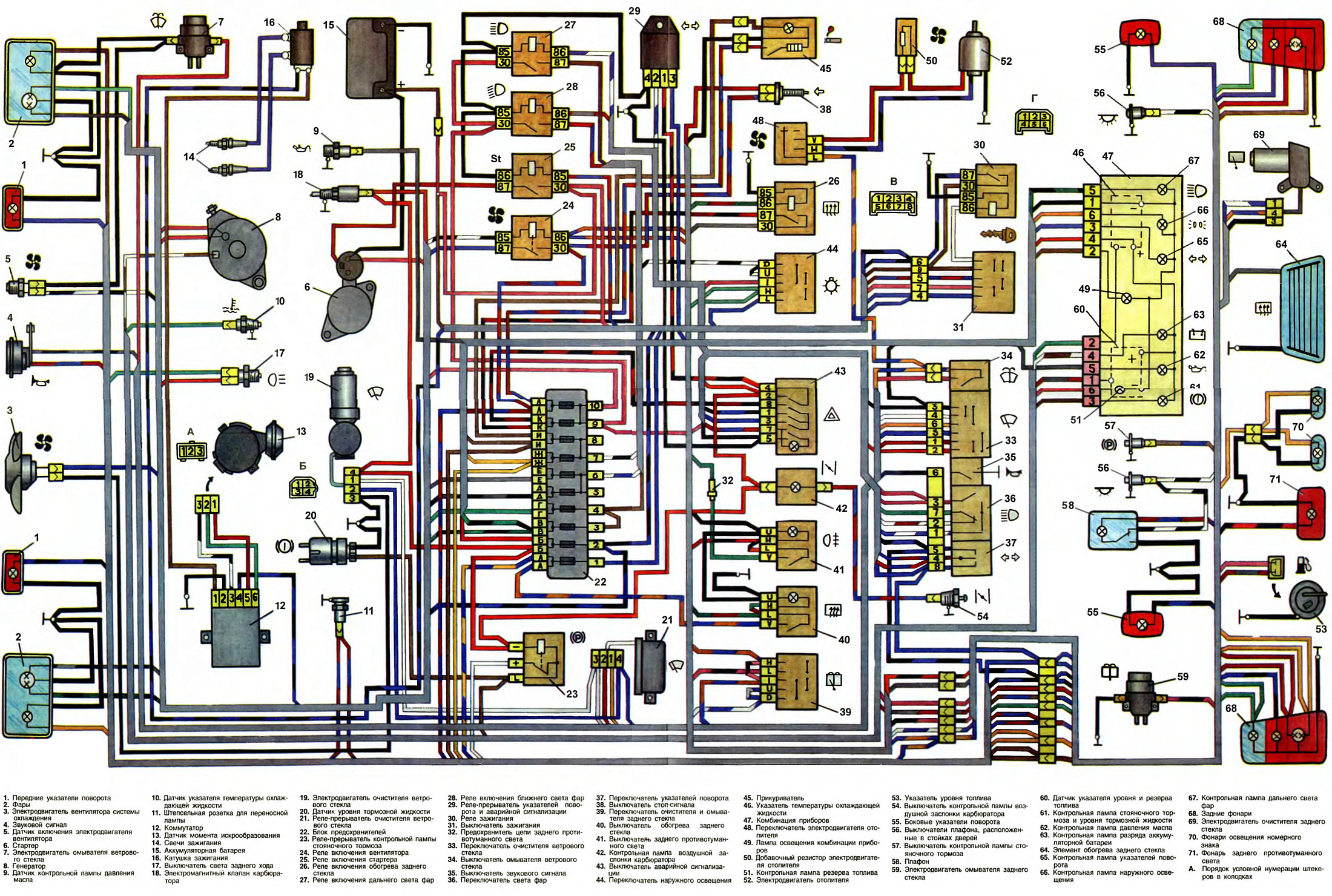
On Oka cars, a single-wire circuit for connecting electrical equipment devices is used, i.e. only one wire goes to all consumers of electrical energy. The second "wire" connecting consumers to sources of electrical energy is the car body, or "ground". This circuit allows for a significant reduction in the number of wires and simplification of their installation. Negative terminals of electrical energy sources are connected to the ground. With this connection, the corrosion of metal body parts due to electrochemical corrosion is reduced.
The sources of electric power in the car are the generator and the battery, connected in parallel. The nominal working voltage of the sources and consumers of electric power is 12 V. However, the voltage in the electrical system, depending on specific conditions, can fluctuate from 11 to 14.5 V, and within these limits, the consumers retain their functionality.
All electrical equipment of cars can be divided into the following main systems:
- 1) a power supply system that includes a battery and a generator with a voltage regulator;
- 2) the engine starting system, which includes the starter, starter relay and the corresponding ignition switch contacts;
- 3) the ignition system, consisting of an ignition coil, a spark timing sensor, a commutator, spark plugs, high-voltage wires, an ignition relay and the corresponding contacts of the ignition switch;
- 4) a lighting and light signaling system that combines headlights, lanterns and corresponding switches and relays;
- 5) control devices with sensors;
- 6) additional electrical equipment, which includes a windshield and rear window wiper and washer, a rear window heating system, a heater motor, a cigarette lighter and an audible signal.
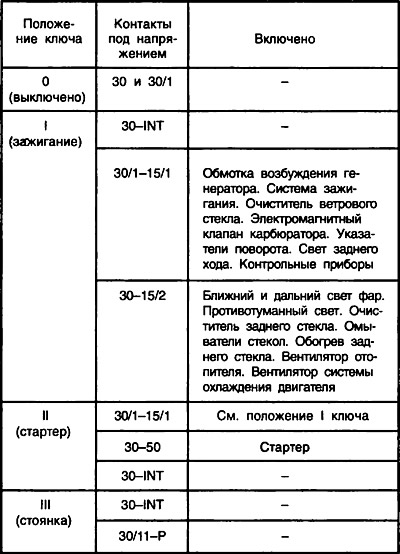
The operation and activation of all systems are controlled by the corresponding switches and relays. The supply voltage to most consumers is supplied via ignition switch 31. The circuits that are switched on at different key positions are shown in the table (see also chapter 32).
The power supply circuits of those electrical equipment units whose operation may be required under any circumstances are always connected to the battery and generator (regardless of the position of the key in the ignition switch). Such units include the sound signal 4, the cigarette lighter 45, the filaments of the brake signal lamps in the rear lights 68, the license plate lights 70, the interior light 58 and the socket 11 for the portable lamp. The circuits of the hazard warning lights, the side lights and the high beam headlight signal circuit are also directly connected to the power sources.
When operating vehicles, short circuits may occur due to damage to the insulation of wires or electrical equipment units. They cause a sharp increase in current in a short-circuited circuit and, if protective measures are not taken, can lead to a rapid discharge of the battery, overheating of the wires, melting of their insulation and ignition of the car interior upholstery.
There are 11 fuses on the vehicle to protect against short circuits. Ten of them are located in the plastic block 22, and one fuse 32, protecting the rear fog light target, is located in a separate housing in the wiring harness near the rear fog light switch 41. This fuse is rated for a maximum current of 8 A.
The fuse box is located under the instrument panel to the left of the steering column. The fuses are thin plates of fusible metal, fixed to a plastic base. Seven fuses (black color) are designed for a maximum current of 8 A, and three (green color) — 16 A. Fuses for 16 A are installed in the power supply circuits of electrical equipment units that consume high current (such as the rear window heating element, cigarette lighter, engine cooling fan motor, etc.).
The circuits protected by the fuses located in the fuse box are listed below.
If a fuse blows, it is recommended to check the circuits it protects, eliminate the fault that caused the blown fuse, and then install a new fuse. Do not use any homemade fuses or fuses not provided for by the vehicle design.
The largest number of fuses are installed in the lighting system, since it has the most extensive and extensive network of wires and is therefore most susceptible to damage and short circuits with ground. The windshield and rear window wiper motors are additionally protected from overloads by thermal bimetallic fuses located in the motors themselves. The cigarette lighter is additionally protected from prolonged switching on by a washer made of a low-melting alloy located in the rear part of the cigarette lighter.
Some electrical equipment power supply circuits do not have any fuses at all. As a rule, these are the most important systems, the trouble-free operation of which is required in emergency situations. For example, the engine ignition system is not protected by fuses, so as not to introduce elements into it that reduce the reliability of the system in operation. If the ignition system fails, the engine will stop working. There are also no fuses in the starting circuit, so as not to reduce the reliability of starting the engine. In addition, the battery charging circuit, as well as the relay for switching on the high and low beam headlights, are not protected by fuses.
Flexible low-voltage wires of the PVA type are used to connect sources and consumers of electrical energy into a common circuit on cars (high voltage wires are described further on sheet 32). They have durable elastic insulation made of polyvinyl chloride plastic. Such insulation is resistant to oil, gasoline and is operational in the temperature range from -40 to 105°C. The conductive core of the wires is made of a large number of soft copper wires to ensure flexibility (from 19 for a wire with a cross-section of 1 mm² to 84 for a wire with a cross-section of 16 mm²).
In order to distinguish wires in bundles and easily trace their connections, the insulation of the wires is made in different colors. It can be painted in a wide range of colors: white, blue, yellow, red, etc. In addition, spiral or longitudinal stripes of white, red, blue or black colors can be applied to the surface of the insulation. Thus, in the bundles of wires there are no two wires of the same color. Black wires are used to connect to the ground, and pink or orange wires are mainly used to connect to the "plus" of power sources. The current flowing through the wires heats them. In addition, this causes a voltage drop in the wires. In order for the heating and voltage drop not to exceed the permissible limits, it is necessary to select the appropriate cross-section of the conductive cores of the wires. The greater the electric current flowing, the larger the cross-section of the wire core should be. Therefore, wires with different cross-sections of the core are used in cars: 16; 4; 2,5; 1,5; 1,0; 0.75 and 0.5 mm².
The largest current flows when starting the engine through the wires connecting the battery to the starter and ground, as well as the engine to ground. These wires have a cross-section of 16 mm². A fairly significant current also flows through the wire connecting the generator to the starter when charging the battery, as well as when the engine is not running, when all consumers are powered by the battery. Therefore, this wire is selected with a cross-section of 4 mm². The same wire connects plug "87" of relay 25 of the starter with plug "50" of the traction relay of the starter 6.
Wires with a cross-section of 2.5 mm² are used to supply voltage from the fuse box to the headlamps, to connect the plugs "30" and "87" of relays 24, 25, 27 and 28 to consumers or the fuse box and to connect the electric motor 3 of the engine cooling system fan to relay 24 and ground. The same wires go to the contacts "30", "30/1", "15" and "15/1" of ignition switch 31 and to contacts "D", "I" and "I" of external lighting switch 44.
Wires with a cross-section of 1.5 mm² are used to connect the rear window heating element 64 to the heating relay 26 and to connect the plug "87" of this relay to the fuse box.
All other vehicle wires have a cross-section of the conductive core from 0.5 to 1 mm², since a relatively small current flows through them.
The wires are connected to the electrical equipment units and are connected to each other using convenient quick-release plug connections. The exception is the connection of wires to the battery, to the "30" clamp of the generator and to the bolt of the starter traction relay. In these important connections, the wire tips are clamped with nuts to ensure maximum reliability of the connections.
To protect the electrical connections from water and dirt, the rear of the front turn signals are covered with covers. Protective rubber caps cover the high-voltage wire tips, coolant temperature and oil pressure sensors, the positive terminal of the battery, and the reversing light switch. Also covered are the bulb sockets of the side turn signals, rear fog lights, and license plate lights.
To facilitate installation, all wires are combined into bundles. Wires in bundles are wrapped with adhesive tape or enclosed in plastic tubes. The bundles are connected to each other using plug connectors, the pads of which are made of polyamide plastic. The holes in the body through which the wires pass are covered with rubber seals that protect the wires from damage on the edges of the holes and do not allow water and dirt to penetrate through the holes.
There are four wiring harnesses in total, front (main) harness, rear, front turn signal harness (2 pcs.) and battery harness.
The main wiring harness is the front one. It has three branches. Two of them are in the engine compartment, and the third one is in the passenger compartment under the instrument panel. From the passenger compartment to the engine compartment, the wiring harness passes through a rubber seal and after exiting it branches out. The right branch of the harness is laid on the front shield, and the left one is on the left mudguard and the front panel of the front. The wiring harness is attached to the body panels with steel brackets welded to the body and plastic clamps.
The harness should be fastened in such a way that it is not too tight, but also does not dangle, as this can lead to the wires being frayed during shaking and short-circuiting them with the ground.
In the car's interior, the front harness runs under the instrument panel and has small branches to the fuse box, to the switches, to the instrument cluster, to the ignition switch and to other electrical equipment units. On the left side, under the instrument panel, there is a fuse box, and behind it, on a bracket, all the auxiliary relays are mounted (except ignition relay).
The front harness is connected to the rear wiring harness using three plug connectors: a two-plug, a six-plug, and an eight-plug. The rear harness runs back under the floor mats along the left side of the body floor and has branches to the right side turn signal and the ceiling light switch in the right door pillar, to the parking brake indicator light switch, up to the ceiling light, and down in front of the rear seat to the right rear light. From the right rear light, the harness goes up and near the right hinge of the rear door goes to the door and goes to the rear window wiper motor reducer and the rear window heating element. The rear harness is secured to the body floor with adhesive tape.
Some electrical equipment units are installed only on some of the vehicles produced.
These units include a cigarette lighter, a rear fog light with a switch, and a rear window with electrical heating and a corresponding relay and switch.
| fuse No | Protected circuits |
| 1 (16 A) | Heater fan electric motor. Relay (winding) and sensor for turning on the engine cooling system fan electric motor. Relay (winding) for turning on the rear window heating. Electric motors for the wiper, rear window washer and windshield washer. |
| 2 (8 A) | Carburetor solenoid valve. Windshield wiper relay and motor. Direction indicators and turn signal and hazard warning flasher relay (in turn indication mode). Indicator lamp for direction indicators. Rear lights (reversing light bulbs). Generator excitation winding (when starting the engine). Carburetor air damper indicator light. Parking brake and brake fluid low level indicator light and relay-breaker. Oil pressure indicator light. Battery discharge indicator light. Coolant temperature gauge. Fuel gauge with reserve indicator light. |
| 3 (8 A) | Left headlight (high beam). High beam indicator lamp |
| 4 (8 A) | Right headlight (high beam) |
| 5 (8 A) | Left headlight (low beam) |
| 6 (8 A) | Right headlight (low beam) |
| 7 (8 A) | Left headlight (side light). Left rear light (side light). License plate lights. Side light indicator lamp. |
| 8 (8 A) | Right headlight (side light). Right rear light (side light). Instrument cluster illumination lamp. Cigarette lighter illumination lamp. |
| 9 (16 A) | Direction indicators and relay-interrupter of direction indicators and hazard warning lights in hazard warning mode. Rear window heating element and relay (contacts) for its activation. |
| 10 (16 A) | Electric motor of the engine cooling system fan and relay (contacts) for its activation. Horn. Socket for portable lamp. Interior light. Tail lights (brake light bulbs). Cigarette lighter. |