




Contents: Removal and installation ↓ Disassembly and assembly ↓ Checking pump parts ↓ Checking the pressure reducing valve ↓
Main dimensions of the oil pump and its drive
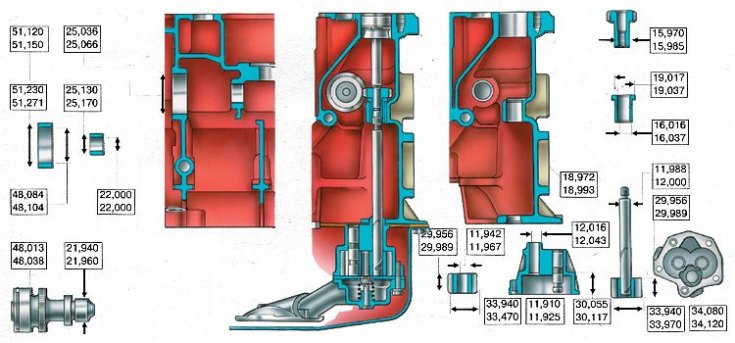
Removal and installation
1. Place the car on an inspection pit or lift, disconnect the wires from the battery and drain the oil from the engine crankcase.
2. Remove the engine splash shield.
3. Loosen the nuts securing the front engine mount cushions to the crossmember and lift the engine slightly with a jack or hoist until the cushion studs come out of the crossmember holes.
4. Remove the engine crankcase.
5. Remove the oil pump together with the intake pipe.
6. Perform the operations for installing the oil pump on the engine in the reverse order of removal.
Disassembling the oil pump
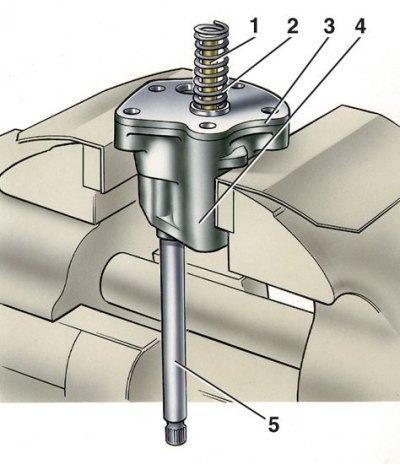
1 – pressure reducing valve; 2 – spring; 3 – lid; 4 – body; 5 – roller
Disassembly and assembly
1. Secure the oil pump in a vice carefully so as not to damage the housing.
2. Loosen the bolts and remove the inlet pipe together with the oil pressure reducing valve.
3. Remove cover 3 of the pump housing and remove the pump shaft with the drive gear and the driven gear from the housing.
4. For assembly, carefully secure the pump in a vice.
5. Install the drive gear with the shaft into the pump housing, and place the driven gear on the axle in the housing.
6. Install the housing cover, the pressure reducing valve with the spring and attach the inlet pipe to the pump housing.
Attention! After assembling the pump, when turning the drive shaft by hand, the gears should rotate smoothly and without jamming.
Checking pump parts
1. After disassembling, wash all pump parts with kerosene or gasoline, blow with a stream of compressed air, and then inspect the pump body and cover; if there are cracks, replace the parts.
[The original can be found on the website: VAZbook]
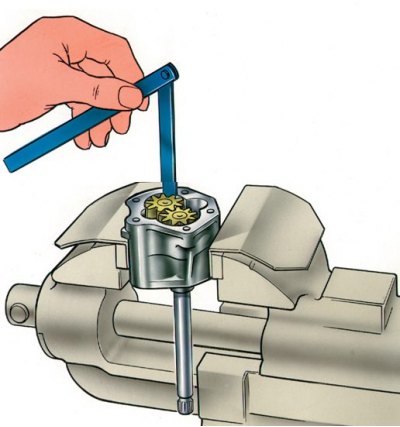
2. Using a set of feeler gauges, check the gaps between the gear teeth, as well as between the outer diameters of the gears and the walls of the pump body, which should be 0.15 mm, respectively (maximum permissible 0.25 mm) and 0.11–0.18 mm (maximum permissible 0.25 mm).
3. If the gaps exceed the maximum values, replace the gears and, if necessary, the pump housing.
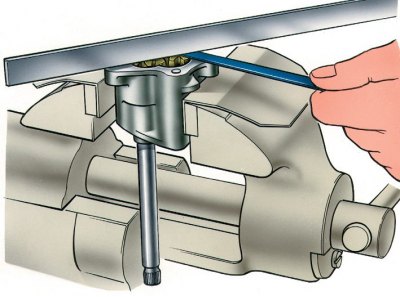
4. Using a feeler gauge and a ruler, check the gap between the ends of the gears and the plane of the housing, which should be equal to 0.066–0.161 mm (maximum permissible 0.2 mm). If the gap is more than 0.2 mm, replace the gears or the pump housing, depending on which is worn out.
5. Check the clearance between the driven gear and its axis, which should be 0.017–0.057 (maximum permissible 0.1 mm), and also between the pump shaft and the hole in the housing, this gap should be 0.016–0.055 (maximum permissible 0.1 mm). If the gaps exceed the limits, replace the worn parts.
Basic data for checking the pressure reducing valve spring
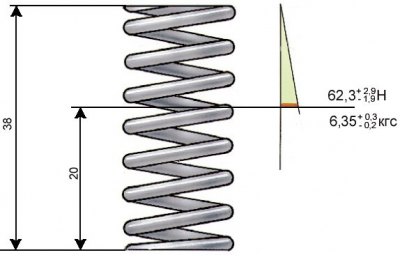
Checking the pressure reducing valve
When repairing the oil pump, check the pressure relief valve. Pay attention to the surfaces of the valve and the housing, as possible contamination or deposits on the mating surfaces can lead to jamming. There should be no nicks or burrs on the mating surface of the valve, which can lead to a decrease in pressure in the system.
Check the elasticity of the pressure reducing valve spring by comparing the obtained data with those shown in the figure.