




Examination
To perform the work you will need a multimeter.
1. Remove the starter (see "Starter - removal and installation").
2. Clean the outer surface of the starter from dirt.
3. To check the traction relay, disconnect the starter winding terminal from the contact bolt (see below, "Repair"). Connect the "50" terminal of the relay to the positive terminal of the storage battery, and the starter housing to the negative terminal. In this case, the anchor of a serviceable relay will extend the drive gear A into the front cover window, and the contact bolts are closed.
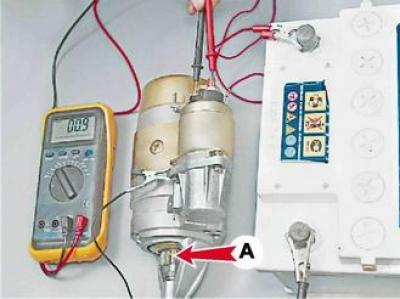
The resistance shown by the ohmmeter should tend to zero.
4. To check the armature and stator windings, remove the rear cover of the starter (see below, "Repair").
5. Having connected one ohmmeter probe to the body, we alternately connect the other to the terminals of the stator windings, checking that they are not shorted to the body.
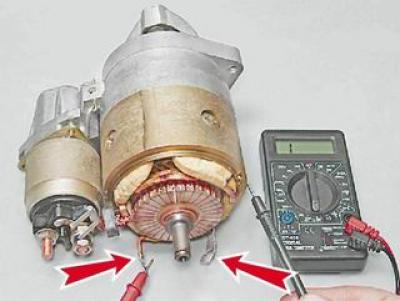
If there is no short circuit, the ohmmeter should show a resistance of at least 10 kOhm.
6. Having connected the ohmmeter probes to the terminals of the stator windings, we check them for breakage.
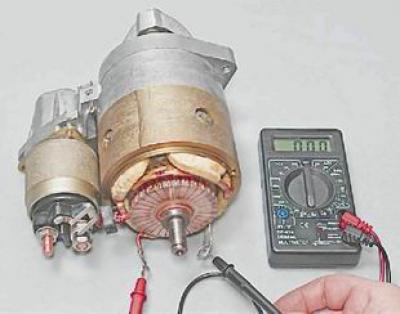
If the resistance tends to infinity, the winding has broken.
7. Having connected one probe of the ohmmeter to the body or shaft of the armature, we connect the other one alternately to the contact plates of the armature, checking the short circuit of the armature windings to ground.
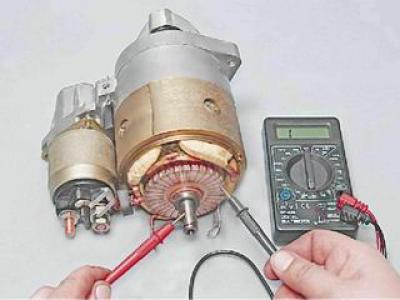
If there is no short circuit, the ohmmeter should show a resistance of at least 10 kOhm.
Repair
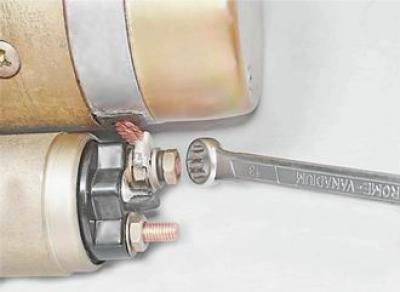
1. With a socket wrench by 13 mm loosen the nut and remove the stator winding terminal from the contact bolt.
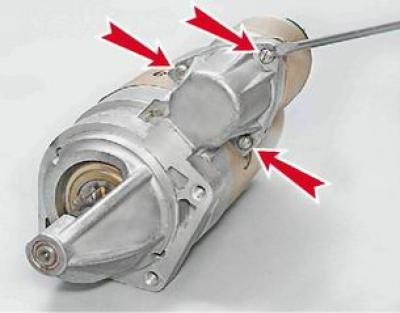
2. Using a slotted screwdriver, unscrew the three screws securing the traction relay.
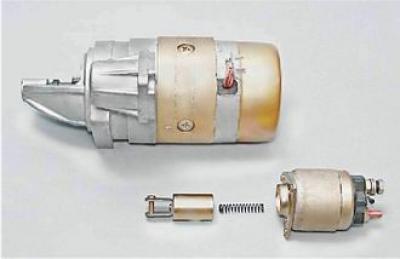
3. Remove the traction relay with the rod and spring.
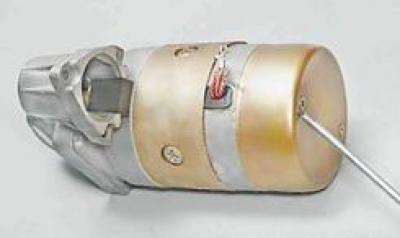
4. Using a slotted screwdriver, unscrew the two screws securing the rear cover casing and remove the casing.
5. Using a slotted screwdriver, unscrew the two screws A and B fastening the stator windings and terminals of the corresponding brushes to the brush assembly.
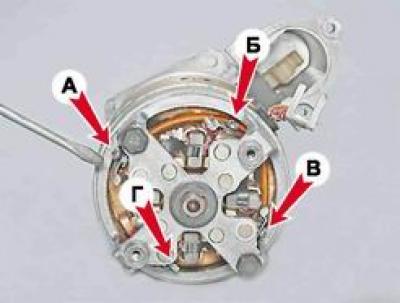
With screws A and IN the brush jumper is secured with a screw G the brush outlet is attached.
6. Using a screwdriver, pry up and remove the locking washer and the adjusting washer located underneath it.
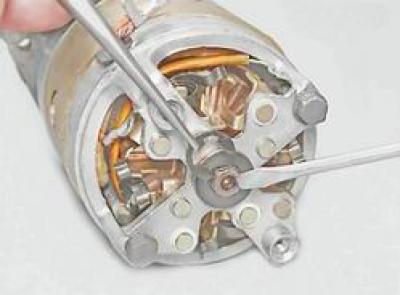
7. With a socket wrench by 10 mm unscrew the two tension bolts. On the bolt located next to the tire A (connecting stator winding) the insulating tube is put on.
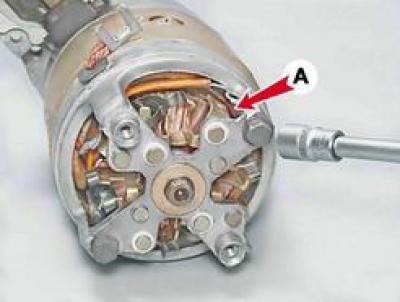
8. Disconnect the back cover and the front cover together with the anchor from the body.
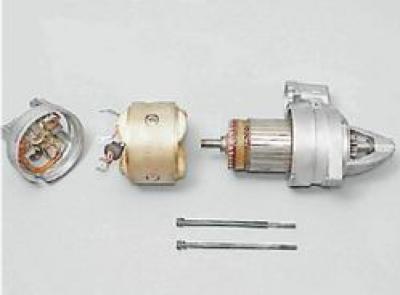
9. Unscrew the two remaining screws securing the brush terminals. A jumper is secured to one of the screws.
10. Using a screwdriver, pry up and move the four springs and remove the brushes from the guides.
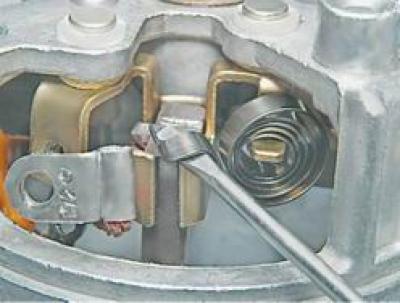
11. Using pliers, remove the cotter pin holding the lever axle.
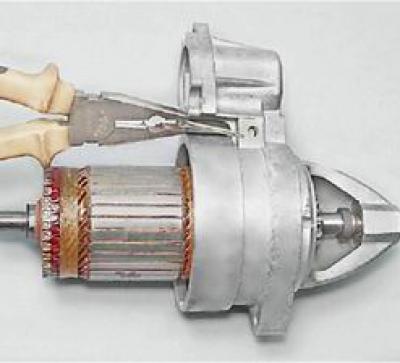
12. Use a beard to push out the axle.
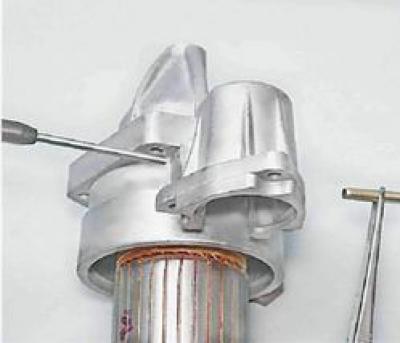
13. Using a screwdriver, remove the rubber seal.
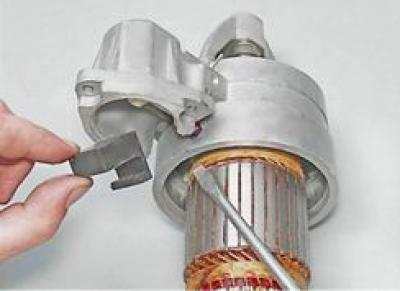
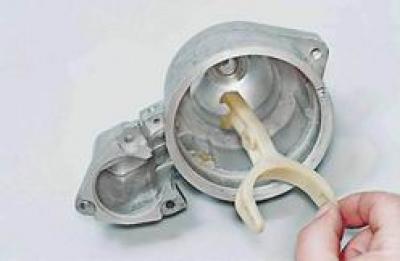
14. Using a screwdriver, press the lever fork and disengage it from the overrunning clutch ring.
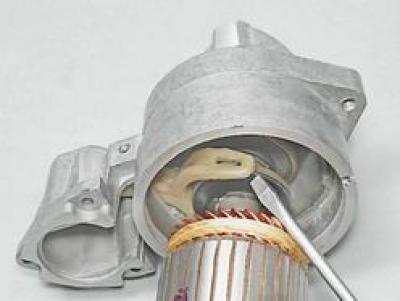
15. Remove the anchor.
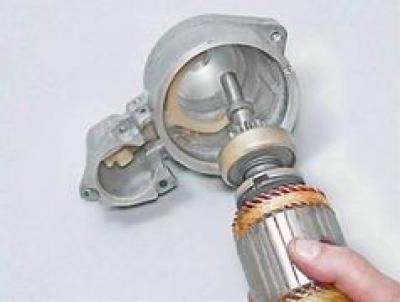
16. Remove the lever from the cover.
17. Having supported the anchor shaft on a wooden block, we press the limiting ring from the retaining ring using a suitable mandrel.
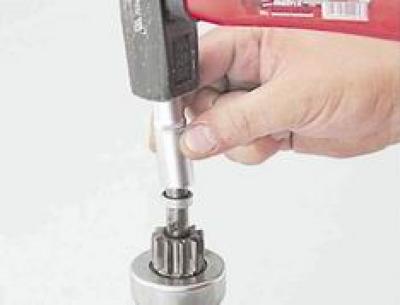
18. Using a slotted screwdriver, remove the retaining ring from the shaft.
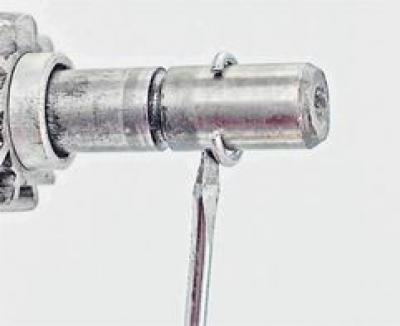
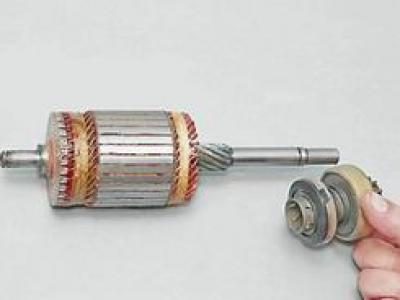
19. Remove the limiting ring and the overrunning clutch with the drive gear from the armature shaft.
Assembly
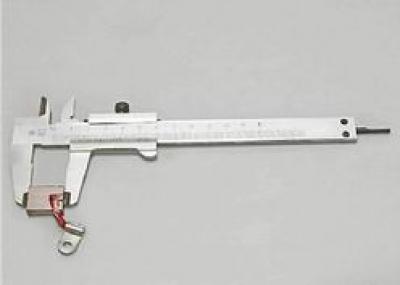
1. Wash the starter parts with white spirit or kerosene, blow with compressed air. Check the condition of the parts. The covers and housing must be free of cracks. The gear teeth must not have significant wear. The gear must easily rotate relative to the hub only in one direction - in the direction of rotation of the anchor. There must be no burrs, nicks or signs of wear on the surfaces of the splines and journals of the shaft. There must be no burns on the working surface of the collector. Remove small burns with fine-grained sandpaper. The brushes must move freely in the grooves of the brush holders. The brush holders of the "positive" brushes must not have a short circuit with the "ground". Brushes worn to a height of less than 12 mm are replaced with new ones.
2. Lubricate the bearing surfaces and splines of the armature shaft, the splines of the overrunning clutch hub, the bearing bushings in the starter covers and the drive lever axle with engine oil. Lubricate the drive ring of the overrunning clutch hub with plastic grease.
3. Install the overrunning clutch with the drive gear on the armature shaft.
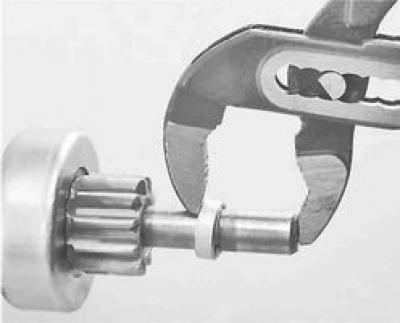
4. Place the gear travel limiting ring on the shaft so that the smaller diameter of the inner conical surface of the ring faces the gear. Install the locking ring in the shaft groove, squeeze it and press the limiting ring onto it with sliding pliers, if necessary pressing the locking ring into the groove with a slotted screwdriver.
5. Next, we assemble the starter in the reverse order.
6. Before installing the casing, check the axial play of the anchor shaft, which should be no more than 0.5 mm. If necessary, adjust it by installing adjusting washers on the anchor shaft (see above, "Repair", item 6).
7. Install the casing.
8. Install and connect the traction relay.