




In this case, the coolant will circulate in a small circle. This can be determined by touch - the lower radiator hose and the radiator itself should be noticeably colder than the thermostat housing, through which the hot coolant circulates.
When the coolant temperature reaches 85°C, the main thermostat valve begins to open and a gradually increasing flow of hot liquid enters the radiator.
In this case, first the radiator itself, and then the lower radiator pipe will begin to heat up.
At 102°C, the main thermostat valve is fully open and the main flow of coolant passes through the radiator. In this case, the radiator should be hot at the top and slightly cooler at the bottom.
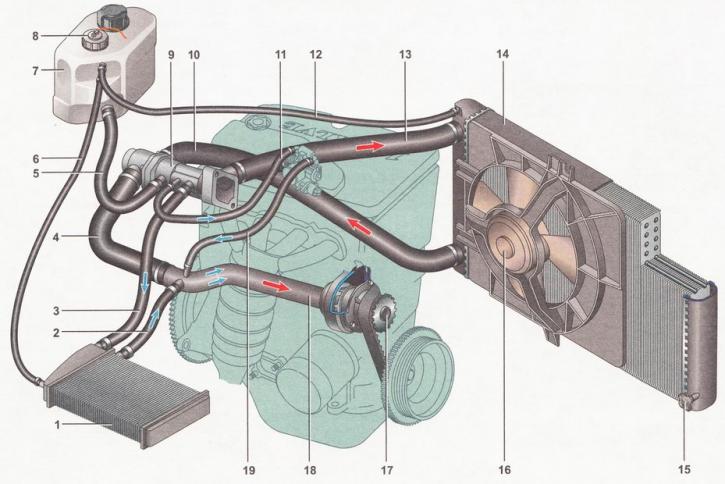
Engine cooling system: 1 - heater radiator; 2 - coolant drain hose from the heater radiator; 3 - coolant supply hose to the heater radiator; 4 - coolant pump hose; 5 - expansion tank hose; 6 - heater radiator steam outlet hose; 7 - expansion tank; 8 - expansion tank fluid level sensor*; 9 - thermostat; 10 - coolant drain hose from engine radiator; 11— hose for supplying liquid to the throttle assembly; 12 - Engine radiator steam outlet hose; 13 - hose for supplying liquid to the engine radiator; 14 - engine radiator; 15 - radiator drain plug; 16 - Electric fan of the engine radiator; 17 - Coolant pump; 18 - supply pipe to the coolant pump; 19 - coolant drain hose from the throttle assembly
The text is copied from the online portal (VAZbook.ru)
* Installed on vehicle parts.