




Contents: Removal ↓ Installation ↓
The rear brake pads must be replaced if the thickness of the lining of any of the pads is less than 1.5 mm, and also if the lining has separated from the base of the pad.
The brake pads of the rear brake mechanisms are replaced only as a set, that is, simultaneously on both wheels.
To complete the job, you will need pliers with thin, curved jaws.
Removal
1. Prepare the car for work (see "Preparing the car for maintenance and repair").
2. Using two mounting blades, bring the pads together as much as possible (see "Brake drum - removal and installation").
3. Using a slotted screwdriver, remove the end of the upper tension spring from the hole in the front brake shoe.
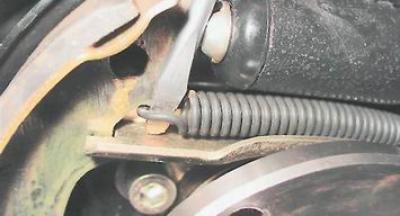
4. Disconnect the pressure spring from the front shoe.
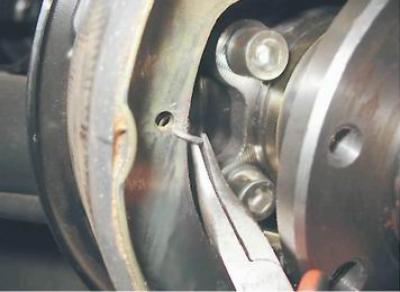
5. Lower the front shoe down and remove it together with the lower tension spring.
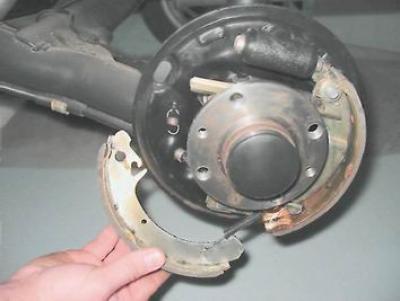
6. Remove the upper tension spring.
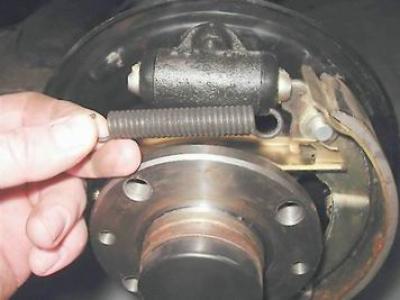
7. Remove the spacer bar.
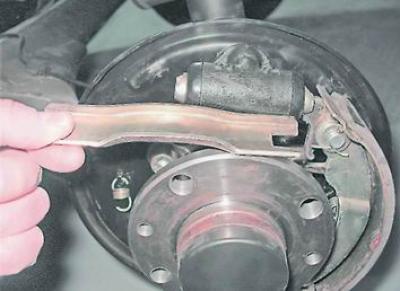
8. Disconnect the pressure spring from the rear shoe.
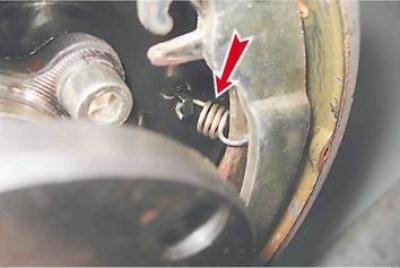
9. Remove the rear shoe by disengaging the hook of the expansion lever from engagement with the tip of the handbrake cable.
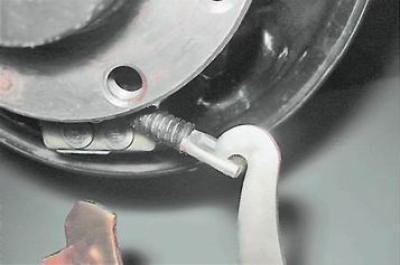
10. Using pliers, remove the cotter pin from the lever axle. Remove the washer, spacer lever, and axle pin from the shoe.
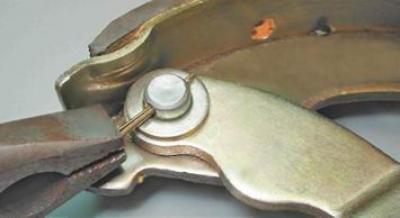
11. Clean the brake mechanism parts from dirt and corrosion.
12. Make sure there are no brake fluid leaks from the working cylinder (replace the leaky cylinder).
Installation
1. Install the parts removed during disassembly in the reverse order.
2. Tighten the upper tension spring with pliers or a slotted screwdriver.
3. Replace the rear right brake pads in a similar manner.
4. To automatically adjust the gap between the brake shoes and drums after complete assembly of the brake mechanism, press the brake pedal several times.
5. Adjust the parking brake (see "Parking brake - adjustment").