




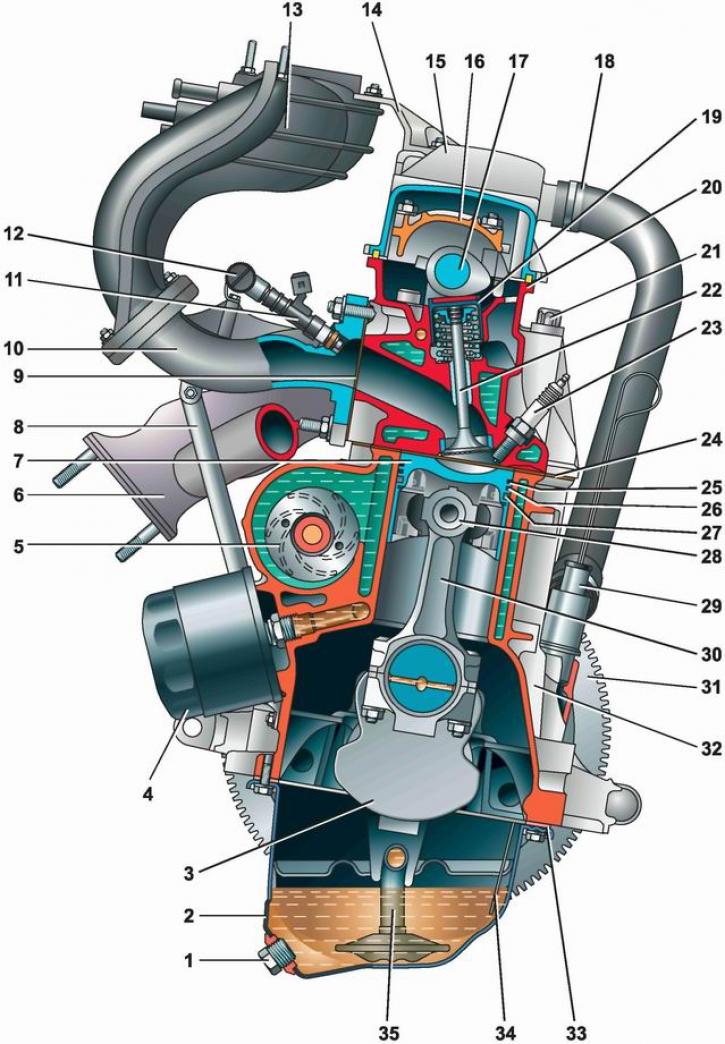
Cross section of engine 11183 (1.6i): 1 - oil pan drain plug; 2 - engine oil pan; 3 - crankshaft; 4 - oil filter; 5 - coolant pump; 6 - exhaust manifold; 7 - piston; 8 - intake manifold mounting rod; 9 - gasket of intake manifold and exhaust manifold; 10 - inlet manifold; 11 - nozzle; 12 - fuel rail; 13 - receiver; 14 - bracket; 15 - cylinder head cover; 16 - camshaft bearing housing; 17 - camshaft; 18 - crankcase ventilation hose; 19 - valve tappet; 20 - cylinder head; 21 - bolt securing the head to the cylinder block; 22 - valve; 23 - spark plug; 24 - cylinder head gasket; 25 - upper compression ring; 26 - lower compression ring; 27 - oil scraper ring; 28 - piston pin; 29 - nipple for installing the oil dipstick; 30 - connecting rod; 31 - flywheel; 32 - cylinder block; 33 - Oil pan gasket; 34 - oil dipstick; 35 - oil intake
The cylinder block is cast iron, with machined cylinders. The internal cavities of the block for the coolant are formed during its casting, and the oil supply channels are made by drilling. Five supports of the crankshaft main bearings are machined in the lower part of the block. The main bearing caps are machined together with their supports and are therefore not interchangeable. In order not to mix up the caps during installation, they are marked with the bearing serial number, starting from the crankshaft pulley. In the second main bearing cap, two threaded holes are made for the oil intake mounting bolts. Steel-aluminum liners are installed in the supports and caps of the main bearings. On both sides of the support of the third main bearing, nests are made for installing thrust half rings that prevent axial movement of the crankshaft. The front half ring is steel-aluminum (yellow on one side, steel-colored on the other), rear - metal-ceramic (yellow on both sides).
The pistons are made of aluminum alloy with steel rings cast into them. To prevent pistons from hitting the valves when the timing belt breaks or its teeth are cut off, the bottom of each piston has recesses for the valve plates. Each piston has one oil scraper ring and two compression rings.
Fingers - floating type (fixed in the piston holes on both sides by spring retaining rings). Some 2111 engines can be equipped with a 21083 engine connecting rod and piston group, where the pins are fixed in the upper heads of the connecting rods using the "hot fit" method.
Connecting rods - steel, forged, with removable caps. The connecting rod caps are not interchangeable and are installed on the connecting rods in only one position. The connecting rods and their caps are marked with the cylinder number.
The oil pan is attached to the cylinder block from below through a gasket.
The engine lubrication system is combined - under pressure and splash. The oil pump is a gear type with internal engagement and a drive from the front end of the crankshaft. Through the oil intake, the pump takes oil from the oil pan and pumps it under pressure into the channels of the engine lubrication system. To monitor the oil level in the pan, a dipstick and an electric sensor for insufficient oil level are installed. The oil filter is full-flow, with a paper filter element and a check valve that prevents oil from leaking from the lubrication system channels into the oil pan after the engine is stopped.
The crankshaft body has drilled channels. When the engine is running, oil under pressure from the block through holes and grooves in the main bearing shells and holes in the main journals gets into the crankshaft channels and through them goes to the connecting rod journals, lubricating them. The technological holes of the channels are closed with stamped steel plugs.
The flywheel is bolted to the crankshaft flange. To connect them in the required position, there is a drilling-shaped installation mark on the flywheel, which should be opposite the connecting rod journal of the fourth cylinder.
On the left side of the block (when viewed from the crankshaft pulley side) a cavity for installing a coolant pump and a lug for installing an oil filter are made.
An aluminum head is installed on top of the cylinder block through a special gasket. It contains a camshaft, eight valves with guide bushings and seats, and eight valve tappets with adjusting washers. The camshaft supports are made in the head. Two camshaft bearing housings are pressed to the upper plane of the head with bolts. The gas distribution mechanism is closed from above with a cover with an oil filler neck. On some cars, a camshaft position sensor is installed in the cylinder head plug, and a pin is installed on the rear end of the shaft, designed for the sensor to determine the shaft position.
The camshaft and coolant pump are driven by a toothed belt from a toothed pulley mounted on the engine crankshaft. The belt is tensioned and directed along the pulleys by a tension roller. The generator is driven by a poly V-belt from the engine crankshaft pulley.
Features of the VAZ-11183 engine (1.6i)
Engine 11183, with a working volume of 1.6 liters, eight-valve, created on the basis of the VAZ-2111 engine. It has a cylinder block increased in height by 2.3 mm and an original crankshaft. The cylinder diameter remains the same - 82 mm, the piston stroke is increased to 75.6 mm against 71 mm in the base engine. Oil nozzles are installed in the main bearing supports. Oil from the nozzles is supplied to the inner surfaces of the pistons for their cooling. Some of the oil gets on the upper heads of the connecting rods and through the conical holes made in them flows onto the piston pins, lubricating them.
The 11183 engine receiver is made of plastic. The engine is equipped with original fuel rail without pressure regulator and injectors, different from those used on the 2111 engine.