




The engine layout is simple and easy to maintain. All engine components that require adjustment or maintenance (distributor, spark plugs, carburetor, air filter, chain tensioner, generator, oil filter), installed in easily accessible places.
The engine cylinders are arranged vertically in a row, united together with the upper part of the crankcase and represent a single casting - cylinder block 3 (Fig. 2). This arrangement ensures structural strength, rigidity, compactness, reliability and reduces engine weight. Coolant ducts are made along the entire height of the cylinders, which improves piston and piston ring cooling and reduces block deformations from uneven heating.
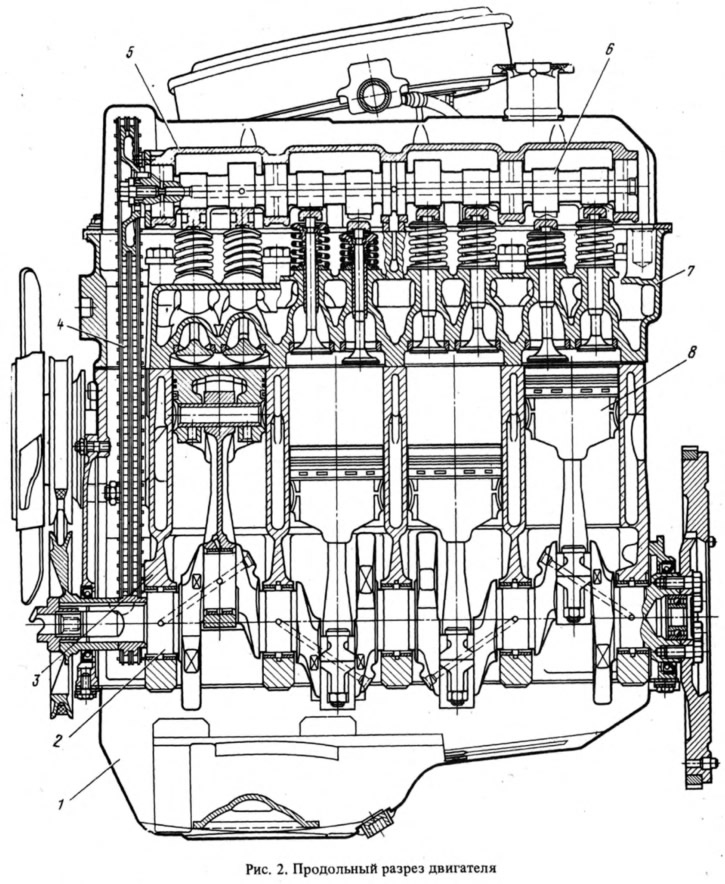
In the lower part of the cylinder block, crankshaft 2 is mounted on five supports. Due to the relatively large diameters of the main and connecting rod journals of the shaft, the specific loads on the bearings are small, so the crankshaft and its bearing liners have a fairly high durability. The front and rear ends of the crankshaft are sealed with self-tightening rubber seals.
In the front part of the cylinder block there is a cavity for placing the chain drive 4 of the camshaft 6. From below the cylinder block is closed by a stamped steel oil sump 1. Cork-rubber gaskets are also installed between the cylinder block and the camshaft cover.
The pistons 8 are cast from aluminum alloy and have two compression (sealing) and one oil scraper ring. Two steel plates are installed in the piston bosses during its casting. They compensate for the uneven thermal deformation of the piston, which occurs when it is heated in the engine cylinders due to the uneven distribution of the metal mass inside the piston skirt.
Cylinder head 7 is common for all cylinders. Cast iron guide bushings and valve seats are pressed into it. A metal-asbestos gasket is installed between the head and the cylinder block. A camshaft is installed on the cylinder head in a special housing 5, which is driven from the crankshaft by a double-row roller chain with a semi-automatic tensioner. The drive from the camshaft to the valves is carried out through short levers 5 (Fig. 3) without pushers, rods and rocker arms. Such a drive ensures precise operation of the valves at a high crankshaft rotation frequency.
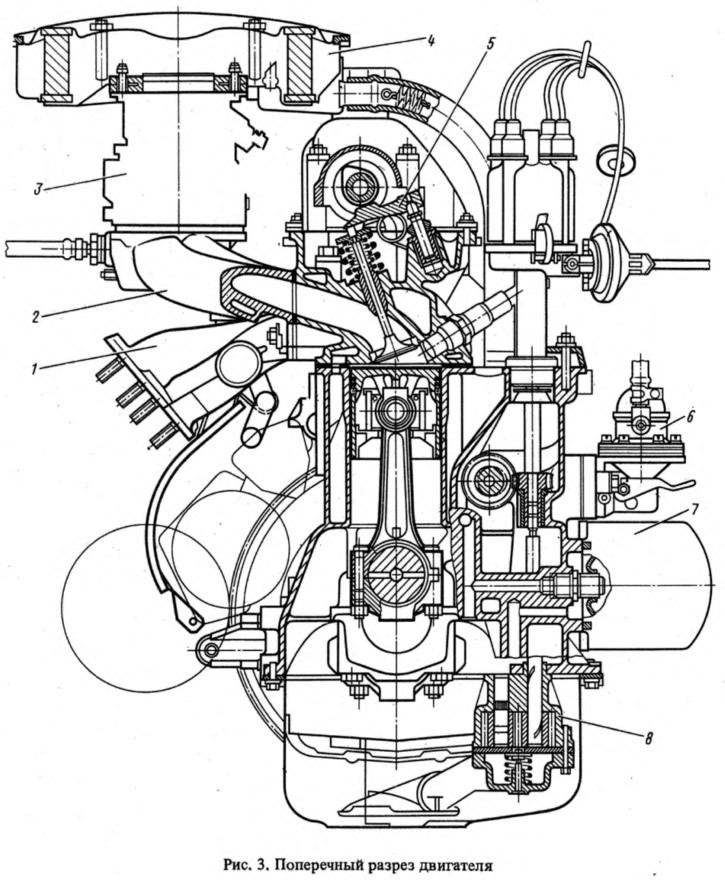
Engine lubrication system - combined (under pressure and splashing); includes a full-flow oil filter 7 with a paper filter element through which all the oil passes. Oil pump 8 is gear.
The engine cooling system is liquid, closed type, with forced circulation of liquid and expansion tank. The system is filled with a special cooling liquid that freezes at low temperatures.
The fuel system includes: fuel tank, fuel pump 6, air filter 4, intake pipe 2, carburetor 3 and exhaust tract. Equipped with pneumatic economizer (econostat) and a diaphragm accelerator pump ensures high throttle response, efficiency, confident start and stable operation of the engine immediately after starting. The air filter is a dry type with a replaceable paper filter element, which has a layer of synthetic cotton wool on the outside for preliminary air cleaning. The filter is reliable in operation, provides high-quality air cleaning and does not require maintenance.
The exhaust tract includes an exhaust manifold 1 and two mufflers puma exhaust (primary and secondary).
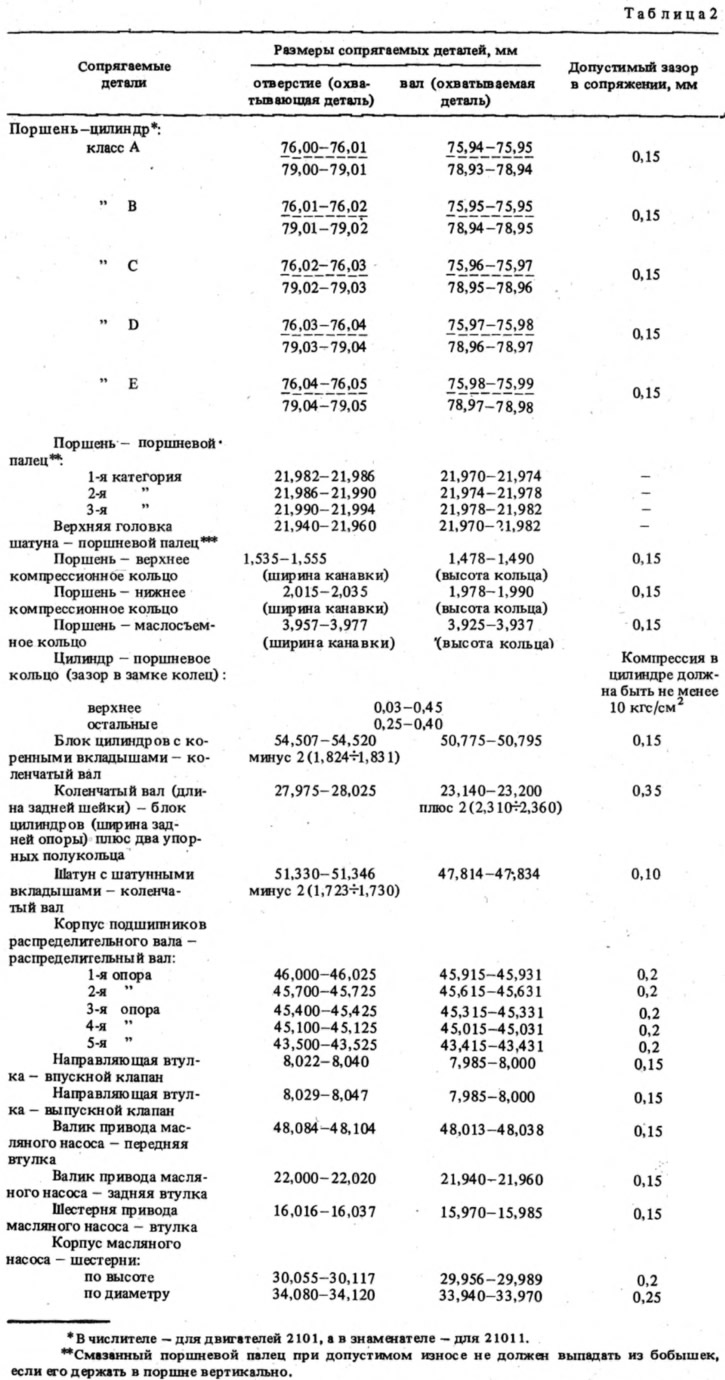
The dimensions of the main mating parts of the engine and the limits of permissible contributions during operation are given in Table 2.
The original is on the portal: VAZbook