




1. Prepare the car for work (see "Preparing the car for maintenance and repair").
2. Check and, if necessary, adjust the timing valve drive clearances (see "Adjusting the valve timing drive clearances").
3. Warm up the engine to operating temperature and turn off the ignition.
4. Remove the fuses of the ECU and engine control system circuits (see "Engine Management System Relays and Fuses").
5. Unscrew the spark plugs (see "Spark plugs - checking and replacement").
6. Install the compression gauge into the spark plug hole of one of the engine cylinders.
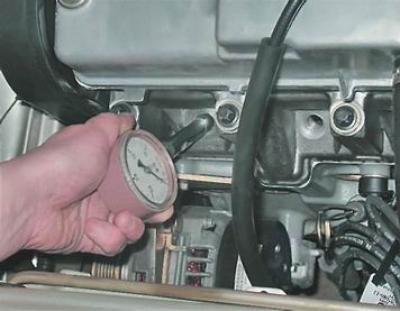
7. The assistant presses the gas pedal all the way to the floor (to fully open the throttle valve) and turns on the starter for 5-10 s.
Note: Measurements must be taken with a fully charged battery, otherwise the readings will be incorrect.
8. Remember or write down the compression meter readings and reset the device.
9. Similarly, we measure the compression in the three remaining cylinders.
In a serviceable engine, the compression in the cylinders should be at least 1.0 MPa (10 bar), and the difference in compression between the cylinders should be no more than 0.1 MPa (1.0 bar).
10. If the compression is lower, then using a medical syringe or oiler, pour about 10 cm³ of motor oil into the spark plug holes of the engine cylinders with low compression.
The information is published on the website: VazBook.ru
11. Repeat the compression test. If the compression has increased, then the rings may be stuck or the piston group may be worn out (see "Piston rings and connecting rod bearings - replacement"). Otherwise, the valves do not close tightly or the cylinder head gasket is faulty.
Recommendation: You can try to eliminate valve sticking with special preparations poured into the fuel tank or directly into the engine cylinders (see the "Instructions" for the preparation). The tightness of the valves can be checked with compressed air under a pressure of 0.2-0.3 MPa (2-3 kgf/cm³), supplied through the spark plug holes. Air must be supplied with the camshaft in such a position that both valves of the cylinder being checked are closed. If the exhaust valve is faulty, air will come out through the exhaust system, and if the intake valve is faulty, through the throttle assembly. If the piston group is faulty, air will come out through the oil filler neck. The release of air bubbles through the coolant in the expansion tank indicates a faulty cylinder head gasket.