




Make sure that the steering wheel spoke is horizontal when the wheels are set to the straight-ahead position. If not, determine the cause of the malfunction and correct it.
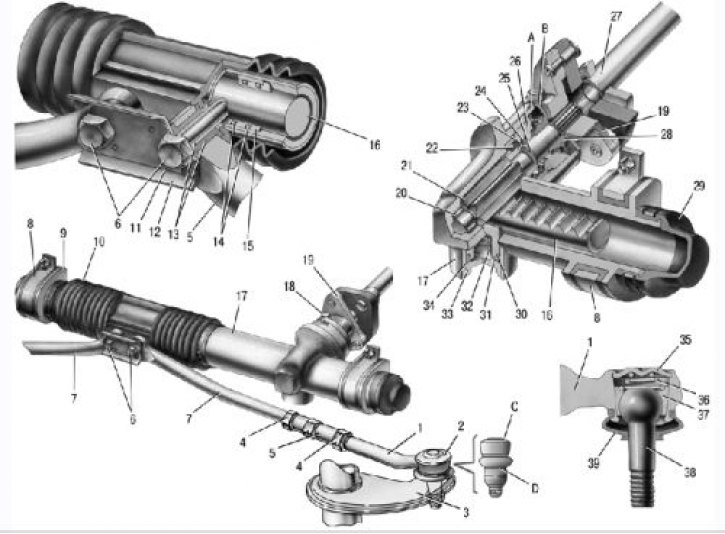
Steering gear assembly with drive: 1 – steering rod end; 2 – ball joint of the tip; 3 – rotary lever; 4 – lock nut; 5 – traction; 6 – bolts for fastening the steering rods to the rack; 7 – inner tie rod ends; 8 – steering gear mounting bracket; 9 – steering gear support; 10 – protective cover; 11 – locking plate; 12 – connecting plate; 13 – rubber-metal hinge; 14 – damping rings; 15 – rack support sleeve; 16 – rack; 17 – steering gear housing; 18 – tension bolt; 19 – elastic coupling flange; 20 – roller bearing; 21 – drive gear; 22 – ball bearing; 23 – retaining ring; 24 – protective washer; 25 – sealing ring; 26 – bearing nut; 27 – intermediate steering shaft; 28 – boot; 29 – protective cap; 30 – stop sealing ring; 31 – rack stop; 32 – spring; 33 – stop nut; 34 – retaining ring of the stop nut; 35 – plug; 36 – liner spring; 37 – ball joint insert; 38 – ball pin; 39 – protective cap; A, B – marks on the dust cover and crankcase; C, D – surfaces on the ball joint and the pivot arm.
While turning the steering wheel from lock to lock, check the following visually and audibly:
- reliability of fastening of the steering gear and steering wheel;
- absence of clearance in rubber-metal hinges 13, in hinges 2 of steering rods and in riveted and splined joints of the elastic coupling of the steering shaft;
- reliability of tightening and locking of bolts 6 fastening rods to the rack and nuts of ball joint pins 2;
- absence of jamming and interference that prevents the steering wheel from turning.
If knocking or binding is detected, disconnect the transverse rods from the pivot arms of the telescopic suspension struts and repeat the check.
Once you have confirmed that the knocking and sticking noises are coming from the steering, remove it from the vehicle and check the clearance between the rack stop and the nut (see "Checking the gap between the rack stop and the stop nut"). The maximum allowable gap between the stop and the nut is 0.2 mm. If necessary, replace worn parts and adjust the gap between the stop and the nut.