




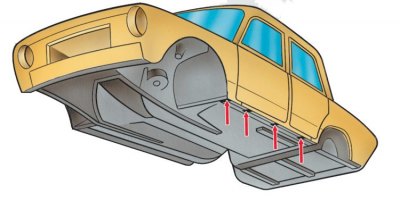
Drainage holes of thresholds |
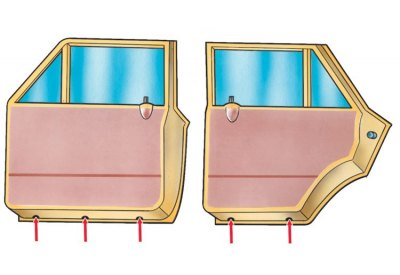
Door drainage holes |
The body is the basic and most expensive element of the car. It is made of modern materials and protected from corrosion by high-quality protective agents. The basis for the durability of corrosion protection is laid by the manufacturer, but its effectiveness and duration depend on proper care, climatic conditions, environmental conditions and storage conditions.
To avoid scratches on the paintwork, do not remove dust and dirt with a dry wiping material. It is better to wash the car before the dirt dries with a low-pressure stream of water using a soft sponge. In summer, wash the car outdoors in the shade. If this is not possible, then immediately wipe the washed surfaces dry, since when water droplets dry in the sun, stains form on the painted surface. In winter, after washing the car in a warm room, wipe the body and door seals dry before leaving, since when the remaining drops freeze, cracks may form in the paintwork and the seals may freeze to the doors. It is not recommended to use soda and alkaline solutions, as well as waste water, to wash the car, so that the coating does not fade.
Before washing the car, clean the drainage holes of the doors and thresholds. When washing the car, avoid direct water jets on electrical equipment, electronic devices, sensors and detachable connections in the engine compartment. Monitor the condition of the protective covers of the detachable connections of electronic units and sensors. If moisture gets into the detachable connections, blow them with compressed air and treat them with the car preparation "Unisma-1" in an aerosol package to protect the contacts from oxidation.
When washing, thoroughly wash the door flanges, hood, trunk lid, welded seams and joints of the engine compartment, trunk and door openings, since accumulated dirt in these areas will lead to the destruction of the protective and decorative coating and to metal corrosion.
If signs of corrosion are detected (corrosion deposits, local paint blisters, etc.) clean the damaged area with fine sandpaper until the metal is clean, treat with the cold phosphating agent "Phosphacor" for cars, cover with GF-021 primer and paint over with enamel from the included jar.
Chips and scratches on the paintwork, chipped mastic on the wheel arches and on the bottom are associated with mechanical impact of an operational nature. Traces of corrosion on welded joints and joints of body parts are superficial in nature and at the initial stage can be removed by polishing with PMA-1 or PMA-2 pastes. If measures are not taken in a timely manner to eliminate defects of the protective and decorative coating of an operational nature, this will lead to the development of corrosion under the coating layer, its peeling and swelling.
To increase the corrosion resistance of the body, a special anti-corrosion compound is applied to the closed box-shaped cavities of the thresholds, side members, cross members and other elements of the body base. When operating the car, we recommend restoring the protective coating of the hidden cavities of the body at maintenance facilities periodically once every 1.5–2 years.
During vehicle operation, the underbody coating is exposed to gravel, sand, and salt. As a result of this exposure, the mastic and primer wear off, and the exposed metal rusts. Therefore, regularly monitor the condition of the underbody coating and promptly restore damaged areas.
Before applying protective coatings (soils, mastics) treat rusty surfaces with "Feran" compound.
To maintain the shine of painted surfaces of the car (especially for vehicles stored outdoors) polish them regularly using polishing pastes. These pastes close microcracks and pores that have appeared in the paint coating during use, which prevents corrosion from occurring under the paint layer.
To ensure that the car body surface retains its shine for a long time, do not leave the car in the sun for a long time, and do not allow acids, soda solutions, brake fluid and gasoline to come into contact with the car body surface.
To prevent stains on the paintwork under the fuel filler flap from gasoline, wipe the surface with a clean cloth before and after refueling.
Wipe plastic parts with a damp cloth. It is not recommended to use gasoline or solvents, otherwise the plastic parts will lose their shine. Of the auto products for cleaning plastic parts, we recommend using the universal interior cleaner "Dinta" or the auto product "Alva".
Remove dust from the upholstery of cushions and seats with a vacuum cleaner. To remove greasy stains on the upholstery, use the universal interior cleaner "Dinta" or neutral soap with water. At the same time, carefully wipe the rubber seals and the surfaces of the doors and trunk lid that come into contact with them with a damp cloth.
Clean the glass with a soft linen cloth or chamois. Wash very dirty glass first with water and windshield washer fluid (30 cm³ per 1 l of water).
Due to the unfavorable environmental conditions in some areas, there are cases of aggressive impact of individual components from the environment on the protective and decorative coatings of the car. These effects are manifested in the form of a red rash, local change in the color of the external paintwork, local destruction of the enamel coating of the body.
The cause of the appearance of red rash is the deposition of tiny particles of airborne metal dust on the horizontal surfaces of the body, which is glued to the body by corrosion products during wetting with dew. Red rash can be removed with a 5% solution of oxalic acid, followed by abundant rinsing with clean water, after which the body must be polished. Without special measures, it is gradually removed by subsequent washing or rain.
Local changes in colour (spots) of the external paintwork and local destruction of the enamel coating of the body are the result of exposure to acidic industrial emissions after their combination with air moisture. Such effects, depending on the severity, are eliminated by polishing or repainting the body.