




Contents: Body frame ↓ Hanging units ↓
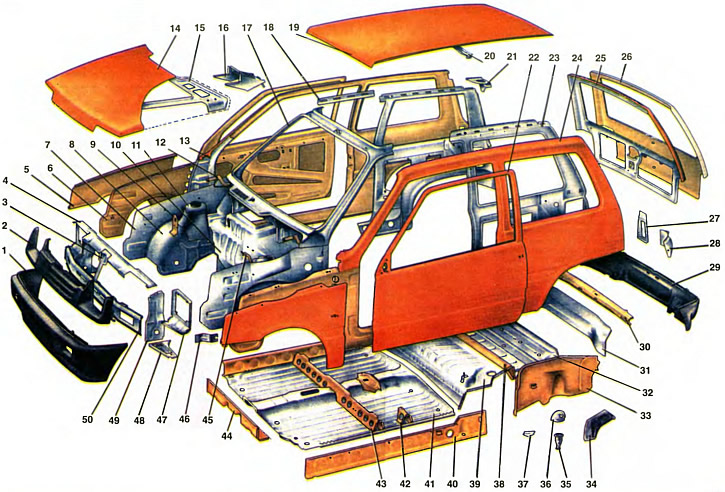
1. Front bumper. 2. Radiator grille. 3. Radiator frame strut. 4. Front upper cross member. 5. Front fender. 6. Front side member. 7. Mudguard panel. 8. Front fender mudguard. 9. Washer reservoir bracket. 10. Front shield. 11. Front suspension strut assembly. 12. Bonnet hinge. 13. Right outer side panel. 14. Outer bonnet panel. 15. Inner bonnet panel. 16. Steering column bracket. 17. Windscreen frame. 18. Upper side panel. 19. Roof panel. 20. Roof reinforcement. 21. Side panel and roof connector. 22. Front door. 23. Left inner side panel. 24. Left side outer panel of the side. 25. Inner panel of the tailgate. 26. Outer panel of the tailgate. 27. Outer panel of the side. 28. Bumper mounting bracket. 29. Rear bumper. 30. Rear crossmember. 31. Rear panel. 32. Rear floor. 33. Rear wheel arch. 34. Rear floor side member. 35. Rear suspension spring cup. 36. Spring support. 37. Arch reinforcement for shock absorber. 38. Center floor cross member. 39. Rear floor panel. 40. Door sill connector. 41. Front floor panel. 42. Front seat bracket. 43. Front bottom crossmember. 44. Front shield reinforcement. 45. Spare wheel carrier. 46. Front shield bracket. 47. Headlight housing. 48. Front cross member to mudguard connector. 49. Radiator frame pillar. 50. Front lower cross member.
The car body is a supporting structure, three-door, all-metal, welded.
The car has passenger and cargo-passenger body options. To convert the body into a cargo-passenger version, the rear seat folds down, increasing the area of the car's luggage compartment.
The front seats are separate with mechanisms for adjusting the backrest tilt and moving the seat forward and backward. The backrests of the front seats can also be folded out to form sleeping places. To seat passengers in the back seat, the backrests of the front seats tilt forward.
Windshield - three-layer, polished; the door and side glass is bent, polished and tempered. The windshield and rear door glass have wipers and washers.
The front and rear of the body are protected by energy-intensive bumpers. The front wings of the body are removable.
Ventilation and heating of the body interior are provided by outside air, which enters through the heater. The air duct system supplies air to the windshield, to the central part of the interior and to the driver's and front passenger's foot area. To heat the interior, the air is heated in the heater, the radiator of which is included in the engine cooling system.
The car body is also equipped with rear-view mirrors, a dashboard, sun visors, passenger handrails, seat belts, a rear shelf, and towing eyes. In the variant version, cars can be additionally equipped with a cigarette lighter, ashtray, and rear door glass heater.
The body frame ensures the safety of passengers in the cabin during impacts from the front, rear and sides by absorbing the impact. Among other passive safety elements, seat belts, soft upholstery of the instrument panel, rear-view mirror design and others play a major role. The fuel tank of the car is located under the floor of the body in a protected area under the rear seat.
Body frame
The main elements of the frame are the front, rear side panels, roof with windshield frame, rear panel, and frame strength elements (side members, cross members, pillars). The plumage parts include the front body panels (roof panel, outer side panels, front fenders, hood, doors and others).
All body components and parts, except for attachments, are connected into a single whole by contact spot welding, and heavily loaded parts are additionally welded by electric arc welding. Due to the reduction in the number of body parts and the use of large-sized panels, the number of welding points is significantly reduced compared to the bodies of other VAZ cars.
The front of the body consists of a front shield 10, mudguards 8 of the front wings, crossbars 4 and 50, struts 11 of the front suspension, struts 49 of the radiator frame, casings 47 of the headlights, amplifier 44 of the front shield and other small parts. Mudguards 8 have front side members 6. The front shield has a platform for the battery and brackets for fastening units and instruments of the engine and electrical equipment of the car.
The body floor includes three main parts: the front 41, rear 39 floor panels and the rear floor 32. The front floor panel is trough-shaped, in the middle of the panel there is a tunnel for the exhaust pipes, protecting them from damage. The rear floor has rear side members 34. The front 43 and middle 38 cross members are welded to the body floor.
The body sidewalls consist of external 13, 24 and internal 23 panels, made of solid parts with central and rear pillars, with openings of the front door and side windows. Linings 18, extensions 27, reinforcements, connector 21 of the sidewall and roof, arches 33 of the rear wheels and other small parts are welded to the sidewalls.
Roof panel 19 has a reinforcement 20. Windscreen frame 17 is welded to the panel at the front.
At the rear, panel 31 of the rear and crossbar 30 are welded to the sidewalls and floor 32 of the rear.
The following removable units are attached to the body: front fenders 5, front doors 22, tailgate, hood, front 1 and rear 29 bumpers, radiator grille 2 and others. The front fender is attached with six self-tapping screws: three along the upper flange of the fender to the mudguard, one screw at the front of the fender and at the bottom at the back, and one screw is attached to the front pillar, which can be accessed through the gap between the pillar and the open door. Insulating pads are installed under the front fender
The body plumage includes front fenders 5, outer panels 13 and 24 of the sidewalls, roof panel 19, outer panels 14 of the hood, rear 26 and side doors.
The main body parts are stamped from low-carbon steel 08kp, the outer panels - 08yu. The thickness of the main body parts is 0.8 mm. roof panels, rear, hood, front fenders - 0.7 mm; amplifiers - 1...1.5 mm; floor crossbars - 1.0 mm; front and rear suspension spring supports - 2 mm Various small body parts (connectors, brackets, extensions) stamped from steel with a thickness of 0.8...2.5 mm.
The body's power structure is made up of welded individual elements of panels and parts (side members, pillars, cross members), which protect the passenger compartment from deformation during impacts. The speed of the car is reduced by smooth deformation of the front and rear parts of the body.
To increase corrosion resistance, the surfaces of the black body are coated with a primer using the cathophoretic method. Under the paintwork, an epoxy primer is additionally applied to improve the adhesion of the surfaces to the paint. Hidden cavities of the body (front and rear side members, floor sills, bonnet and front door pockets, cavities under the front shield reinforcements, as well as between the side panels and rear wheel arches, between the mudguards and the front pillar reinforcements) are treated with anti-corrosion compounds such as HTM-ML or "Movil", "Movil-2". The bottom of the body, side members, inner surfaces of the front wings are additionally coated with plastisol grade D-11A. Plastisol D-11 A is used only at car factories, as it requires a high drying temperature. During the operation of the car, to restore the coating of the bottom of the body, anti-noise bitumen mastic BPM-1 is used, which dries at 18...20°C for 24 hours.
Hanging units
The front doors, tailgate and bonnet consist of outer and inner panels, connected to each other by bending the flanges.
The front doors open in the direction of the vehicle. The front end of the door is reinforced with an extension. The door is hung on two hinges, the movable links of which are welded to the extension, and the fixed ones are attached with special bolts to the front pillar of the body. It is possible to adjust the gap between the door and the body within small limits using enlarged holes in the fixed links of the hinges. The front doors are equipped with cable window lifters, locks with a lock and door opening limiters.
The tailgate is also hung on two hinges, which are bolted to the rear edge of the body roof. To access the bolts, it is necessary to remove the top of the door seal and the rear part of the roof trim. With a one-piece molded roof trim, there are holes in the trim for access to the bolts, covered with plugs, and removing the roof trim is not required. Enlarged holes in the fixed links of the hinges and the installation of adjusting linings under them allow you to adjust the position of the door in the body opening.
The hood is hung on the rear edge of the front of the body on hinges. In order for the hood to have the same gaps with the front fenders and to prevent the front surfaces from sinking or protruding, the position of the hood is adjusted by shifting the hinges in the enlarged holes in the hood for their fastening, as well as by changing the position of the rubber buffers in height. Bending of the hinges is allowed during adjustment.
The bumpers are made of frost-resistant polypropylene. The front bumper 1 is attached at the front with two bolts, at the top with two latches and at the ends with nuts of the side holders. The rear bumper 29 is attached to the body with bolts and side holders.
The 2nd radiator grille is made of polypropylene and is attached to the front of the body with ten screws using flange nuts: six screws at the front, two screws on the sides of the grille at the top and two screws on the lower edges.