




Contents: Rotary type front door locks ↓ Rear door locks ↓ Window lifters ↓ Hood lock ↓ Trunk lid lock ↓ Tailgate lock ↓ Seats ↓ Body sealing ↓
Open large image in new tab »
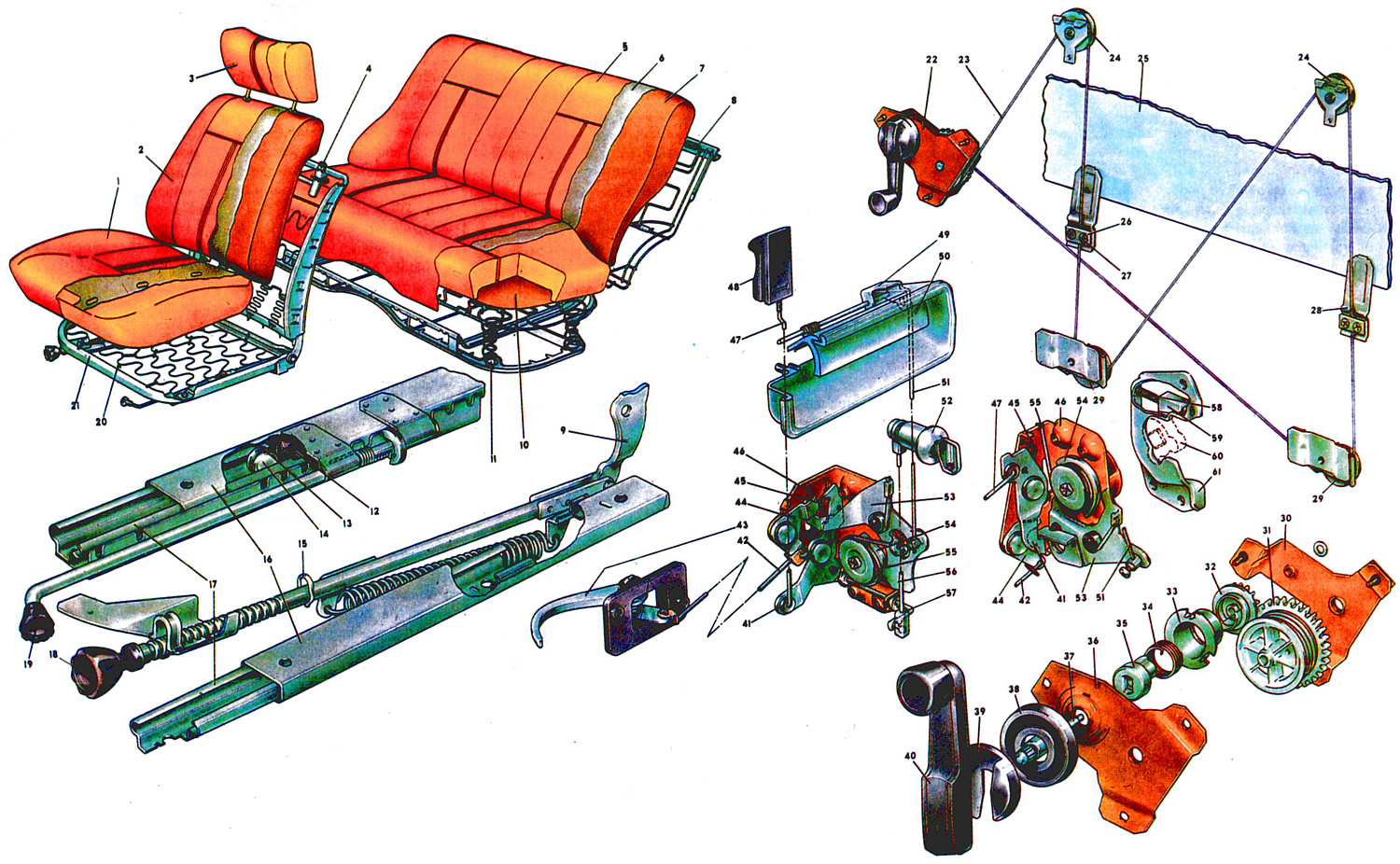
Fig. 36: 1. Seat cushion. 2. Seatback. 3. Headrest. 4. Headrest guide. 5. Upholstery. 6. Upholstery support. 7. Padding. 8. Rear seatback frame. 9. Front seatback reinforcement. 10. Cushion padding lining. 11. Seat cushion fixing hole. 12. Runner stopper. 13. Roller ring. 14. Roller. 15. Split pin. 16. Runner sliders. 17. Runner guides. 18. Backrest tilt adjustment screw. 19. Runner latch handle. 20. Cushion spring. 21. Front seat frame. 22. Window regulator. 23. Cable. 24. Upper roller. 25. Lowering window. 26. Pressure plate. 27. Pressure plate fastening screw. 28. Rear bracket of the lowering window. 29. Lower roller. 30. Window regulator housing. 31. Drum with driven gear. 32. Drive gear. 33. Drive shaft support. 34. Brake spring. 35. Brake spring driver. 36. Window regulator housing cover. 37. Drive shaft. 38. Socket. 39. Trim, handles. 40. Window regulator handle. 41. Lock lock lever. 42. Inner lock drive rod. 43. Inner door handle. 44. Inner lock drive lever. 45. Lock lever spring. 46. Lock housing. 47. Button rod. 48. Lock lock button. 49. External lock drive rod. 50. External lock handle. 51. External drive rod. 52. Door lock switch. 53. External drive lever. 54. Lock ratchet. 55. Spring. 56. Lock switch rod. 57. Lock release shaft. 58. Cracker spring. 59. Lock cracker. 60. Lock rotor. 61. Lock clamp housing.
Rotary type front door locks
The teeth of the rotor 60, mounted on the central shaft, when the door is closed, run onto the teeth of the retainer and turn the shaft and the ratchet 54 mounted on it, which is locked by the projection of the lever 56 of the external drive under the action of the spring 55. When the door is completely closed, the second tooth of the rotor 60 enters the second recess of the retainer, and the support at the end of the central shaft (not shown in the picture) comes into contact with the cracker 59 of the retainer and, by selecting a gap, prevents the vertical movement of the door when the car is moving. At the same time, the support does not allow the door to open spontaneously in the event of a collision or rollover of the car, when, due to deformation of the door or body, the rotor of the lock tends to disengage from the retainer in the longitudinal direction of the car. The support, going behind the walls of the retainer, blocks the movement of the door. The door retainer is secured with three bolts to the body pillar. Enlarged holes in the pillar allow you to adjust the position of the retainer in height and ensure its alignment with the lock, as well as in depth to ensure complete adhesion of the door to the seals and the location of the door flush with the outer surfaces of the body. Ratchet 54 has two teeth that provide preliminary and complete locking of the lock. This prevents spontaneous opening if the door is not completely closed. When the door is opened, the ratchet returns to its original position by spring 55.
The door is opened by the outer handle 50 via the leash 49, the force from the leash is transmitted via the rod 51 to the lever 56 of the outer drive, which turns and releases the ratchet. The door opens under the pressure of the compressed seal. The lower end of the rod 51 is locked with a screw on the lever of the outer drive. From the passenger compartment, the door is opened by the handle 43 of the inner drive, mounted on a bracket, which is secured with two screws on the inner panel of the door. By loosening the screws, it is possible to move the bracket with the handle to the desired position. The force from the handle 43 is transmitted via the rod 42 to the lever 44 of the inner drive, which in turn presses the lever 56, releases the ratchet, and the door opens.
The lock can be blocked by button 48 to prevent access to the passenger compartment from the outside. When button 48 is pressed with the door closed, rod 47 turns locking lever 41 to a position in which lever 56 of the external drive is blocked by a groove in lever 41. When the front door is open, the lock does not operate and, in order to avoid damaging the lock, it is prohibited to press the button. The locking button is installed on the threaded end of rod 47 using a bracket. The position of the button is adjusted by moving the bracket to the next turns of the rod thread. From the passenger compartment side, the button groove and the bracket inserted into it are covered with a cap. The lock locking buttons are located in the most convenient places for the driver near the central pillars.
The locked front door lock can be released by lifting the button 48, or pulling the handle 43, or the switch 52 of the lock. When turning the key of the switch, the leash of the latter acts through the rod 57 on the shaft. The shaft turns the lever 41, which with its groove locks the lever 56 of the external drive when the lock is closed. When turning the key in the opposite direction, the lever 41 releases the lever of the external drive and returns the button to the upper position. By pulling the handle 43 of the internal drive, the force is transmitted through the rod 42 to the levers 44 and 41, releasing the lock and returning the lock button to the upper position.
Rear door locks
Unlike the front doors, the rear door locks can be locked both when the doors are closed and when they are open (the button can be pressed when the door is open and then closed). The lock can only be unlocked by lifting the lock button. This ensures the safety of passengers in the rear seat.
The front and rear door locks comply with safety requirements. The handles of the internal drive are positioned in such a way as to exclude the possibility of opening the doors if accidentally touched. The external handles do not have protruding parts. The design of the lock retainers prevents spontaneous opening of the doors in collisions and rollovers.
The door opening limiter fixes its maximum opening preventing deformation of the outer door panel. The limiter has a steel rod, the front end of which is connected with a pin to the lugs of the plate welded to the body side pillar. The rod passes through a plastic housing secured with two bolts to the door. The housing contains two steel balls, which are pressed against the rod by a spring. The free end of the rod is riveted, a steel washer is installed on it, in front of which a rubber buffer is located, limiting the maximum opening angle of the door. On the limiter rod there are two pairs of figured protrusions, which, when the door is opened, move the balls apart and allow fixing the full and intermediate positions of the door opening.
Window lifters
The front door window regulator is cable-operated and is secured with three nuts on the inner door panel. Four rollers 24 and 29, which the window regulator cable covers, are secured on brackets. The front lower roller 29 tensions the cable. To do this, pre-tighten the tension roller bolt with the nut and, by striking them through a special device, shift them along the groove on the inner door panel. After tensioning, the bolt is finally tightened. The total length of the cable after stretching is 2930±5 mm. The cable is wound on a drum 31, the toothed crown of which is in engagement with the drive gear 32. In the support 33 of the drive shaft 37, coaxially with the gear 32, a spring brake is placed, which prevents the spontaneous lowering of the glass. On the vertical sections of the cable, using two screws 27 and pressure plates 26, brackets 28 of the lowering glass are secured. The drop glass is placed in guide grooves, which are secured with bolts to the door panel.
The window lifter handle 40 is installed on the splined end of the drive shaft 37 and secured with the trim 39 in the groove of the shaft. A plastic socket 38 is installed under the handle, which is pressed against the trim by the door trim. To remove the window lifter handle from the shaft, it is necessary to first move the trim 39 along the handle and remove the handle with the trim.
Hood lock
The hood lock is secured to the air intake box with two nuts. The lock housing is stamped from sheet steel. At the top, in the middle part, the housing has a special cutout for fixing the lock pin welded to the hood and holding the hood from transverse displacements. A hook and a hood ejector are mounted on the housing on axles, which are tightened by a single spring.
When closing the hood, the pin of the lock on the hood presses the hook due to the oblique cut and sinks the ejector, stretching the spring. The hook, under the action of the spring, grabs the pin. When acting on the handle, the wire rod, located in a plastic casing, pulls the hook and unlocks the lock. The ejector, under the action of the spring, lifts the hood above the surface of the body, allowing it to be further opened by hand. The handle of the lock drive is installed on the bracket under the instrument panel on the left side.
The bonnet lock is adjusted by moving the lock using the enlarged oval holes in the lock body.
Trunk lid lock
The trunk lid lock has a plastic housing attached with two nuts to a bracket on the inner panel of the lid. The rotor and lever are mounted on axles in the housing, which are acted upon by a spring. The rotor and lever axles are riveted in the lock cover.
When closing the trunk lid, the rotor rotates by pressing the lock. At the same time, the lower arm of the lever, under the action of the spring, engages with the rotor tooth and fixes the closed position of the lock. The lock enters the groove of the housing and fixes the trunk lid from vibrations and lateral displacements. The lock is welded to the plate, which is fastened with two nuts on the studs of the cross member of the rear body.
To open the lock, the cylinder with the drive extension is turned with a key; the extension turns the lever by the upper arm and releases the rotor.
Normal operation of the lock can be adjusted by rearranging the lock or* retainer using the enlarged holes in the housing and retainer plate. Having outlined the contours of the lock housing and retainer plate and having loosened the fastening nuts, they are moved in the desired direction, after which the nuts are finally tightened.
Tailgate lock
The VAZ-2104 tailgate lock consists of a housing made of zinc alloy. The housing contains a hook with a spring; a drive with a button and a cylinder locked with a key. The hook engages with the tooth of the latch, which is fixed to the crossbar of the rear of the body. To prevent door vibration, the lock has a special pin, which, when the door is closed, enters the conical socket on the upper part of the latch. The chrome-plated handle is also made of zinc alloy. Normal operation of the lock is regulated by rearranging the lock or latch due to the enlarged holes in the lock body and latch.
Sun visors are mounted above the windshield and can be rotated both horizontally and vertically to provide protection from direct and lateral sunlight. The visors have a wire frame and are lined with a film similar to the roof lining film; there are foam pads between the film and the frame. The driver's sun visor has a pocket for documents.
The passenger handrails consist of a steel strip with a plastic lining of a shaped seat on it. They are fixed to the upper part of the side. The screws for fixing the handrails are covered with plastic decorative caps. There are plastic hooks for clothes on the rear handrails.
Seats
The front seats are separate with individual adjustment of the seat position and backrest tilt. Each seat is mounted on runners, along which it moves forward and backward within 175 mm, and when unfolded into a sleeping position within 325 mm (total travel of the sled).
The seat runners consist of guides 17 and sliders 16 stamped from sheet steel. The sliders can move along the guides on two rollers 14 each. A limiter 12 is installed between the rollers, preventing the rollers from coming together. A comb-shaped retainer is welded to the inner guide of each seat. The seat movement handle 19 is rigidly connected to the latch, which, under the action of a spring, enters one of the grooves of the retainer comb. When the handle 19 is pressed down, the latch is released, and the seat can be moved to the desired position. The seat runners are attached to brackets welded to the body floor. The seat back has a coarse and fine adjustment of the angle of inclination.
The backrest tilt adjustment mechanism is located on the outside of the seat and consists of a screw with handle 18 and a rod, a spring, a backrest reinforcement 9 and a lock welded to the front part of the cushion frame 21. The screw with handle 18 is screwed into the end of the rod. On the threaded section of the screw there is a cylindrical groove into which a cotter pin 15 is inserted through a groove. The cotter pin prevents the screw from being completely unscrewed from the rod. On the screw between the handle and its threaded end there are annular grooves that engage with the teeth of the lock. The rear end of the rod is connected with a pin to the lower end of the reinforcement 9 welded to the frame of the front seat back. The seat back is pivotally mounted on the frame 21 of the cushion and is fixed due to the rod and the lock. If the handle 18 of the screw is raised up (coarse adjustment of the backrest tilt), the screw comes out of engagement with the lock; the spring of the traction moves the screw with the traction relative to the lock back, and the backrest forward. The driver or passenger can press the backrest back to the desired position. When turning the handle (fine adjustment) the screw is held in place by the lock, and the rod for the amplifier 9 moves the seat back to a comfortable position.
The cushion 21 and seat back frames consist of thin stamped and wire metal frames. Wire springs 20, bent in the form of snakes, are attached to the frames of the cushion frame 21 using metal brackets. To avoid squeaking, the brackets and ends of the springs are covered with a layer of polyethylene. The back springs are connected to the frame with special plastic holders. Foamed polyurethane padding is installed on the cushion and seat back frame. In the first production cars, the back padding was made of coconut palm waste. The seat upholstery is made of artificial leather on a knitted base with a backing of synthetic welded wadding to obtain clear decorative patterns.
The front seats have headrests 3, adjustable in height and tilt. In the desired position, the headrest is held by spring clamps in guides 4 welded to the seat back frame. The headrest has a frame with two posts inserted into guides 4. Polyurethane foam padding is fixed to the frame and covered with upholstery. By turning the headrest relative to the posts, its position in terms of tilt angle changes.
The front seats can be folded down for rest. To do this, remove the headrests upwards from the guides 4, move the seat forward as far as it will go (seat travel 325 mm) and, lifting the handle 18, remove the screw from engagement with the lock, lay the seat back in a horizontal position or comfortable for rest.
To fold the seat back, lift handle 18, return the back to its original position and move the seat back, lower handle 18 down and engage the screw with the lock.
The rear seat of the VAZ-2105 consists of a separate backrest and a cushion. The cushion is installed on spikes welded to the crossbar of the body floor with two holes 11 in the frame. The seat back is fastened in the upper part with two strips that enter the brackets that are welded to the rear shelf. In the lower part, the back is fastened with two tongues that are welded to the wheel arches and bent onto the brackets of the lower corners of the backrest frame. The frames of the cushion and backrest are made of thin stamped and wire frames to which springs are attached with metal brackets. The brackets are covered with a polyvinyl chloride film to prevent the springs from squeaking. Padding 7 made of elastic polyurethane foam is installed on the cushion frame. Under the padding 7 of the cushion is placed a lining 10. The seat upholstery is made of artificial leather on a knitted base.
The rear seat of the VAZ-2104, unlike the VAZ-2105, can be folded to increase the luggage compartment area. The cushion and seat back are mounted on the body with hinges, which allow the cushion to be raised vertically, pressing it against the backs of the front seats, and the back to be laid in place of the cushion. The hinges are attached with screws to the crossbars of the body. The back in the unfolded position is fixed with two stops, which enter the brackets on the bottom of the cushion. In the passenger version, the back is locked with two clamps on the inner sides of the body.
To unfold the rear seat, lift the rear seat cushion to a vertical position. If necessary, move the front seats forward. Press the locking handles and place the backrest in place of the cushion so that the backrest stops enter the brackets. To return the seat to its original position, lift the seat back, fixing it in the normal position. Lower the cushion to a horizontal position.
Body sealing
Sealing is achieved by various rubber seals, sealing mastics, rubber plugs for process holes and careful adjustment of mating parts.
The air intake box is sealed from smoky air entering the passenger compartment from the engine compartment by a rubber seal installed on the upper flange of the box. The seal is secured by the elasticity of a perforated metal frame placed in the lower part of the seal.
The trunk lid in the opening is sealed with a seal made of sponge rubber and installed on the flanges of the drainage channels along the contour of the opening. The design of the seal is similar to the air intake box seal.
The door opening seals are made of sponge rubber with a branch to which a plastic edging with a metal frame is sewn, ensuring the seal is fastened to the door opening flanges. Non-drying mastic 51-G-7 is applied under the seal at the corners of the central pillars and door hinges.
The windshield and rear window glass are sealed with rubber seals that do not require the use of sealing mastics. The lower seals of the door drop-down windows are made of plastic, the profile of which ensures easy and reliable installation. To reduce friction, pile is glued to the seals of the drop-down windows. When water seeps under the seal, it flows to the bottom of the door and then pours out through the drain holes. The mechanisms of the lock, window lifter and the inner surface of the door trim are protected from water by a plastic film, which is attached to the door panel with spring holders.
The internal cavities of the pillars with an outlet to the outside are sealed against cold air and dust with rubber seals, which, when the body was heated during the drying of the paintwork, increased in volume and filled the internal cavities of the pillars. The internal cavities of the rear pillars are sealed with foam rubber and gaskets inserted inside the pillars.