




Open large image in new tab »
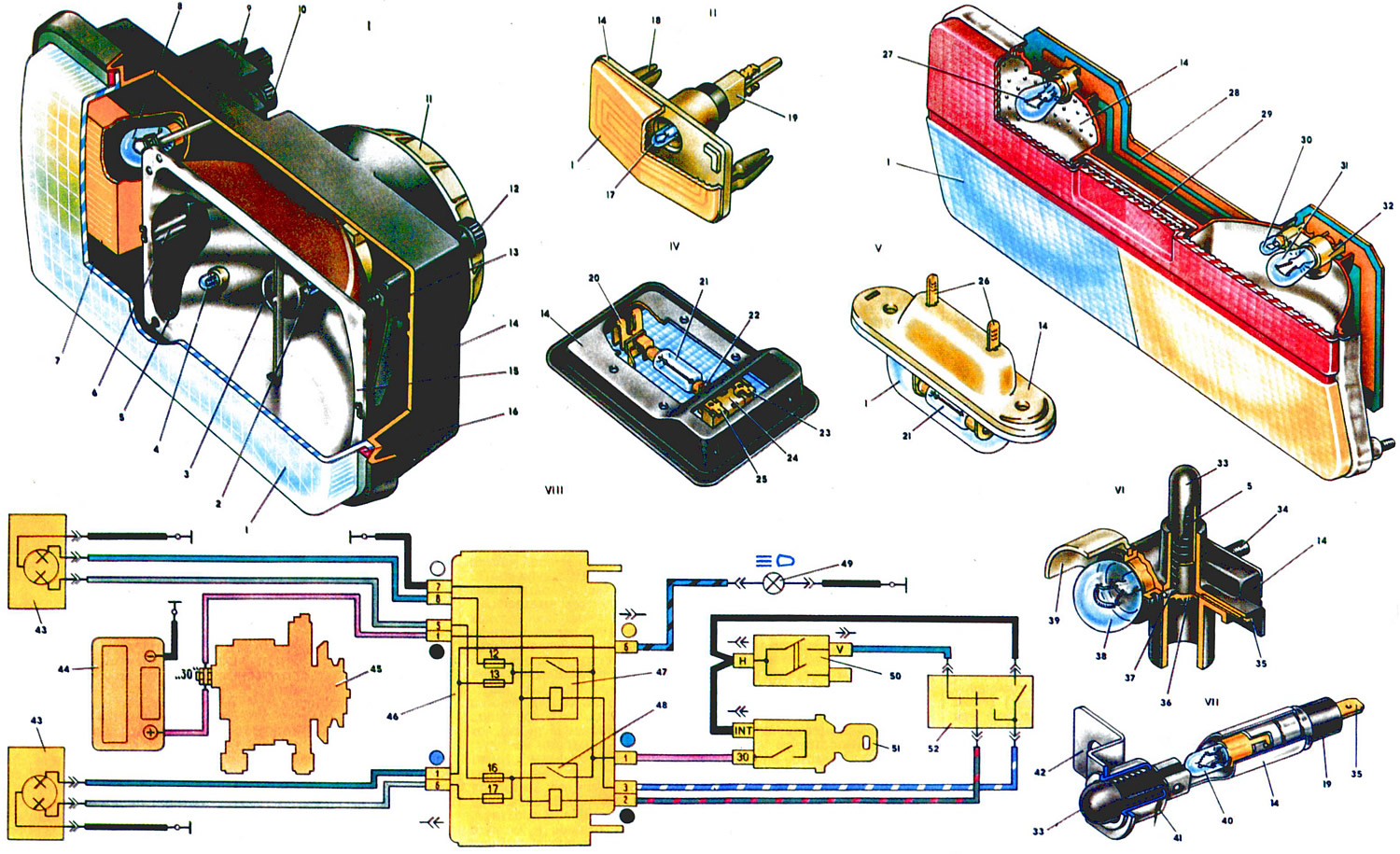
Fig. 32: 1. Diffuser. 2. AKG12-60+55 headlight bulb. 3. Lamp screen. 4. A12-4 side light bulb. 5. Return spring. 6. Stop. 7. Direction indicator lens. 8. A12-21-3 direction indicator bulb. 9. Socket for connecting the headlight hydraulic corrector. 10. Screw for adjusting the headlight beam in the vertical direction. 11. Casing. 12. Screw for adjusting the headlight beam in the horizontal direction. 13. Bracket. 14. Housing. 15. Reflector. 16. Glue for gluing and sealing the diffuser. 17. A12-4 bulb. 18. Holder. 19. Plug holder with lamp socket. 20. Post-plug for supplying voltage and fastening the lamp. 21. Lamp AC12-5. 22. Lamp post. 23. Plug for connection to ground. 24. Switch. 25. Plug for connection to the switches located in the door pillars. 26. Plugs-lamp holders. 27. Lamp A12-21-3 fog light. 28. Lamp A12-4 parking light. 29. Printed circuit board. 30. Reflector. 31. Lamp A12-21-3 brake signal. 32. Printed circuit board holder. 33. Button. 34. Lamp fastening bolt. 35. Plug for supplying voltage. 36. Contact washer. 37. Spring support pin. 38. Lamp A12-5. 39. Screen. 40. AMN12-3 bulb. 41. Button guide. 42. Bulb mounting bracket. 43. Headlights. 44. Battery. 45. Generator. 46. Mounting block. 47. High beam relay. 48. Low beam relay. 49. Speedometer with high beam indicator lamp. 50. Exterior lighting switch. 51. Ignition switch. 52. Headlight switch. I - Headlight. II - Side turn signal. III - Tail light. IV - Interior light. V - License plate light. VI - Underhood light. VII - Glove compartment light. VIII - Headlight wiring diagram.
Headlights
On VAZ-2105 and VAZ-2104 cars two block headlights are installed (right and left), combining headlights, direction indicators and parking lights. Headlights can be installed both domestically and in the Czechoslovak Socialist Republic. They have the same dimensions and characteristics, but differ slightly in design. Below are described headlights manufactured in the Czechoslovak Socialist Republic.
The design of the headlamp units provides an asymmetrical low beam that meets the requirements of UNECE regulations (United Nations Economic Commission for Europe). Each headlight is attached to the front of the body with four screws, which are screwed into special plastic holders that fit onto the edges of the headlight socket.
The low and high beam headlights are switched on by switch 52 located on the steering column, with the external lighting switch 50 turned on. In addition, by pulling the long lever of switch 52 towards you, you can briefly switch on the high beam headlights both with the external lighting switch on and off. This is ensured by the fact that the voltage to the contacts of the light signaling switch 52 is supplied directly from the "1XT" plug of ignition switch 51, bypassing the external lighting switch 50. In order not to damage the contacts of switch 52, the headlights are switched on via additional relays 47 and 48 of type 112.3747, located in the mounting block 46.
The headlamp has a black plastic housing 14, to which a glass diffuser 1 is glued in front with special glue. At the back, the housing is covered with a removable plastic casing 11. Thus, the internal cavity of the headlamp is isolated from dust and moisture. A reflector 15 with a headlamp lamp 2 and a parking light lamp 4 is installed in the housing 14. The wires from lamps 2 and 4 are connected to a plug connector installed on the back of the headlamp housing. On the outside of the headlamp there is a parabolic socket into which a cartridge with a side turn signal lamp 8 is inserted. This socket is covered with an orange plastic diffuser 7.
Reflector 15 headlights - steel rectangular. Its reflecting surface has the form of a paraboloid of large diameter, limited at the top and bottom by horizontal planes. The paraboloid concentrates the reflected rays of light into a beam, directing it along its axis if the lamp filament is at the focus of the paraboloid.
Due to the increased horizontal diameter, the rectangular reflector provides large angles of light beam dispersion in the horizontal direction. Therefore, with low beam, the right side of the road is better illuminated and the light beam in the direction of the eyes of oncoming drivers is reduced, which increases traffic safety. To create a mirror surface, the reflective surface of the reflector is coated with varnish and then with a thin layer of aluminum. This coating reflects up to 90% of the light falling on it.
Diffuser 1 is made of colorless glass with a high degree of transparency. Its outer surface is smooth, and on the inner surface there is a system of prisms and lenses that turn parts of the light beam in the horizontal direction and concentrate the light flow at the most critical points of the road.
A lamp 32 is inserted into the reflector from the back. The lamp is halogen, i.e. its bulb contains iodine vapor. Halogen lamps have increased luminous efficiency and almost 2 times longer service life than conventional lamps. In addition, the luminous efficiency of halogen lamps does not decrease over time, since they do not have tungsten deposition on the inner walls of the lamp bulb and it does not darken. Since the lamp heats up to high temperatures, it is necessary to ensure that the outer surfaces of the lamp bulb are always clean. It is especially necessary to avoid greasy fingerprints. For this purpose, it is recommended to wear gloves when replacing the lamp and degrease the glass of the lamp with alcohol, otherwise the lamp bulb will quickly darken and the lamp will fail.
The process that occurs in a halogen lamp is as follows. Iodine vapors come into contact with tungsten deposited on the walls of the lamp, and iodide tungsten is formed. This compound is unstable at high temperatures and, when it enters the hot filament zone, it decomposes into iodine and tungsten, which is deposited on the filament, and iodine moves to the walls of the bulb. Thus, when the lamp is switched on, there is a constant transfer of tungsten from the walls to the filament. Therefore, the filament thins more slowly, and the walls of the bulb remain clean.
Lamp 2 has two tungsten filaments: one (55 W) for low beam and the other (60 W) for high beam. The high beam filament is in the focus of the reflector, so the high beam rays are concentrated into a narrow beam directed almost parallel to the road and illuminating it well at the maximum distance from the car. The low beam filament is brought forward from the focus of the reflector and covered from below with a special metal screen. This is done in order to limit the spread of light upward. If you direct the low beam beam at a wall, the light spot will have the shape of an ellipse with the upper half cut off. The upper boundary of the illuminated area in the left part of the spot will pass exactly along the horizontal axis of the ellipse, and in the right part along the line emanating upward from the center of the ellipse at an angle of 15° to its horizontal axis. This shape of the light beam provides good illumination of the road in front of the car (especially its right side and the shoulder) and reduces the possibility of blinding oncoming drivers.
A screen 3 is installed in the reflector in front of the lamp. It holds back the direct light coming from the lamp filaments and provides a clearer boundary of the low beam. The flange of the lamp has projections that fit into the corresponding grooves of the reflector. Therefore, the lamp is installed in the reflector in a strictly defined position.
The direction of the headlight beam can be changed in the horizontal direction with screw 12, and in the vertical direction with screw 10. When screw 12 is rotated, bracket 13 moves the left edge of the reflector forward or backward, and it rotates relative to stop 6. When screw 10 is rotated, the reflector rotates relative to stop 6 and bracket 13 (i.e. relative to the horizontal axis). Spring 5 constantly pulls the lower right edge of the reflector back.
The headlight housing has a socket 9 for attaching the headlight hydrocorrector tip, which can be installed on some vehicles. The hydrocorrector allows the headlight beams to be moved vertically from the driver's seat. Such adjustment is desirable when the vehicle's front end is raised or lowered when the vehicle's load changes, and consequently the direction of the headlight beams changes.
Side direction indicators
Side direction indicators 19.3726 are attached to the front wings of the car with two elastic holders 18, cast in one piece with the housing. A PVC seal is installed under the indicator. The housing 14 of the indicator is plastic. A plastic orange diffuser 1 is also welded to the housing by ultrasonic welding. The holder 19 of the plugs with the lamp socket is inserted into the housing from the back of the indicator. A lamp 17 of the A12-4 type is installed in the indicator.
Ceiling light. Ceiling light type 15.3714 is installed to illuminate the interior of VAZ-2105 and VAZ-2104 cars. Ceiling light is attached to the roof of the car with two self-tapping screws. AC12-5 lamp is installed in the ceiling light.
The lampshade has a plastic housing 14 and a transparent plastic diffuser on which a switch 24 and a plug 20 with a contact for attaching the lamp are installed. Voltage is supplied to plug 20. Plug 23 is connected directly to the "ground", and plug 25 to the ground through switches in the door pillars. When the doors are opened, these switches close plug 25 to the "ground", and the lamp lights up. With the doors closed, the lamp can be turned on by the lampshade switch.
Number plate lights. Number plate lights type 12.3747 are installed at the rear of the trunk lid and are secured to it with two screws. They also illuminate the trunk when the lid is raised.
The flashlight has a plastic housing 14 and a diffuser 1, which is attached to the housing using a spring-loaded protrusion on the housing. Two holders-plugs 26 are installed in the housing for installing the lamp and connecting the wires.
Rear lights
The rear lights serve to indicate the dimensions of the car at night, to indicate a turn, to signal the brakes and to signal when the car is reversing. The rear lights are divided into right and left. The left light is a mirror image of the right. The lights are attached to the outer panel of the rear of the car with four screws. The same screws are used to attach the diffuser to the body of the light.
The body of the 14 lamp is made of metallized plastic and is divided by partitions into four chambers. On the outside of the car, the lamp has two chambers. The lower chamber contains the A12-21-3 turn signal lamp, and the upper chamber contains lamps 27 and 28. Lamp 28 of the A12-4 type is intended for the side light, and lamp A12-21-3 is for the fog light. In the middle lower part of the lamp, there is a reversing light chamber with lamp A12-21-3.
Diffuser 1 is three-color plastic: red in the area of the brake signal and side light cameras, orange in the area of the turn signal camera, and colorless in the area of the reversing light camera. In the middle upper part, a reflector 30 is welded to the diffuser using ultrasonic welding — a light-signaling device that reflects the light falling on it.
Underhood lamp
The PD-526 underhood lamp serves to illuminate the engine compartment. The lamp is attached with a bolt to the air intake box located in front of the windshield. The housing socket contains the A12-5 lamp, to replace which you need to lightly press button 33.
[The original can be seen on the website www.VAZbook.ru]
The lamp has a solid plastic housing 14, on the flange of which a plastic screen 39 is put on. Voltage is supplied to plug 35. A spring contact is put on bolt 34, the head of which is cast into the housing, connecting the central contact of the lamp with the "mass" of the car. Button 33 is hollow, plastic. Inside the button there is a return spring, the lower part of which rests on pin 37, pressed into the housing. On the lower part of the button there is a contact washer 36, closing plug 35 with the base of the lamp.
Glove compartment lighting lamp. The LV-211 type lamp is installed in the upper left part of the glove compartment and is secured to the instrument panel with a screw. The lamp has a mounting bracket 42, to which the guide for button 33 is welded. A housing 14 is riveted to the end of the plastic button 33, into which a socket 19 with a miniature AMN 12-3 bulb is inserted. To replace it, it is necessary to remove the socket with the bulb from housing 14. Voltage is supplied to the bulb through plug 35, and its base through socket 19, housing 14 and guide 41 is closed to the "ground" wire, the tip of which is clamped with the screw securing the bulb. The closed lid of the glove compartment, pressing the button, presses housing 14 away from guide 41, breaks the connection circuit with the "ground" and the bulb goes out.