




Open large image in new tab »
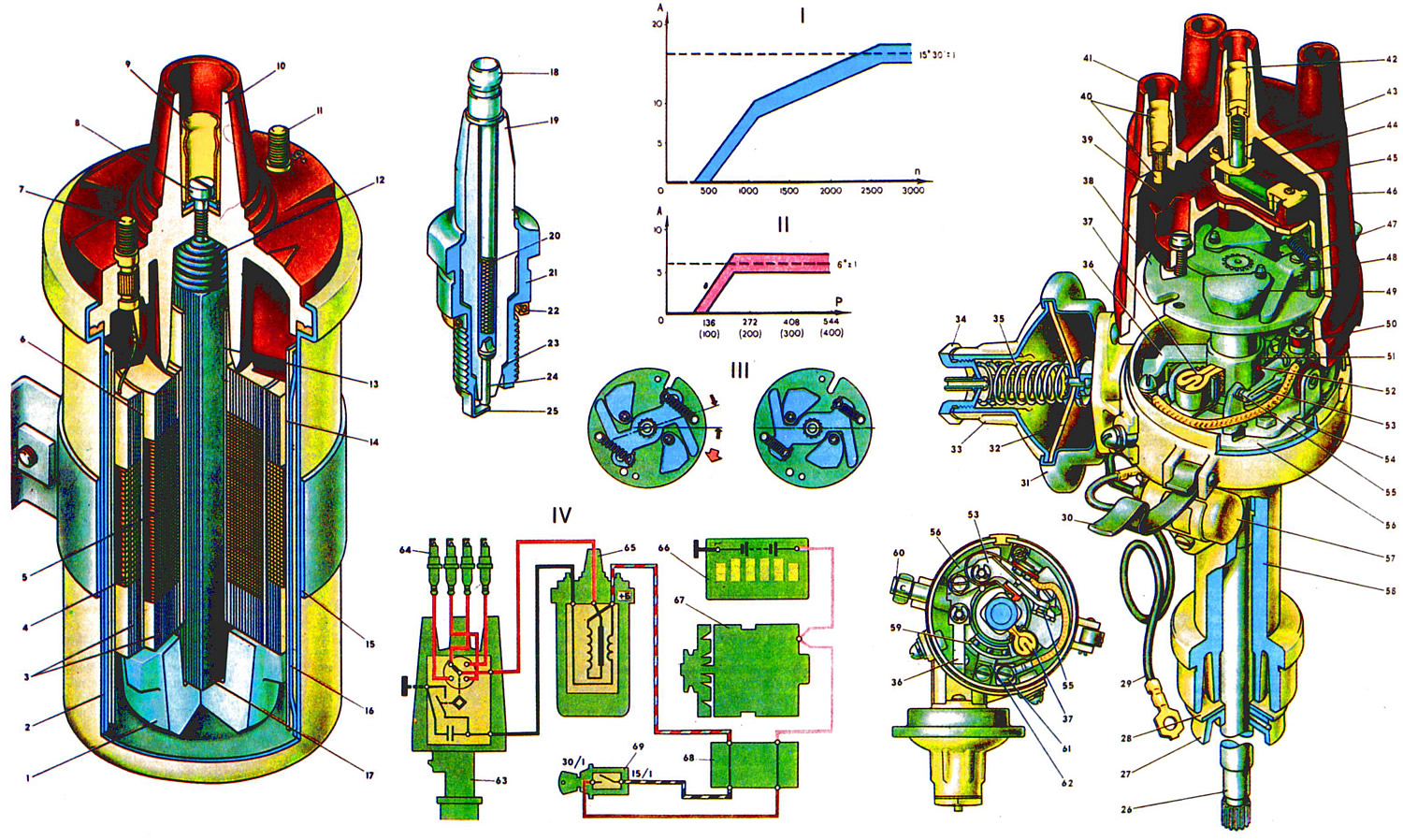
Fig. 31: 1. Insulator. 2. Ignition coil housing. 3. Insulating paper of windings. 4. Primary winding. 5. Secondary winding. 6. Insulating tube of primary winding. 7. Terminal of output of end of primary winding. 8. Contact screw. 9. High voltage terminal. 10. Cover. 11. Terminal "+B" of output of beginning of primary and end of secondary windings. 12. Spring of central terminal. 13. Frame of secondary winding. 14. Outer insulation of primary winding. 15. Fastening bracket. 16. Outer magnetic circuit. 17. Core. 18. Contact nut. 19. Spark plug insulator. 20. Rod. 21. Spark plug housing. 22. Sealing ring. 23. Heat-dissipating washer. 24. Central electrode. 25. Side electrode of spark plug. 26. Distributor shaft. 27. Oil deflector sleeve of shaft. 28. Washer. 29. Current supply wire to distributor. 30. Cover locking spring. 31. Vacuum regulator housing. 32. Diaphragm. 33. Vacuum regulator cover. 34. Nut. 35. Vacuum regulator spring. 36. Vacuum regulator rod. 37. Lubricating wick (felt) of cam. 38. Support plate of ignition advance regulator. 39. Ignition distributor rotor. 40. Side electrode with terminal for wire to spark plug. 41. Ignition distributor cover. 42. Central terminal for wire from ignition coil. 43. Central carbon electrode with spring. 44. Central rotor contact. 45. 5-6 kOhm resistor for radio interference suppression. 46. External rotor contact. 47. Centrifugal ignition timing spring. 48. Centrifugal timing drive leading plate. 49. Ignition timing weight. 50. Insulating sleeve. 51. Breaker cam. 52. Lever insulating block. 53. Breaker lever. 54. Post with breaker contacts. 55. Breaker contacts. 56. Breaker movable plate. 57. Capacitor 0.20-0.25 μF. 58. Ignition distributor housing. 59. Breaker movable plate bearing. 60. Oil can housing. 61. Terminal clamp screw. 62. Bearing retaining plate. 63. Ignition distributor. 64. Spark plugs. 65. Ignition coil. 66. Battery. 67. Generator. 68. Mounting block. 69. Ignition switch. I - Characteristic of the centrifugal regulator of the ignition distributor. A - ignition advance angle, degrees;. n - rotation frequency of the ignition distributor shaft, min⁻¹. II - Characteristic of the vacuum regulator of the ignition distributor. A - ignition advance angle, deg;. P - vacuum GPa (mm Hg.). III - Scheme of operation of the centrifugal ignition advance regulator. A - ignition advance angle, deg. IV - Scheme of the ignition system.
The ignition system components include the spark coil and spark plugs, ignition switch, distributor, and high and low voltage wires.
Ignition coil. The VAZ-2105 and VAZ-2104 vehicles are equipped with a B-117A ignition coil. It is located in the engine compartment and is secured with two bolts welded to the left mudguard. The ignition coil is used to convert intermittent low-voltage current (12 V) into high-voltage current (11-20 kV). The coil is a transformer on an "iron" core 17 and an annular external magnetic circuit 14. The core is located in a cardboard frame on which the secondary winding 5 is wound first, and the primary winding 4 is wound on top of it. The windings together with the magnetic circuit and the core are placed in an aluminum case and filled with transformer oil. The windings together with the core are mounted on a cup-shaped ceramic insulator 1. The coil housing is closed from above with a plastic cover 10, the flange of which is rolled into the housing and sealed with a gasket made of oil-resistant rubber. The terminals of the windings are connected to the terminals cast into the cover. The terminals of the beginning of the primary and end of the secondary winding are soldered to terminal 11, marked "+B", and the terminals of terminal 7 (without marking) soldered terminal of the end of the primary winding. Terminal of the beginning of the secondary winding (high voltage terminal) connected to the core plates and then, through spring 12 and screw 8, to terminal 9.
Spark plugs are designed to ignite the combustible mixture in the engine cylinders by a spark discharge between the electrodes. VAZ-2105 and VAZ-2104 cars use A17J1B spark plugs or similar foreign-made spark plugs. The letter A in the spark plug designation indicates that the thread of the screw-in part is M14x1.25. The numbers (17) characterize the glow number of the spark plug. The second letter (3) means that the length of the threaded part of the spark plug housing is 19 mm. The last letter B means that the thermal cone (skirt) of the insulator protrudes beyond the end of the housing. The gap between the spark plug electrodes should be 0.5-0.6 mm.
The spark plugs are of a non-separable design. A ceramic insulator 19 is rolled into a steel housing 21. A composite central electrode is located in the opening of the insulator, consisting of the electrode 24 itself, made of a heat-resistant chromium-nickel alloy, and a steel rod 20. This rod is filled in the insulator with a conductive glass sealant, preventing the breakthrough of gases through the opening of the insulator. The gap between the spark plug housing and the insulator is sealed by rolling the housing around the flange of the insulator, as well as a steel washer 23, which simultaneously serves to remove heat from the insulator to the housing, maintaining the temperature of the insulator skirt at a certain level.
The ignition switch is designed to turn on and off the ignition circuits and other consumers of electrical energy of the car. The ignition switch is mounted on a bracket on the left side of the steering column and secured with two screws.
The switch consists of a housing with a lock and an anti-theft device and a contact part. The principle of the anti-theft device is that after removing the key from the lock, set to position III (Parking), the locking rod of the lock extends, enters the groove of the steering shaft and locks the shaft. The key can be removed from the lock only in position III.
Until 1985, ignition switches used a contact part with push-button contacts. Its fixed contacts were closed by pressing movable conductive jumpers to them. Since 1985, a contact part with sliding contacts has been used. This contact part has brass posts-plugs with contacts installed in the socket.
The ignition distributor is used to interrupt the current in the low voltage circuit of the ignition coil and distribute high voltage pulses to the spark plugs. On VAZ-2105 and VAZ-2104 cars, the ignition distributor type 30.3706-01 is used. It is installed in the left front part of the engine and is driven by helical toothed gear 27 (see fig. 4), having a splined hole into which the distributor shaft tail is inserted.
The main parts of the ignition distributor are: the breaker, the centrifugal and vacuum ignition advance regulators and the distributor.
The interrupter consists of a cam 51 with four projections and a stand 54 with contacts that the cam opens when rotating. The cam is lubricated with a felt pad 37 soaked in oil. An axis is riveted to the stand, on which a lever 53 with a contact pressed by a leaf spring to the stand contact is mounted on a textolite bushing. The gap between the interrupter contacts should be 0.4±0.05 mm.
The support plate 38 of the centrifugal ignition advance regulator is soldered to the upper end of the cam bushing. The axles of the metal-ceramic weights 49 and the struts of the springs 47 are riveted to the plate. The other end of the spring is attached to the struts riveted to the plate 48 of the centrifugal regulator. When the engine is running, under the action of centrifugal forces, the weights diverge, rest against the plate 48 and, overcoming the resistance of the springs, turn the plate 38 (and therefore cam 51) clockwise relative to the distributor shaft.
The vacuum ignition advance regulator consists of a housing 31 with a cover 33, between which a flexible diaphragm 32 is clamped. On one side, a rod 36 is attached to the diaphragm, and on the other side, there is a spring 35, which presses the diaphragm with the rod in the direction of rotation of the cam 51. Under the action of the vacuum, the diaphragm bends and, through the rod, turns the plate with the breaker contacts counterclockwise.
The distributor consists of a rotor 39 and electrodes installed in a plastic cover 41. The central 44 and outer 46 rotor contacts are riveted to the rotor, between which a resistor 45 for suppressing radio interference is located in a special recess; a spring-loaded carbon electrode 43 rests on the central rotor contact, transmitting high-voltage pulses from the ignition coil to the rotor. When the rotor rotates, these pulses are transmitted from the outer contact 46 to the side electrodes 40, cast in the cover and then to the spark plugs.
High-voltage wires are used to transmit high-voltage current pulses from the ignition coil to the distributor and from the distributor to the spark plugs. To reduce radio and television interference, the wires have a resistance distributed along their length of 200 Ohm/m. The core of the wire, which is a linen cord, is enclosed in a sheath made of plastic with a maximum addition of ferrite. A 0.11 mm diameter wire made of nickel-iron alloy is wound over this sheath, 30 turns per centimeter. On the outside, the wire has an insulating sheath made of polyvinyl chloride.
Operation of the ignition system. The ignition system has a primary circuit (low voltage) and secondary (high voltage). The current in the primary circuit is closed along the path: "plus" of the battery 66 - contacts "30/1", "15" ignition switch 69 terminal "+B", primary winding of ignition coil 65 ignition distributor breaker 63 ground "minus" of storage battery. If the generator voltage is greater than the battery voltage, then the current goes from terminal "30" of the generator and closes through the ground to its rectifier. Otherwise, the current path is the same as described above.
Since 1986, an additional ignition relay of type 113.3747-10 has been installed on VAZ-2105 and VAZ-2104 cars. In this case, when the ignition is turned on, contacts "30/1" and "15" of the ignition switch close the power supply circuit of the relay winding. The relay is triggered and current flows through its closed contacts to the primary winding of the ignition coil. The relay is located under the instrument panel next to the ignition switch.
The current flowing through the primary winding of the ignition coil creates a magnetic field around the turns; when the breaker contacts open, the current in the primary winding disappears, the magnetic field sharply decreases and induces an EMF in them. In the secondary winding, the EMF reaches 12-24 kV, and in the primary winding, 200-300 V. The faster the magnetic lines of force cross the turns of the windings, the (i.e. the faster the magnetic field disappears), the greater the EMF induced in them.
EMF induced in the primary winding of the ignition coil (EMF of self-induction) tends to maintain the disappearing current and, therefore, slow down the reduction of the magnetic field. In addition, it causes sparking between the open contacts of the breaker. To prevent these phenomena, there is a capacitor 57 in the ignition distributor. If there were no capacitor, the disappearance of the magnetic force field would occur relatively slowly and the EMF in the secondary winding would not exceed 4000-5000 V.
The high-voltage current induced in the secondary winding of the ignition coil is closed along the path: secondary winding of the ignition coil - high-voltage wire, central terminal of the cover, central contact 44, resistor 45, external contact. 46 of the rotor, side electrode of the distributor cover, spark plug - "ground". Then, through parallel circuits, the current passes through the battery, generator, all switched-on consumers to contacts "30/1" and "15" of the ignition switch, and then to the "+B" terminal to the secondary winding of the ignition coil.
To obtain maximum power and efficiency of the engine, it is necessary to ignite the combustible mixture a little earlier than the piston reaches TDC, so that combustion ends when the crankshaft rotates 10-15° after TDC, i.e. the spark discharge must be created ahead of time. The initial ignition advance angle must be 5-7° before TDC. If the ignition is too early, the combustible mixture burns before the piston reaches TDC and slows it down. As a result, engine power decreases, knocks occur, the engine overheats and runs unstably at low idle speed. With late ignition, the combustible mixture will burn when the piston goes down, i.e. under conditions of increasing volume. In this case, the gas pressure will be lower than with normal ignition and the engine power will decrease.
In order for the fuel to burn in a timely manner, each engine speed requires its own ignition advance angle. This work is performed by a centrifugal ignition advance regulator. As the distributor shaft speed increases, the weights 49 rotate relative to the axes under the action of centrifugal forces. The edges of the weights rest against the leading plate 48 and, overcoming the tension of the springs, rotate the support plate 38 together with the breaker cam 51 by an angle of A. The cam projections open the breaker contacts earlier and the ignition advance increases. As the shaft speed decreases, the centrifugal forces acting on the weights decrease and the springs rotate the support plate 38 with the cam 51 against the direction of shaft rotation, i.e. the ignition advance decreases.
When the engine load changes, the residual gas content in the engine cylinders changes. At high loads, when the carburetor throttle valves are fully open, the residual gas content in the combustible mixture is low, so the mixture burns faster and ignition should occur later. When the engine load decreases, (throttle cover) the residual gas content increases, the mixture burns longer and ignition must occur earlier. The ignition advance angle is adjusted depending on the engine load by the vacuum ignition advance regulator.
The vacuum regulator diaphragm of the ignition distributor is subjected to a vacuum drawn from the area above the throttle valve of the primary chamber of the carburetor. When the throttle valve is closed (engine idle), the vacuum extraction hole is located above the edge of the throttle valve, so there is no vacuum and the vacuum regulator does not work. When the throttle valve is opened slightly, a vacuum appears, the diaphragm 32 is pulled back and by means of the rod 36 it turns the movable plate 56 of the breaker against the direction of rotation of the distributor shaft. The ignition advance increases. As the throttle valve opens further, (increase in load) the vacuum decreases and the spring presses the diaphragm back to its original position. The movable plate of the breaker turns in the direction of rotation of the distributor shaft and the ignition advance decreases.