




Open large image in new tab »
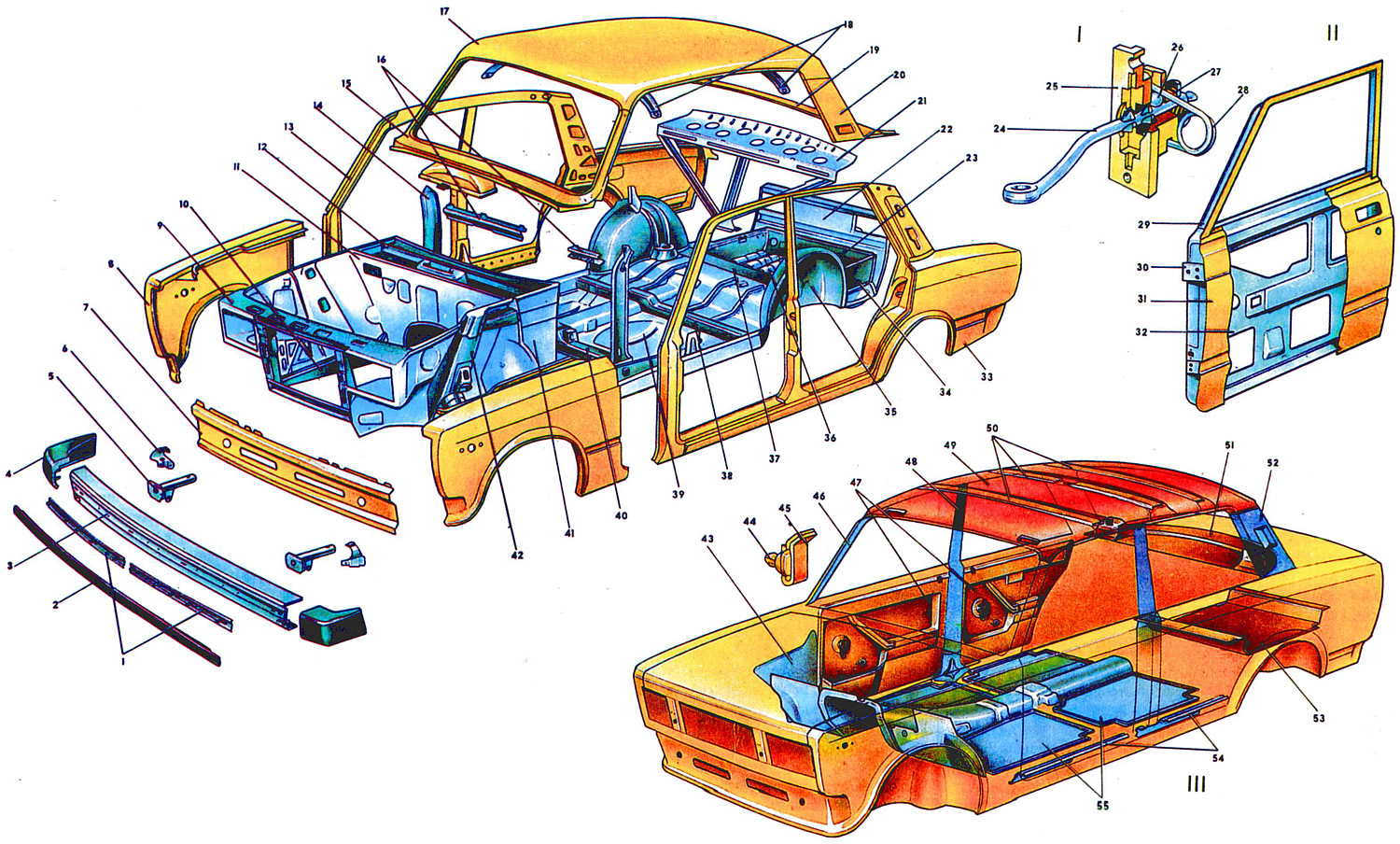
Fig. 34: 1. Trim holders. 2. Front trim. 3. Bumper beam. 4. Side trim. 5. Tubular extension. 6. Bracket. 7. Front trim panel. 8. Front wing. 9. Front cross member. 10. Front side member. 11. Front shield. 12. Air intake box. 13. Body side. 14. Front pillar trim. 15. Windscreen frame. 16. Instrument panel cross member. 17. Roof panel. 18. Roof reinforcements. 19. Rear window frame. 20. Side roof panel. 21. Rear shelf with diagonals. 22. Rear panel. 23. Rear lower cross member. 24. Door opening limiter rod. 25. Door opening limiter housing. 26. Stopper ball. 27. Buffer. 28. Stopper spring. 29. Door window frame. 30. Door hinge. 31. Front door outer panel. 32. Inner door panel. 33. Rear wing. 34. Luggage compartment side member. 35. Inner rear wheel arch. 36. Luggage compartment mooring. 37. Cross member above rear axle. 38. Cross member under rear seat. 39. Floor panel. 40. Cross member under front seats. 41. Front side panel. 42. Front wing mudguard with pillar assembly. 43. Front side panel trim. 44. Holder. 45. Door trim. 46. Windscreen pillar trim. 47. Door trim. 48. B-pillar trim. 49. Roof trim. 50. Gaskets. 51. Tailgate shelf trim. 52. Rear side roof panel trims. 53. Luggage compartment floor mat. 54. Trim runs. 55. Floor mats. I - Body frame. II - Front bumper. III - Door limiter. IV - Front door. V - Body interior trim.
The body of the VAZ-2105 car is a sedan type, metal, all-welded, load-bearing structure, four-door. Doors with drop-down windows. Door hinges are located in the front. Door locks and safety locks. Rear door windows with two glasses. Front and rear windows have panoramic glass. Windshield is three-layer, polished; rear - polished, tempered. All glass is of the safety type. The protruding parts of the body and interior are made safe (handles, levers, sun visors and other parts).
The outer surfaces of the body have no sharp edges or protrusions. To ensure safety while driving, the hood opens forward in the direction of travel. The outer and inner rear-view mirrors provide the driver with good visibility: the inner mirror is equipped with a device against blinding the driver from the headlights of the car behind. All bodies have the ability to install seat belts for all passengers. Welded nuts for the belts are located on the rear shelf, rear pillars, rear wheel arches and on the floor under the mat. The interior equipment of the cabin does not distract the driver's attention; there are no shiny parts, blinding lamps or glare from control devices in his field of vision; rotating soft visors above the windshield protect the driver's eyes from blinding sun rays.
The door locks can withstand heavy loads and prevent the doors from opening spontaneously when the car hits an obstacle. Adjustable headrests on the front seats prevent neck injuries from impacts when driving into a car from behind. A comfortable adjustable seat that holds the body during lateral acceleration, good thermal and noise insulation of the body, a highly efficient heating system, supply and exhaust ventilation of the cabin - all this dramatically reduces driver fatigue.
The body rigidity is selected in such a way that when the car collides with the front or rear part, the impact is smoothly absorbed due to the deformation of the front and rear parts of the body. The passenger compartment has high rigidity and is not deformed. The bottom of the body and wheel arches are coated from below with 1-1.5 mm thick D-11 A plastisol for protection against corrosion and noise insulation. Anti-corrosion protective non-drying lubricant NGM-ML or auto-preservative for thresholds such as "Movil" are sprayed into the hidden cavities of the body for additional protection against corrosion.
The body of the VAZ-2104 car structurally retained most of the parts of the VAZ-2105 body, differing in the rear part. The panels of the sidewalls, roof, rear wings, and rear trim are not interchangeable.
Body frame
All parts and components of the frame are mainly connected to each other by contact spot welding; heavily loaded parts are additionally welded using arc welding. Roof panel 17 is welded to side panels 20 using gas welding.
The body frame consists of the following main units: the front of the body, the floor with reinforcements and the rear panel, the side panels, the rear fenders, the roof with the frames of the windshield and rear windows, the front fenders with reinforcements.
The front end consists of a vertical shield 11 of the front end, a box 12 of the air intake, mudguards 42 of the front wings with the struts of the front suspension, front side members 10, a crossmember 9 of the front end, a radiator frame, a panel 7 of the lining. A platform for the battery is welded to the right mudguard of the front wing.
The body floor with reinforcements and the rear panel includes the front and rear floor panels, the luggage compartment floor 36, the spare wheel and fuel tank floors, the rear panel 22. The front 10 and rear floor side members, the luggage compartment floor side members 34, the central pillar connectors, the cross members 23, 37, 38, 40, the crossbar bracket, the inner arches 35 of the rear wheels and other parts are welded to the floor panels.
Sidewall 13 consists of a one-piece stamped panel, an outer rear wheel arch, a central pillar and reinforcements located along the sidewall contour. The right and left sidewalls are connected to each other by a crossbar 16 of the instrument panel and a shelf 21 of the rear with diagonals.
The rear fenders 33 are welded to the sidewalls, the rear panel 22, to the spare wheel or fuel tank floor. Reinforcers are welded to the rear fenders. The right fender has a fuel tank filler neck niche cover. The fixed hinge of the cover is attached to the fender with two screws. In the closed and open positions, the cover is fixed with a servo spring, fixed to the hinge of the cover.
The roof consists of a panel 17, side roof panels 20 welded together by gas welding, and roof reinforcements. The frame 15 of the windshield and the frame of the rear window are welded to the roof panel.
The front fenders 8 are welded to the front panel 7, to the mudguards 42, to the front side pillars 13.
The body parts are stamped from low-carbon sheet steel with a thickness of: 0.7 mm for the outer panels, 0.9 mm for the front floor and roof, 1.0 mm for the front fender mudguards, rear wheel arches, side members and floor cross members, for heavily loaded parts (front side members, central pillars) 1.5 mm. Various small body parts (amplifiers, connectors, brackets, extensions) stamped from steel with a thickness of 0.8-2.5 mm.
Body attachments
The doors, hood, and trunk lid are hung on the welded body. All these units consist of outer and inner panels made of 0.7 mm thick steel and connected to each other by bending the flanges of the outer panels with subsequent spot welding. To increase the rigidity of the hood and trunk lid, their outer and inner panels are additionally connected to each other with glue, which hardens when the paintwork of the body dries. The hood is hung along the front edge of the body on hinges. The hood is fastened to the hinges with bolts. Enlarged holes in the hinges for bolts allow adjustment of the hood position in the body opening. The trunk lid has hinges with a torsion mechanism, which facilitates opening and holding the lid in the open position. Enlarged holes in the hinges allow adjustment of the trunk lid position.
Upper parts of doors (window openings) are made of steel profiled frames that are welded to the inner door panels. The 30 door hinges allow the door position in the opening to be adjusted vertically to ensure uniform gaps with the body along the upper and lower edges. To prevent the doors from hitting the body pillars with their front end when opening, they have opening limiters.
Bumpers with front 2 and side 4 pads are installed on the cars. The bumpers are attached to the body using two tubular brackets 5. The brackets are sealed with rubber seals.
The article is copied from the website VAZBOOK
Interior body upholstery
The upholstery and finishing materials of the interior have a matte surface that does not produce glare. The shape and color of the upholstery and interior parts of the car meet modern aesthetic requirements.
The upholstery 49 and 52 of the roof and the rear side panels of the roof are beige. The floor mats 55, the upholstery of the front and central pillars 46 and 48, the upholstery of the side panels of the front, the instrument panel and the radio panel, the shelf of the instrument panel and the mat 53 of the luggage compartment are black. The color of the upholstery 47 of the doors, seats and the shelf of the rear is selected depending on the color of the paint of the car body.
The metal frame of the instrument panel is covered with polyurethane foam and PFM-0.9 film on top. The instrument panel is secured at the top with four nuts through the instrument panel and glove compartment and with four screws at the bottom to the body crossbar. The radio panel is installed below the instrument panel.
The roof trim 49 is made of polyvinyl chloride PVC film with a 3 mm thick foam rubber lining duplicated underneath. The trim is glued to the roof trim frame made of high-strength polystyrene. The edges of the trim along the perimeter bend around the edge of the frame. The trim frame is attached to the body frame with screws. In the front part of the roof, the trim is pressed to the body frame with screws for fastening the sun visors, rear-view mirror and handrails.
The upholstery of the 52 side roof panels is made of ABS plastic and is each secured with three spring holders, made integral with the upholstery, for which purpose there are holes for fastening along the front and rear edges of the inner side roof panel.
The upholstery of the 46th and 48th front and central pillars is made of black ABS plastic. The upholstery of the front pillars is secured with screws with a black decorative and protective coating. The screws are located in inconspicuous places. The upholstery of the central pillars is installed on hooks made in one piece with it, in the holes of the pillars and secured at the top with a screw.
The front side panels are covered with fiberboard trim 43, which is secured along the rear edge with two holders in the body openings through the openings in the trim. The front part of the trim is secured with wire holders riveted to the trim. The front surface of the trim is covered with a film with a decorative coating.
The right and left upholstery of the front floor, floor casings, rear part of the body, air intake box are made of layered noise-absorbing panels with a bitumen layer 2 mm thick. The upholstery is covered on both sides with polyethylene film. The body floor is covered with black polyvinyl chloride mats 55, which are fixed with screws. The middle floor mats have pile, with burdock-type zippers. In the door openings, the mats are pressed with facing thresholds made of polypropylene.
The door trims 47 are made of ABS plastic and are attached to the inner door panels with plastic holders 44.
The interior trim of the first production VAZ-2105 car body may differ slightly.