




Open large image in new tab »
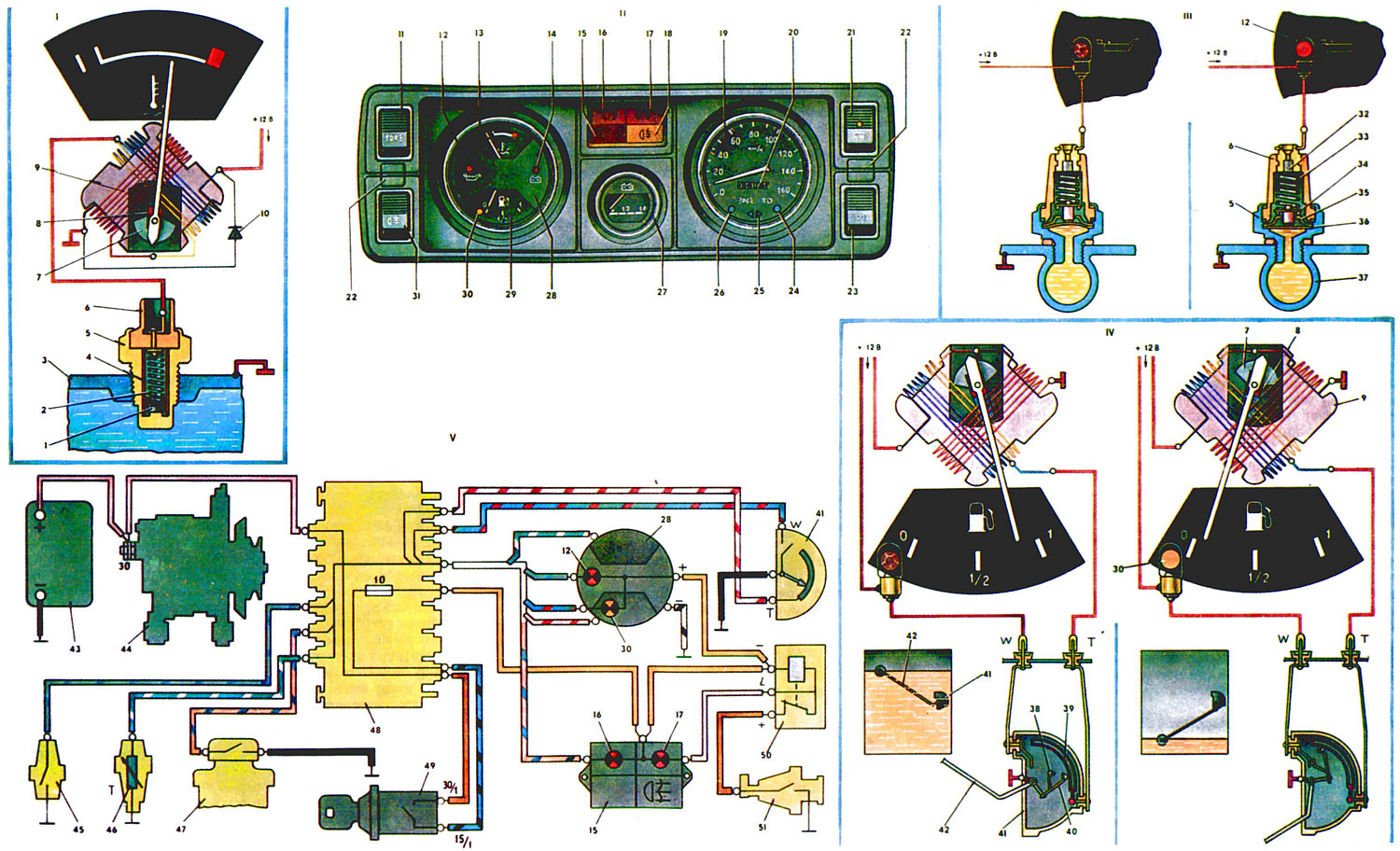
Fig. 33: 1. Thermistor. 2. Contact spring. 3. Cylinder head. 4. Paper insulating cartridge. 5. Sensor housing. 6. Sensor cover. 7. Pointer balance arm. 8. Permanent magnet on the pointer axis. 9. Frame with pointer coils. 10. Instrument protection diode. 11. Outside lighting switch. 12. Oil pressure indicator lamp. 13. Coolant temperature gauge. 14. Battery charge indicator lamp. 15. Indicator lamp unit. 16. Brake fluid level indicator lamp. 17. Parking brake indicator lamp. 18. Fog light indicator lamp. 19. Speedometer. 20. Trip meter. 21. Rear window heating switch. 22. Instrument cluster mounting screw plugs. 23. Heater fan switch. 24. High beam indicator lamp. 25. Direction indicator lamp. 26. Exterior lighting indicator lamp. 27. Voltmeter. 28. Instrument cluster. 29. Fuel gauge. 30. Fuel reserve indicator lamp. 31. Tail fog light switch. 32. Oil pressure sensor air filter. 33. Spring. 34. Movable sensor contact. 35. Fixed contact (connected to ground). 36 Diaphragm. 37. Cylinder block. 38. Fuel reserve signal contact. 39. Sensor rheostat. 40. Rheostat moving contact. 41. Fuel level and reserve indicator sensor. 42. Lever with float. 43. Battery. 44. Generator. 45. Oil pressure warning lamp sensor. 46. Coolant temperature indicator sensor. 47. Brake fluid level sensor. 48. Mounting block. 49. Ignition switch. 50. Parking brake warning lamp flasher relay 51. Parking brake warning lamp switch. I - Coolant temperature gauge. II - Instrument cluster. III - Oil pressure warning lamp. IV - Fuel level gauge. V - Electrical diagram of control instruments.
On VAZ-2105 and VAZ-2104 cars, all control devices are located on the instrument panel. It contains: speedometer 19, voltmeter 27, block of 15 control lamps, instrument cluster 28, and four switches.
The instrument panel is attached to the instrument panel using two screws covered with plugs 22. To remove the panel to replace burnt-out lamps or damaged instruments, remove plugs 22 with a screwdriver, unscrew the screws and carefully remove the instrument panel from the instrument panel socket. When installing the panel in place, avoid sharp bends of the flexible shaft of the speedometer drive, which lead to residual deformation of the shaft casing. The bending radii of the shaft in the mounted state must be at least 100 mm.
The instrument cluster is of type 12.3801. It consists of two instruments - coolant temperature indicator 13 and fuel level indicator 29. In addition, it has three control lamps: 30 - fuel reserve, 12 - low oil pressure and 14 - battery charge. The instrument cluster is attached to the dashboard using two clamps and nuts. The instrument cluster housing is made of plastic. The outer rim with glass is attached to it at the front, and a printed circuit board made of foil-clad fiberglass is fixed at the back, on which the indicator mechanisms are installed, as well as the diode 10 for protecting the instruments. The diode is connected between the "+" and "ground" conductors. Through it, reverse current pulses are closed to ground, which prevents the permanent magnets of the indicators from demagnetizing. To eliminate the mutual influence of the magnetic fields of the indicators, steel screens are located between them.
A characteristic feature of the instrument cluster and speedometer is the conical shape of the protective glass of the scales, this shape allows eliminating glare that interferes with reading the instrument readings. In order not to damage the glass, it must not be cleaned with solvents.
There are two types of instrument clusters, differing in the circuit for connecting the battery charge indicator lamp. Before 1988, when the G-222 generator was used, one lamp terminal was connected to the "ground" and the second to the "87" plug of the charge indicator lamp, if the car had one. Since 1988, when the 37.3701 generator began to be installed, one lamp terminal was connected to the "plus" of the power supply, and the second to the "61" terminal of the generator.
Speedometer. The VAZ-2105 and VAZ-2104 cars use a speedometer of type 17.3802. It is attached to the instrument panel using two brackets and nuts.
The speedometer has a pointer indicator of the vehicle speed and a trip meter. The speedometer mechanisms are driven by a flexible shaft from a drive installed on the rear cover of the gearbox. One revolution of the flexible shaft corresponds to 1 m of the traveled distance. In the lower part of the speedometer there are three information control lamps 24, 25 and 26 of the AMN 12-3 type, which notify the driver about the switching on of the high beam headlights, turn signals and external lighting. The lamp sockets are covered with colored light filters.
The speedometer speed indicator mechanism consists of a permanent magnet mounted on a drive shaft and an aluminum frame (in the form of a cup), fixed on the axis together with the pointer. When the magnet rotates, the magnetic lines of force penetrate the card and induce an EMF in it, under the action of which eddy currents arise in the card. These currents create the card's own magnetic field. As a result of the interaction of the rotating magnetic field of the permanent magnet and the magnetic field of the card, a torque acts on it, which turns the card, and with it the pointer, in the direction of rotation of the magnet.
The fuel level indicator is of the magnetoelectric type, used in tandem with the BM-150 type sensor, which is installed in the fuel tank. This sensor also turns on the fuel reserve indicator lamp 30 when there are 4-6.5 liters left in the tank (or 5-7.5 l on VAZ-2104 cars).
The indicator has a stamped steel body, in which a plastic frame 9 with coils and a scale is fixed with two nuts. In the lower left part of the body there is a bushing with a lamp holder for the fuel reserve control lamp 30.
The indicator mechanism consists of a plastic frame on which the coils are wound, and an axis with an arrow, a permanent magnet 8 and a counterweight 7. The arrow axis rotates in two bearings, one of which is made in the form of a screw and is used to adjust the free play of the axis during assembly. The socket of this screw contains a special damping grease that prevents the arrow from vibrating when the car is moving. The counterweight serves to balance the mass of the magnet and to set the arrow to the "0" mark when the device is turned off.
The coils have three windings, one of which is wound perpendicular to the other two. Thus, three magnetic fluxes created by three windings act on the permanent magnet. Their direction is determined by the gimlet rule. Devices with this operating principle are also called logometric.
The sensor has a wire rheostat 39, along which the contact 40, controlled by the float, slides. Depending on the fuel level, the float rises or falls and moves the movable contact of the rheostat, changing the resistance of the sensor.
When the sensor resistance is 285-335 Ohm, the pointer should be at the beginning of the scale, at 100-13 Ohm in the middle of the scale, and at 7-25 Ohm at the end of the scale, when the sensor float is in the lower position, contact 38 closes with the fixed contact connected to the "%" terminal of the sensor and control lamp 30 turns on.
The coolant temperature gauge measures the coolant temperature in the engine cooling system and works together with the TM-106 sensor. Just like the fuel gauge, it is magnetoelectric and has the same design and operating principle. It differs in winding data and the absence of a control lamp.
The TM-106 sensor is screwed into the cylinder head. Its sensitive element is the thermistor 1, which changes its resistance when the temperature changes. The thermistor is pressed by a spring 2 to the bottom of the housing 5, i.e. one side of it is connected to the "ground" through the housing. The other side of the thermistor is connected through a spring to the output plug, fixed in the plastic cover 6. If the sensor resistance is 1000-5000 Ohm, the arrow should be at the beginning of the scale, and with a resistance of 98-110 Ohm, at the beginning of the red zone of the scale (at a pointer temperature of 20°C).
Voltmeter. On VAZ-2105 and VAZ-2104 cars, a voltmeter of type 12.3812 is used. It is attached to the instrument panel with a bracket.
The voltmeter mechanism is of the magnetoelectric type. It consists of a coil wound on a detachable plastic frame. The axis of the pointer rotates in the holes of the frame, on which a permanent magnet is fixed, interacting with the magnetic field created by the coil. There are two permanent magnets located outside the coil. One is fixed, and the other is installed at the end of the screw and can move when the screw rotates. The permanent magnets serve to hold the pointer at the beginning of the scale.
When current passes through the voltmeter coil, a magnetic field is created and the movable magnet is set in the direction of the resulting magnetic flux, which consists of the magnetic fluxes of the permanent magnets and the coil. The greater the current passing through the coil, the greater the amount by which the pointer deflects. An additional resistor is connected in series with the coil. Its resistance is calculated so that at a voltage of 16 V the pointer deflects to the end of the scale.
The voltmeter mechanism is enclosed in a steel screen, which serves to strengthen the magnetic flux inside the coil. The screen together with the mechanism is mounted on a steel base, on which the voltmeter terminal plugs and an additional resistor are also fixed. The base is attached to the voltmeter body with two screws.
The oil pressure indicator lamp 12 for insufficient oil pressure in the engine lubrication system is switched on by a sensor of the MM-120 type, which is screwed into the cylinder block 37 on the left side and monitors the oil pressure in the main oil line of the cylinder block.
In the steel body 5 of the sensor, a diaphragm 36 made of polyester film and a fixed contact connected to the body of the sensor (with "ground") are rolled. If the pressure in the engine lubrication system is below 0.02-0.06 MPa (0.2-0.6 kgf/cm²), then the moving contact 34 of the sensor is pressed by a spring to the fixed one, the power supply circuit of the control lamp 12 is closed and the lamp lights up as soon as the oil pressure exceeds 0.02-0.06 MPa (0.2-0.6 kgf/cm²), it bends the diaphragm 36 and, overcoming the resistance of the spring, pushes the moving contact away from the fixed one with the pusher. The power supply circuit of the control lamp opens and the lamp goes out.
The control lamp unit is fixed in the center of the instrument panel with two self-tapping screws. The unit has a plastic housing divided into sections by partitions. One section is a reserve, and the rest are equipped with baseless control lamps of the A12-1.2 type.
A two-color plastic diffuser is ultrasonically welded to the front of the body. Its lower half is orange, and the upper half is red (in the area of the brake system warning lights). A printed circuit board made of foil-clad fiberglass is attached to the back of the case. Sockets with control lamps are installed on the board and wires are soldered.
Since 1989, a control lamp unit with six lamps has been used. Control lamps for the carburetor air damper and rear window heating have been added.
Brake system warning lights. Parking brake warning light 17 is switched on via flasher relay 50 type RS-492. It starts "flashing" when the parking brake lever is raised. In this case, switch 51 is closed to ground and the current goes from fuse "10" of the mounting block along two circuits. One circuit is closed to ground along the following path: fuse "10" - orange wire, warning light 17, pink wire, plug "L", flasher relay 50 and through its closed contacts to plug "+" - along the brown wire to switch 51 and to ground. The other circuit is closed to ground along the following path: fuse "10" of the mounting block - orange wire - plug "-", relay-breaker winding and through its closed contacts to plug "+" then along the brown wire to switch 51 and to ground.
The current flowing through the winding of the relay-breaker heats it up. The bimetallic plate of the relay-breaker bends from heating and the contacts of the relay-breaker open. The current in both circuits is interrupted and lamp 17 goes out. Then the bimetallic plate cools down and takes its previous shape. The contacts of the relay-breaker close again, turning on the control lamp, and the described cycle is repeated with a frequency of 60-120 times per minute, causing the parking brake control lamp to flash.
Since 1995, the relay-interrupter 50 has not been installed on cars and now, when the car is braked with the parking brake, the control lamp 17 lights up continuously, without blinking.
The brake fluid level indicator lamp 16 is switched on by the sensor 47, located in the cover of the brake master cylinder reservoir, when the fluid level becomes the minimum permissible. In this case, the current goes along the circuit: fuse "10" of the mounting block, orange wire, indicator lamp 16 - pink wire with a blue stripe, through the mounting block, closed contacts of the sensor and through the black wire to ground. Since 1989, simultaneously with the installation of a six-lamp block of indicator lamps, the wiring diagram for the indicator lamp 16 for the brake fluid level has also changed. Now, an orange wire from fuse "10" goes to one terminal of sensor 47, and the other end is connected to the indicator lamp 16 by a pink wire with a blue stripe through the mounting block. In this case, the second terminal of the lamp is connected to ground.
Also since 1989, a circuit for checking the serviceability of the brake fluid level indicator lamp 16 has been added. The lamp terminal to which the wire from the sensor approaches is also connected by a red wire through a diode to the "50" plug of the ignition switch. When the starter is turned on, voltage is supplied to lamp 16 through the diode, and it lights up. After the starter is turned off, the lamp goes out.