




The location of the contact patch in the engagement of the main transmission gears
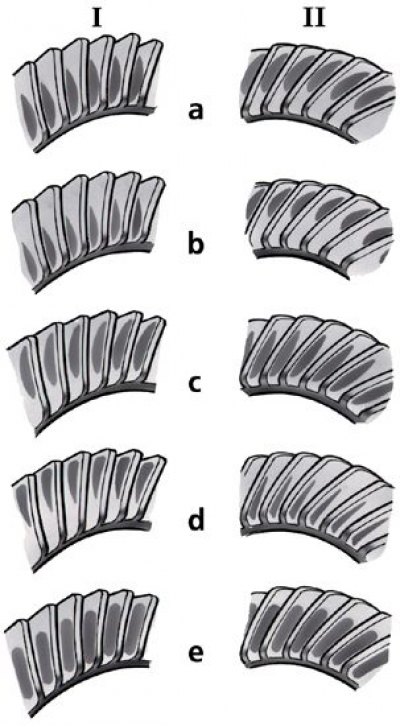
I – forward side;
II – reverse side;
a and b – incorrect contact in the gear engagement: move the driving gear away from the driven gear, reduce the thickness of the adjusting ring;
c and d – incorrect contact: move the drive gear towards the driven gear by increasing the thickness of the adjusting ring;
e – correct contact in gear engagement
1. Install the adjusted gearbox on the stand and lubricate the working surfaces of the driven gear teeth with a thin layer of lead oxide.
2. Launch the stand; use the stand levers to slow down the rotation of the installed axle shafts so that under load, traces of contact with the teeth of the drive gear remain on the surfaces of the teeth.
3. Change the direction of rotation of the stand and, by braking, obtain contact marks on the other side of the driven gear teeth, which corresponds to the car moving backwards.
4. The engagement is considered normal if on both sides of the driven gear teeth the contact patch is uniformly located closer to the narrow end of the tooth, occupying two thirds of its length and not extending to the top and base of the tooth, as shown in Fig. The location of the contact patch in the engagement of the main gear gears, e.
5. Cases of incorrect divergence of the contact patch on the working surface of the tooth are shown in Fig. Location of the contact patch in the engagement of the main transmission gears (a, b, c, d).
6. To adjust the correct position of the drive gear with replacement of the ring, it is necessary to disassemble the unit.
7. When assembling, repeat all operations for pre-tensioning the roller bearings of the drive gear, checking the torque of resistance to rotation, pre-tensioning the roller bearings of the differential box and adjusting the lateral clearance of the engagement of the gears of the main transmission.