




Contents: Ignition switch ↓ Spark plugs ↓ Ignition coil ↓ Ignition distributor sensor ↓ Switch ↓ High voltage wires ↓ Controller ↓ Synchronization sensors ↓ Coolant temperature sensor ↓
The ignition system is designed to ignite the working mixture in the engine cylinders by a spark discharge, which must be created at a strictly defined moment. Most cars of the VAZ-2108, VAZ-2109 family use an electronic contactless ignition system. It includes spark plugs, a spark distributor sensor, a switch, and high and low voltage wires.
Some VAZ-21083 and VAZ-21093 vehicles are equipped with a microprocessor (digital) ignition system. The basis of this system is a controller, which is a specialized microcomputer. Based on sensor signals, the controller accurately determines the ignition timing in the engine cylinders according to a given program and issues commands to the switch. As a result, fuel consumption is reduced, the toxicity of exhaust gases is reduced, and optimal engine power characteristics are achieved. The microprocessor ignition system includes the following original units: a controller, a two-channel switch, two ignition coils, and sensors for the start of counting, angular pulses, and temperature. The switch, spark plugs, and high-voltage wires used are the same as in the contactless ignition system.
Ignition switch
The ignition switch is designed to turn on and off the ignition and starting circuits, control devices, lights and other consumers of electrical energy of the car. Ignition switches are installed in two types: KZ813, manufactured in Hungary, or 2108-3704005-40 of domestic production. They are interchangeable, but have different designs. The ignition switch kit includes an additional ignition relay, which was not used in the first batches of VAZ-2108 cars. The wiring diagram of the ignition switch with the additional relay is shown in Figure 106.
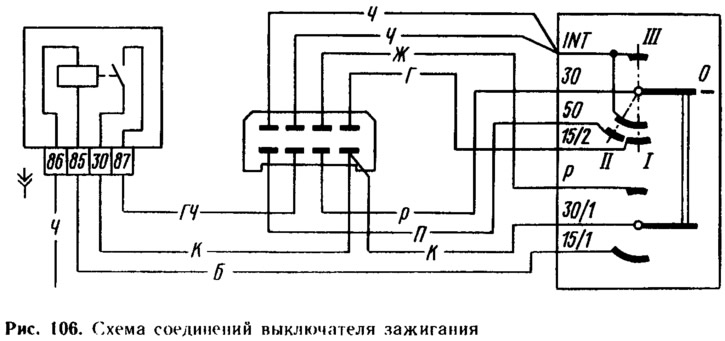
The ignition switch consists of two main parts: the contact part and the lock part. The lock part has an anti-theft device and a locking device against restarting the starter. The principle of the anti-theft device is that after removing the key from the lock in position III ("Parking"), the locking rod of the lock extends, enters the groove of the steering shaft and locks the shaft. The lock is designed so that the key can only be removed in position III.
The starter reactivation lock prevents the key from being turned again from position I (Ignition) to position II (Starter). The starter can only be reactivated after the key has been returned to position O (Off). This device prevents the starter from being accidentally activated when the engine is running, which could result in damage to the starter drive.
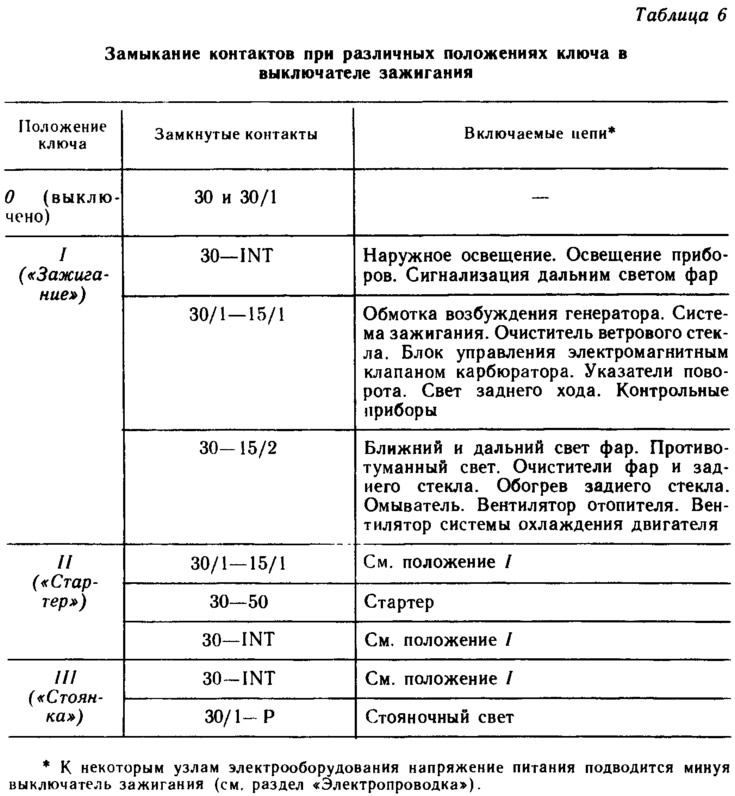
The ignition switch contact part is non-separable. Voltage from the battery and generator is supplied to contacts "30" and "30/1". Table 6 shows which switch contacts are closed in different key positions.
Spark plugs
Spark plugs are used to ignite the working mixture in the cylinders by a spark discharge between the electrodes. The cars in question are equipped with spark plugs of the FE65P type (made in SFRY) or domestically produced A-17DV-10 spark plugs. The letter A in the spark plug designation indicates the thread length of the screw-in part M14X 1.25. The numbers 17 characterize the glow number of the spark plug. The second letter D in the designation indicates that the length of the threaded part of the spark plug body is 19 mm. The last letter B means that the thermal cone (skirt) of the insulator protrudes beyond the end of the body.
The A-17DV-10 spark plugs differ from the A-17DV spark plugs (used in Zhiguli cars) in the shape of the insulator, increased thickness of the side electrode and the introduction of an anti-corrosion coating of the body. All this increases the reliability of the spark plug at higher voltages and increases its durability.
Since 1988, the vehicles in question may be equipped with FE65PR or FE65CPR spark plugs, which have a 4...10 kOhm interference suppression resistor inside. With these spark plugs, high-voltage wires without interference suppression tips are installed on the engine.
Ignition coil
The ignition coil converts intermittent low voltage current (12 V) into high voltage current (20...25 kV), necessary for breaking down the air gap between the spark plug electrodes. Ignition coil type — 27.3705. It is a transformer with an open magnetic circuit, which consists of an internal core and an external ring magnetic circuit. The secondary winding, which has a large number of turns, is wound around the core. One end of it is connected to the central terminal of the ignition coil, and the other to the low-voltage terminal "B". Primary winding (with fewer turns) wound over the secondary. Its terminals are connected to low-voltage terminals. To increase the reliability of insulation and improve cooling, the ignition coil is filled with transformer oil.
On cars with a digital ignition system, two ignition coils of type 29.3705, molded in plastic, each with two high-voltage terminals are installed. One ignition coil generates high-voltage pulses to the spark plugs of cylinders 1 and 4, and the other to the spark plugs of cylinders 2 and 3.
Ignition distributor sensor
The ignition distributor sensor produces low-voltage control pulses and distributes high-voltage pulses to the spark plugs. The distributor sensor type is 40.3706. It is a four-spark, with vacuum and centrifugal ignition advance regulators.
Building 13 (figure 107) cast from aluminum alloy. Shaft 15 rotates in two porous metal-ceramic bushings impregnated with oil. Bushing 17 is pressed into the housing, and bushing 25 is located in holder 7. The main parts of the ignition distributor sensor: sensor, centrifugal ignition advance regulator, vacuum ignition advance regulator and ignition distributor.
(The text is on the website: VAZbook.ru)
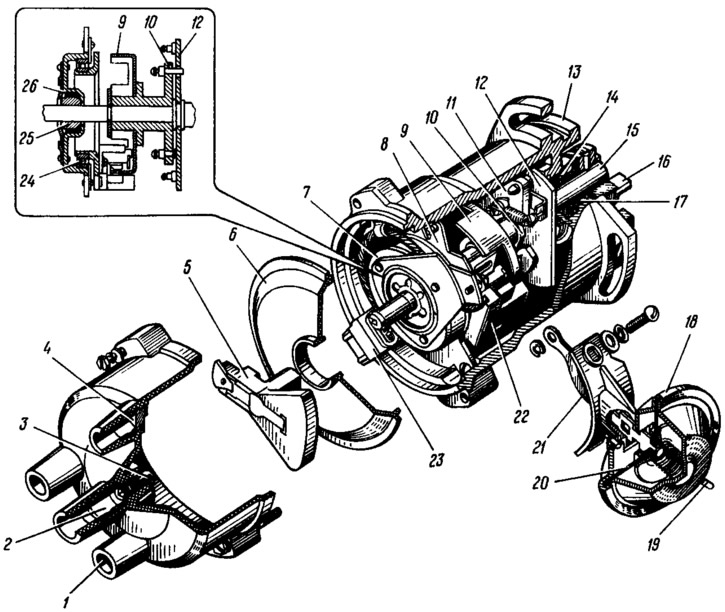
Figure 107. Ignition distributor sensor:
1 - lid; 2 - terminal for wire from ignition coil; 3 - central carbon electrode; 4 - side electrode with terminal; 5 - rotor; 6 - protective screen; 7 - Front bearing roller holder; 8 - sensor support plate; 9 - screen; 10 - driven plate of the centrifugal regulator; 11 - weight; 12 - leading plate; 13 - ignition distributor sensor housing; 14 - oil seal; 15 - roller; 16 - coupling; 17 - bushing of the rear end of the roller; 18 - vacuum regulator housing; 19 - nipple for vacuum supply; 20 - diaphragm; 21- vacuum regulator rod; 22 - contactless sensor; 23 - connector block; 24 - sensor support plate bearing; 25 - front end bushing of the roller; 26 - felt ring.
Sensor 22 — contactless microelectronic, based on the use of the Hall effect. This effect consists of the occurrence of a transverse electric field in a semiconductor plate with current when a magnetic field acts on it. The sensor consists of a permanent magnet, a semiconductor plate and an integrated microcircuit. There is a gap between the plate and the magnet.
In the gap of the sensor there is a steel screen 9 with four slits. When a screen slit passes through the gap, a magnetic field acts on the semiconductor plate and the potential difference is removed from it. If the screen body is in the gap, the magnetic lines of force are closed through the screen and do not act on the plate. In this case, the potential difference on the plate does not arise.
An integrated circuit built into the sensor converts the potential difference created on the plate into negative voltage pulses of a certain magnitude at the sensor output (figure 108, II). When the screen is in the gap of the sensor, there is voltage U at its outputmax approximately 3 V less than the supply voltage. If the screen slit passes through the sensor gap, then the voltage Umax at the sensor output close to zero (no more than 0.4 V). The ratio of the period T to the duration Tand impulse (duty cycle) equals 3. The sensor supply voltage is 8...14 V.
Centrifugal ignition timing regulator consists of a leading plate 12, fixed on a shaft 15, a driven plate 10 and two weights 11. The weights rotate on axles riveted to the leading plate. A screen 9 is riveted to the sleeve of the driven plate. Thus, the driven plate 10 is a single whole with the screen 9 and can rotate within small limits on the shaft 15.
Vacuum ignition timing regulator 18 is fixed to the distributor sensor housing. Diaphragm 20 is clamped between the housing and the regulator cover. On one side, rod 21 is fixed to the diaphragm, and on the other side, there is a spring. Rod is pivotally connected to plate 8, on which a contactless sensor is mounted. Under the action of vacuum, the diaphragm bends and through rod 21 turns plate 8 against the direction of rotation of shaft 15.
Distributor consists of a rotor 5 mounted on the end of a shaft 15 and electrodes 4 cast into a plastic cover 1. The central and outer contacts are riveted to the plastic rotor 5 and filled with epoxy resin, as well as a 1 kOhm resistor designed to suppress radio interference. A spring-loaded carbon electrode 3 rests against the central contact of the rotor, transmitting high-voltage pulses from the ignition coil to the rotor. When the rotor rotates, these pulses are transmitted from the outer contact to the side electrodes 4 and then to the spark plugs.
Switch
The switch converts the control pulses of the sensor and the current pulses in the primary winding of the ignition coil. On cars with a contactless ignition system, a single-channel electronic switch 36.3734, or 3620.3734, or 56.3734, or HIM-52 is used (produced by Hungary). All of them are interchangeable. The digital ignition system uses a two-channel switch type 42.3734.
During the passage of a positive pulse (voltage Umax, see Figure 108, II) from the contactless sensor there is a gradual (within 4.8 ms) increase in current in the primary winding of the ignition coil to a maximum value of V (see figure 108, I), equal to 8...9 A. At the moment when the voltage at the sensor output drops to the output transistor of the switch closes and the current through the primary winding of the ignition coil is abruptly interrupted. As a result, a high voltage pulse is induced in the secondary winding.
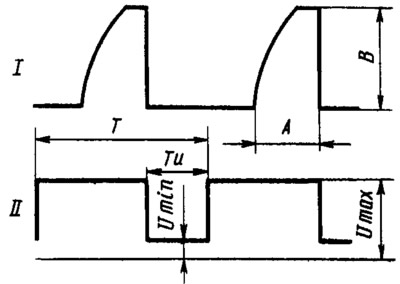
Figure 108. Switch (I) and non-contact sensor (II) pulses on the oscilloscope screen:
t - current accumulation time; B - maximum current value; T - pulse period; Tand - pulse duration.
High voltage wires
High-voltage wires transmit high-voltage pulses from the ignition coil to the distributor and from it to the spark plugs. To reduce radio interference, the wires have a resistance distributed along their length, which is 2000 Ohm/m for wires of the PVVP-8 type (red color) and 2500 Ohm/m for wires PVSh1V-40 (blue color). On the spark plug side, the wires are fitted with tips with 5.6 kOhm interference suppression resistors. If FE65PR or FE65CPR spark plugs are used, the wires are not fitted with interference suppression tips.
Controller
The controller of the "Electronics MS2713-02" type is used to control the moment of spark formation in the digital ignition system, as well as to control the electromagnetic shut-off valve of the carburetor. It is an electronic microprocessor system and is essentially a miniature specialized computer. Its memory contains the values of the ignition advance angles, which must correspond to the given crankshaft rotation frequency, vacuum in the intake pipe and coolant temperature.
Based on the sensor signals, the controller selects the required ignition advance angle from memory and at a strictly defined moment sends ignition signals to the switch. In addition, depending on the position of the carburetor throttle valve and the crankshaft speed, the controller turns on or off the electromagnetic shut-off valve of the carburetor.
The controller has a built-in pressure sensor connected by a hose to the engine intake pipe. All controller outputs are made in the form of an "open collector" of an npn transistor with a load capacity of no more than 10 m.
Synchronization sensors
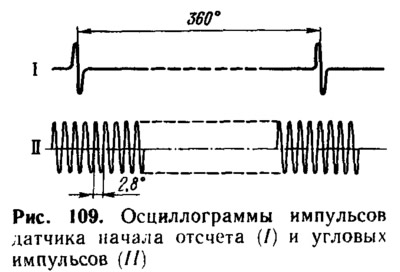
The synchronization sensors used in the digital ignition system, type 14.3847, are installed on the clutch housing. The sensors are designed to synchronize the controller operation with the TDC of pistons 1 and 4 cylinders (reference sensor or NO) and the angular position of the crankshaft (angular pulse sensor or AP). The YI sensor is located above the toothed rim of the flywheel, and the NO sensor is located above a special marker pin pressed into the flywheel.
Both sensors are identical, made in the form of a coil with a magnetic core. The operating principle of the sensors is based on the law of electromagnetic induction. When a ferromagnetic object passes under the sensor core (for example, a flywheel ring gear tooth), eMF is induced in the sensor coil. Its value depends on the gap between the sensor core and the crown tooth, as well as on the crankshaft rotation frequency.
The HO sensor generates one pulse per one crankshaft revolution at the moment the marker pin passes through its magnetic field. This moment corresponds to the TDC position of pistons 1 and 4 cylinders. The UI sensor creates pulses when the flywheel ring gear teeth pass through its magnetic field. Since the number of ring gear teeth is 128, the UI sensor pulse period is 360/128=2.8° along the crankshaft.
The pulses generated by the NO and UI sensors are shown in Figure 109. The amplitude of the voltage pulses is from 0.2 to 100 V in the crankshaft speed range from 25 to 6000 rpm. The gap between the sensor core and the top of the flywheel ring gear tooth or the end of the marker pin should be 0.3...1.2 mm.
Coolant temperature sensor
Engine coolant temperature sensor used in the digital ignition system, type 19.3828, semiconductor, with a linear characteristic. It is installed on the outlet pipe of the engine cooling jacket. Inside the sensor housing there is a special microcircuit. A direct current of 1.5 mA is supplied to the sensor terminals. Depending on the temperature, the voltage drop at the sensor terminals changes (microcircuits). This voltage drop when the sensor is powered with a constant current of 1.5 mA is numerically equal to (in millivolts) coolant temperature in K, multiplied by ten.
The sensor output voltage in the controller is converted into two types of signals. A low-level signal corresponds to a temperature below 50°C, and a high-level signal corresponds to a temperature above 50°C. These signals are used to select the ignition advance angle for two engine states: cold or hot.