
English Русский
Български
Беларускі
Український
Српски
Hrvatski
Română
Polski
Slovenský
Magyar
| Articles | Contacts | Sitemap |   
Repair and maintenance Lada Repair and maintenance Mazda Repair and maintenance Mitsubishi Repair and maintenance Toyota Repair and maintenance Land Rover Repair and maintenance Hyundai Repair and maintenance Nissan
VAZbook.ru


Main     1111   2101   2105   2106   2107   2109   2110   2115   2121  
VAZ-2108 (1984-2003) VAZ-2109 (1984-1997) VAZ-21099 (1990-2004)
  • Main
  • «Sputnik»
  • VAZ-2108
  • Electrical equipment
  • Engine electrics
  • Keeping the battery in good working order

Keeping the battery in good working order (VAZ-2108)

            0

Contents: Checking the electrolyte level ↓ Checking the battery level ↓ Battery charge ↓

Checking the electrolyte level


The electrolyte level should be between the "MIN" and "MAX" marks on the translucent battery case. During battery operation, the electrolyte level gradually decreases as the water contained in it evaporates. Therefore, its level should be checked every 4 months. Operation of the battery with an electrolyte level below the "MIN" mark is not permitted. To restore the electrolyte level, only distilled water should be added.

If it is definitely established that the cause of the low level is splashing, then it is necessary to add electrolyte of the same density as that remaining in the battery element. If the level is above the norm, then the electrolyte must be collected with a rubber bulb.

Checking the battery level


To determine the degree of discharge when the battery fails, and also every 4 months, measure the density of the electrolyte with an automotive densimeter and compare it with the data in Table 18. If the battery is discharged by more than 25% in winter and 50% in summer, it should be removed from the car and recharged.

The text is published on the portal [VAZBOOK]
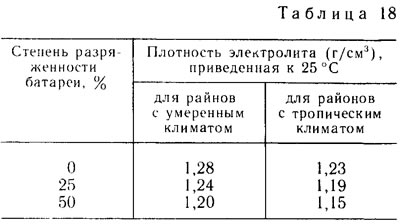
To determine the degree of discharge when the battery fails, and also every 4 months, measure the…


When measuring the density, make sure that no electrolyte gets on the surface of the battery, the body or other parts, causing corrosion, current leakage, etc.


The density of the electrolyte depends on the temperature. With every 15°C change, the density changes by approximately 0.01 g/cm³. Therefore, if the electrolyte temperature differs from 25°C, then the temperature correction should be added or subtracted from the densimeter readings:
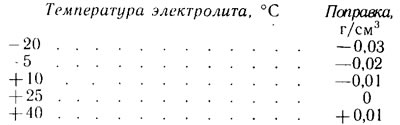
The density of the electrolyte depends on the temperature. With every 15°C change, the density…


To avoid getting erroneous results, do not measure the density of the electrolyte in the following cases:
  • if its level does not correspond to the norm;
  • when the electrolyte is too hot or cold. The optimum temperature of the electrolyte when measuring the density is 15-25°C;
  • immediately after adding distilled water. You should wait until the electrolyte mixes. If the battery is discharged, this may take even several hours;
  • after several starts. You should wait until the electrolyte density in the battery cells is uniform;
  • with "boiling" electrolyte. You should wait until the bubbles in the electrolyte collected in the densimeter pipette rise to the surface.

If, when measuring the specific gravity of the electrolyte, it is found to be excessively high (1.3 g/cm³ and above), then it is necessary to remove some of the electrolyte from the element, add distilled water instead, wait until the electrolyte mixes, and measure the density again.


If the density of the electrolyte is low, then after removing it from the element, add electrolyte with a density of 1.40 g/cm³.

Battery charge


The battery removed from the vehicle must be carefully cleaned, especially its upper part, and the electrolyte level must be checked. The battery is charged with a current of 2.75 A with the plugs unscrewed. When charging the battery, it is necessary to periodically check the electrolyte temperature and not allow it to rise above 40°C. If the temperature reaches 40°C, then the charging current must be halved or the charge must be interrupted and the battery must be cooled to 27°C.

Charging stops when abundant gas emission begins in all battery compartments, and the voltage and density of the electrolyte remain constant during the last 3 hours of charging.

The density of the electrolyte of a charged battery at 25°C should be (1.28±0.01) g/cm³ for regions with a temperate climate and (1.23±0.01) g/cm³ for the tropics.

After adjusting the electrolyte density, continue charging the battery for another 30 minutes to mix the electrolyte. Then disconnect the battery and measure its level in all elements after 30 minutes. If the electrolyte level differs from the norm, it is brought to the recommended value, as indicated above.


This article is available at russian, bulgarian, belarusian, ukrainian, serbian, croatian, romanian, polish, slovak, hungarian
The text was reviewed by the specialist: Grigory Vologodtsev

Share with friends:

Previous articles
VAZ-2108: Engine electrics
Next articles

Bringing a dry-charged battery into working condition
Possible faults of the battery
Features of the battery device
Features of the generator device
Rules for checking and operating the generator
Possible generator faults
Generator Checks
Checking the voltage regulator

More articles from other manuals on VAZ cars:
➠ Keeping the battery in good working order VAZ-1111 (1988-1996)
➠ Keeping the battery in good working order VAZ-2101 (1970-1983)
➠ Keeping the battery in good working order VAZ-2105 (1979-2010)
➠ Bringing a dry-charged battery into working condition VAZ-21213 (1994-2006)
➠ Rechargeable battery VAZ-2106 (1976-2006)
Link in different formats to this page


Visitor comments

No comments yet


How much will 44 + 17 ?


VAZ-21099 (1990-2004) 
  • General information
  • Specifications
  • User manual
  • Maintenance
  • Car care
  • Troubleshooting
  • Power unit
  • Engine repair
  • Cooling and lubrication system
  • Power and exhaust system
  • Transmission
  • Car gearbox
  • Clutch and drive shafts
  • Chassis
  • Car suspension
  • Steering
  • Brake system
  • Body
  • Exterior
  • Interior
  • Doors and locks
  • Electrical equipment
  • Equipment and devices
  • Lighting and signaling
  • Engine electrics
  • Ignition system


VAZ-2109 (1984-1997) 
  • General information
  • Vehicle operation
  • Vehicle device
  • Power unit
  • Engine repair
  • Cooling and lubrication system
  • Supply system
  • Transmission
  • Clutch
  • Gearbox and drive
  • Chassis
  • Car suspension
  • Steering
  • Brake system
  • Body
  • Body elements
  • Electrical equipment
  • Engine electrics
  • Equipment and devices


VAZ-2108 (1984-2003) 
  • General information
  • Introduction to guide
  • Power unit
  • Engine repair
  • Cooling and lubrication system
  • Power and exhaust system
  • Transmission
  • Clutch and drive shafts
  • Car gearbox
  • Chassis
  • Front suspension
  • Rear suspension
  • Steering
  • Brake system
  • Body
  • Exterior
  • Interior
  • Doors and glass
  • Electrical equipment
  • Equipment and devices
  • Engine electrics
  • Ignition system


VAZbook.ru © 2017 · Mobile version · Contact with administration · Sitemap: EN BG BY UA RS HR RO PL SK HU · Site search · News and articles VAZ-1111 · VAZ-11113 · VAZ-2101 · VAZ-21011 · VAZ-2104 · VAZ-2105 · VAZ-21051 · VAZ-2106 · VAZ-21061 · VAZ-2107 · VAZ-21099 · VAZ-2109 · VAZ-2108 · VAZ-2110 · VAZ-2112 · VAZ-2114 · VAZ-2115 · VAZ-2121 · VAZ-21213 · VAZ-21214 ·
The site stores technical data using cookies to improve the service.