




Contents: Testing the generator on the bench ↓ Checking the rotor excitation winding ↓ Stator check ↓ Checking the rectifier block valves ↓ Checking additional diodes ↓
Testing the generator on the bench
Allows you to determine the generator's serviceability and whether its characteristics correspond to the nominal ones. The brushes of the generator being tested must be well ground to the contact rings, and the rings themselves must be clean.
The generator is installed on the stand and connections are made as shown in Figure 129. The electric motor of the stand is switched on, the voltage at the generator output is set to 13 V using rheostat 5 and the rotor speed is increased to 5000 rpm. The generator is allowed to operate in this mode for at least 2 minutes and then the output current is measured. For a serviceable generator it should be at least 55 A.
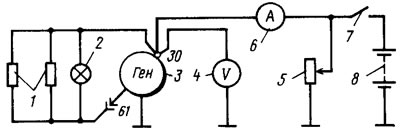
Figure 129. Connection diagram for testing the generator on the bench: 1 - 100 Ohm resistors, 2 W; 2 - control lamp 12 V, 1.2 W; 3 - generator; 4 - voltmeter; 5 - rheostat; 6 - ammeter; 7 - switch; 8 - battery
If the measured value of the output current is less, this indicates faults in the stator or rotor windings, damage to the valves or wear of the contact rings and brushes. In this case, a thorough check of the windings and valves is necessary to determine the location of the fault.
The generator output voltage is checked at a rotor speed of 5000 rpm. Rheostat 5 sets the output current to 15 A and measures the generator output voltage, which should be (14.1±0.5) V at an ambient air and generator temperature of (25±10)°C.
If the voltage does not fit within the specified limits, then replace the voltage regulator with a new one, known to be in good working order, and repeat the check. If the voltage is normal, then the old voltage regulator is damaged and must be replaced. And if the voltage still does not fit within the above limits, then it is necessary to check the windings and valves of the generator.
Checking the rotor excitation winding
The excitation winding can be checked without removing the generator from the car, by removing only the voltage regulator together with the brush holder. Having cleaned the contact rings with sandpaper if necessary, use an ohmmeter or test lamp to check whether there is a break in the excitation winding and whether it shorts to the housing.
Stator check
The stator is checked separately after disassembling the generator. The terminals of its winding must be disconnected from the rectifier valves. First of all, check with an ohmmeter or with a test lamp and a battery to see if there are any breaks in the stator winding and if its turns are shorted to the housing.
The insulation of the winding wires must be free of overheating, which occurs when there is a short circuit in the rectifier valves. The stator with such a damaged winding should be replaced. Then, a special defectoscope is used to check whether there are short-circuited turns in the stator winding.
Checking the rectifier block valves
[The article is copied from the website: VAZbook.ru]
A working valve allows current to flow in only one direction, while a faulty valve may not allow current to flow at all (chain break) or pass current in both directions (short circuit). If one of the rectifier valves is damaged, the entire rectifier unit must be replaced.
A short circuit of the valves can be checked without removing the generator from the car, after disconnecting the wires from the battery and the generator. Also disconnect the terminal "b" of the voltage regulator from the terminal "30" of the generator and the wire from the terminal "B" of the voltage regulator. You can check with an ohmmeter or with a lamp (1-5 W, 12 V) and a battery, as shown in Figure 130.
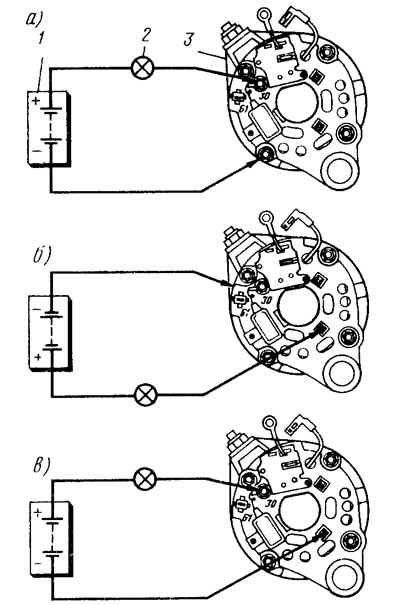
Fig. 130. Schemes for testing rectifier valves: a - testing of positive and negative valves simultaneously; b - checking negative valves; in - checking positive valves; 1 - battery; 2 - control lamp; 3 - generator
In order to simplify the fastening of the rectifier parts, three valves have a positive rectified current on the body (these are positive polarity direct current valves). They are pressed into one plate of the rectifier block, connected to the output "30" of the generator. The other three valves (negative) have a minus of the rectified current on the body. They are pressed into another plate of the rectifier block, connected to the ground.
First, check the short circuit loops simultaneously in the positive and negative valves. To do this, connect the battery plus through a lamp to the generator clamp "30", and the minus to the generator body (figure 130,a). If the lamp is on, both the negative and positive valves are shorted.
You can check for a short circuit of the negative valves by connecting the positive terminal of the battery through a lamp to one of the mounting bolts of the rectifier unit, and the negative terminal to the generator housing (figure 130.6). The lamp burning means a short circuit in one or more negative valves. It should be remembered that in this case the lamp burning may be a consequence of the stator winding turns shorting to the generator housing. However, such a malfunction is less common than a short circuit of the valves.
To check for a short circuit in the positive valves, the battery plus is connected through a lamp to the generator clamp "30", and the battery minus is connected to one of the rectifier unit mounting bolts (figure 130,c). Lighting of the lamp will indicate a short circuit of one or more positive valves.
Without disassembling the generator, a break in the valves can be detected only indirectly when checking the generator on a bench by a significant decrease (by 20-30%) in the strength of the output current compared to the nominal. If the windings, additional diodes and voltage regulator of the generator are in good condition, and there is no short circuit in the valves, then the reason for the decrease in the output current is a break in the valves.
Checking additional diodes
A short circuit of additional diodes can be checked without removing and disassembling the generator by disconnecting the wires from the battery and generator and the wire from the "B" terminal of the voltage regulator.
The battery plus is connected to the generator terminal "61" via a lamp (1-3 W, 12 V), and the battery minus is connected to one of the rectifier unit mounting bolts. If the lamp lights up, there is a short circuit in one of the additional diodes. The damaged diode can only be found by removing the rectifier unit and checking each diode separately.
A break in the additional diodes can be detected with an oscilloscope by the distortion of the voltage curve on the "61" plug, as well as by the low voltage (below 14 V) on the "61" plug at the average rotation frequency of the generator rotor.