

Checking the electrolyte level
The electrolyte level should be 5-10 mm above the upper edge of the separators and not rise above the lower edge of the filler neck. During operation of the battery, the electrolyte level gradually decreases, as the water that is part of it evaporates. To restore the electrolyte level, it is necessary to add only distilled water.
If it is determined that the cause of the low level is sloshing, then it is necessary to add electrolyte of the same density as that remaining in the battery cell. If the level is above the norm, then the electrolyte must be taken with a rubber bulb with an ebonite tip.
Checking the degree of discharge of the battery
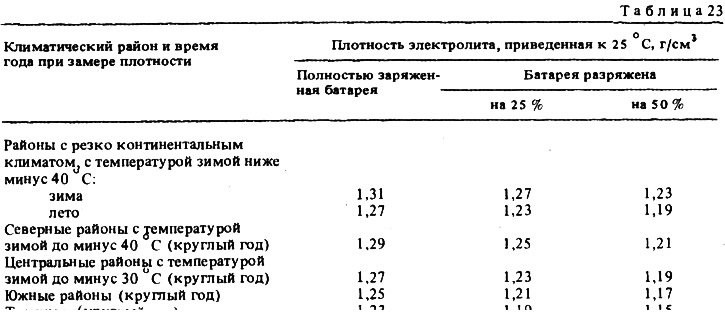
To determine the degree of discharge, measure the density of the electrolyte with a car densimeter and compare it with the data in Table. 23. If the battery is discharged by 25% in winter or 50% in summer, then it should be removed from the car and recharged.
During the density measurement, make sure that no electrolyte containing sulfuric acid, which causes corrosion, current leakage, etc., drips onto the surface of the battery, body and other parts.
The density of the electrolyte depends on the temperature. With a change in the latter for every 15°C, the density changes by approximately 0.01 g / cm3. Therefore, if the electrolyte temperature differs from 25°C, then. temperature correction should be added or subtracted to the densimeter readings:

To avoid erroneous results, do not measure the density of the electrolyte in the following cases:
- if its level does not correspond to the norm;
- when the electrolyte is too hot or too cold. The optimum temperature of the electrolyte when measuring density is 15–25°C;
- after adding distilled water. Wait until the electrolyte is mixed. If the battery is low, this may even take several hours;
- after a few starts. You should wait until a uniform density of the electrolyte in the battery cell is established;
- at "boiling" electrolyte. You should wait until the bubbles in the electrolyte collected in the densimeter pipette rise to the surface.
If the electrolyte density is too low (less than 1.22 g/cm3) and at the same time there is a strong heating of the battery in operation (more than 10°C above ambient temperature) or electrolyte density in different battery cells differs by more than 0.2 g/cm3, then in these cases it is necessary to recharge the battery with a current of 2-3 A for 24 hours. If, after recharging, the battery voltage is less than 12 V, then it is unusable.
If, when measuring the density of the electrolyte, it is found that it is excessively high (1.3 g/cm3 and higher), then it is necessary to bring it to the norm, as indicated below.
Battery charge. The battery removed from the vehicle must be carefully cleaned, especially its upper part, and the electrolyte level checked. The battery is charged with a current of 5.5 A for several hours until the voltage becomes constant and the density of the electrolyte remains unchanged. At the end of the charge, the density of the electrolyte sometimes differs from the norm. In this case, it is brought to the recommended value. If the density of the electrolyte is greater than normal, then a part of the electrolyte should be sucked out of the cell, topped up with distilled water instead, wait until the electrolyte is mixed, and again measure the density. If the density of the electrolyte is low, then after removing it from the cell, add electrolyte with a density of 1.40 g/cm3.