




The thickness of the adjusting ring is selected when replacing one of the following parts: differential box, differential bearing, clutch housing or gearbox.
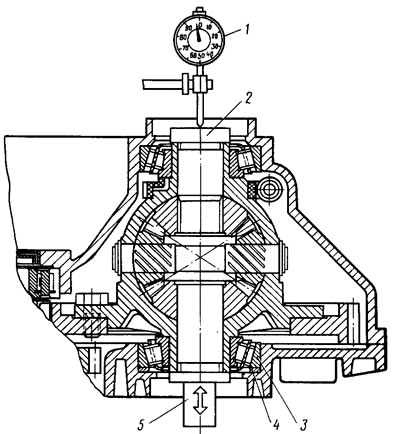
Figure 75. Selecting the adjusting ring
The thickness of the adjustment ring is determined in the following sequence:
- press in the outer ring of the tapered roller bearing 3 together with the mounting ring 4 (figure 75) into the gearbox housing. The mounting ring 4 has a constant thickness of 1.25 mm;
- press the outer ring of the other differential bearing into the clutch housing. At the same time, make sure not to mix up the outer rings of the differential bearings;
- install the differential into the gearbox housing and, having closed it with the clutch housing, tighten the nuts securing the gearbox to the clutch housing with a torque of 2.5 kgf·m, after which turn the differential for self-adjustment of the bearings by 2-3 turns;
- the support mandrel 2 is installed on the differential box and the indicator 1 with an extension is secured using a universal holder. The indicator leg is installed on the support mandrel with a preliminary tension equal to 1 mm, and the indicator is fixed in this position, and its arrow is set to zero;
- move the differential from below and watch the indicator reading. When measuring the axial displacement of the differential, do not turn it, so as not to distort the measurement results.
The formula S = A + B + C is used to calculate the thickness of the differential bearing adjusting ring. In this formula, S is the thickness of the adjusting ring; A - axial displacement of the differential; B — differential bearing preload; C — thickness of the mounting ring (constant value).
Example: The indicator reading when moving the differential is 1.00 mm. The differential bearing preload is 0.25 mm, the thickness of the mounting ring is 1.25 mm
S = 1,00 + 0,25 +1,25 = 2,50
After determining the thickness of the adjusting ring, separate the clutch and gearbox housings, remove the differential, press out the outer bearing ring from the gearbox housing and install the selected adjusting ring instead of the installation ring 9. Press in the outer bearing ring of the differential, install the differential in the gearbox housing and, having closed it with the clutch housing, tighten the nuts securing the gearbox to the clutch housing.
The torque of resistance to turning of the differential is checked with a dynamometer 02.7812.9501. To do this, pass the tip of the dynamometer through the hole of the differential box (for wheel drive shaft) until it wraps around the satellite axle. Turn the dynamometer handle several turns clockwise and determine the torque of resistance to rotation on the scale. It should be: for new bearings 15-35 kgf-cm, for worn-in bearings at least 3 kgf-cm.