




Primary shaft 17 (figure 61) is made in the form of a block of drive gears, which are in constant engagement with the driven gears of all forward gears. They are located on needle bearings on the secondary shaft 14. In addition to them, two synchronizers 12 and 10 are installed on the shaft. The drive gear of the main gear is made together with the secondary shaft. The differential is double-satellite. The preliminary tension in the differential bearings is adjusted by selecting the thickness of ring 9. The driven gear of the main gear is attached to the flange of the differential box.
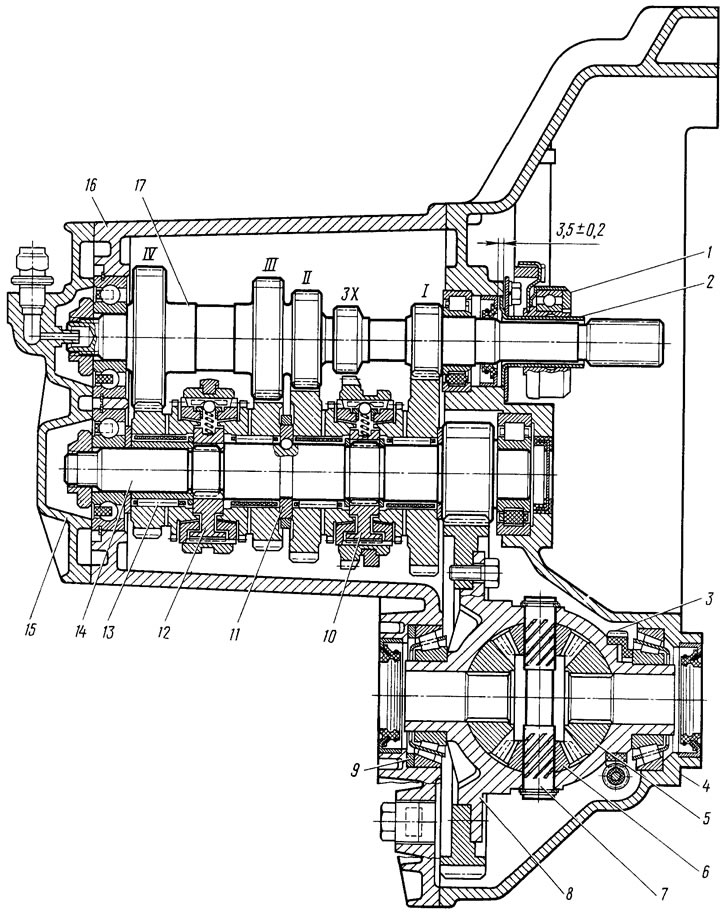
Figure 61. Four-speed gearbox: 1 - clutch release bearing; 2 - Clutch release bearing sleeve guide sleeve; 3 - speedometer drive pinion; 4 - clutch housing; 5 - axle gear; 6 - satellite; 7 - satellite axis; 8 - differential box; 9 - adjusting gasket; 10, 12 - synchronizers; 11 - thrust half rings; 13 - Needle bearing gear; 14 - secondary shaft; 15 - rear cover of the gearbox housing; 16 gearbox housing; 17 - primary shaft
The gearbox control drive 1 consists of a lever 11 (figure 62) with a spherical pin 12, a ball joint 13, a rod 9 connected by a hinge 7 to a rod 6. and gear selection and shifting mechanisms. A lever 5 is fixed to the inner end of the rod 6, which acts on the three-arm lever 3 of the gear selection mechanism 2. This mechanism is made as a separate unit and is attached to the clutch housing 4. The opening for the passage of the rod 9 is closed by a protective cover 10.
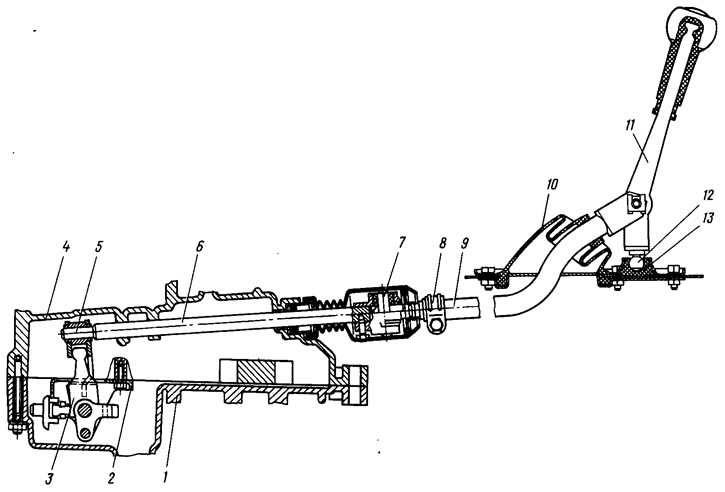
Figure 62. Gearbox control drive (for clarity, the left part of the figure is rotated 90° around the axis of the rod 6)
In building 16 (figure 63) the gear selection mechanism has two axles. One of them has a three-arm gear selection lever 3 and locking brackets 2. The other axle passes through the holes in the brackets 2, securing them from turning. Arm B of lever 3 is used to engage forward gears, arm B is used to engage reverse gear, and lever 5 acts on the third arm (see figure 62) gear selection rod. Under the action of the spring, lever 3 (see figure 63) gear selection and locking brackets 2 move on their axes until ball 18 stops in the step on axis 17. In this position, the brackets lock fork 12 of the reverse gear with one end, entering its groove between protrusions A, and with the other end the fork of the first and second gears (as well as the V-gear fork of the five-speed gearbox); shoulder B of the gear selection lever is set to the position of engagement of III and IV gears. When the gear shift lever is moved transversely towards reverse, lever 3 and brackets 2 move on the axles, compressing the spring. In this case, instead of the bracket, shoulder B of the gear selection lever enters the groove of the reverse fork 12, and the brackets lock the forks of engagement of the forward gears. Thus, when lever 3 is moved along its axis, gears are selected, and when it is turned on the axle, gears are engaged.
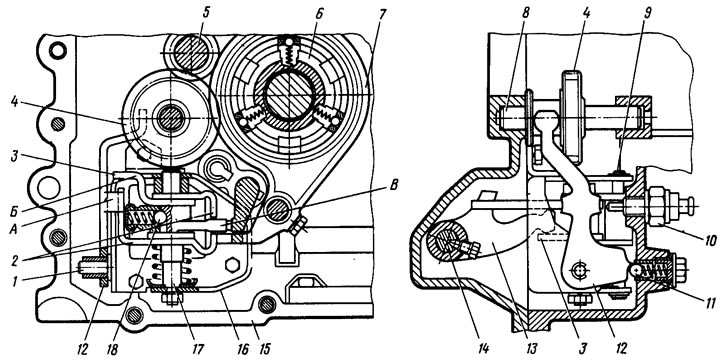
Figure 63. Gear selection mechanism: 1 - fork axle; 2 - locking brackets; 3 - three-arm gear selector lever; 4 - intermediate reverse gear; 5 - primary shaft; 6 - synchronizer of 1st and 2nd gears; 7 - fork for engaging 1st and 2nd gears; 8 - reverse intermediate gear axis; 9 - guide axis of locking brackets; 10 - Reversing light switch; 11 - Reverse fork lock; 12 - reverse gear fork; 13 - gear selection rod lever; 14 - gear selection rod; 15 - clutch housing; 16 - gear selection mechanism housing; 17 - gear selector lever axis; 18 - gear selector lever lock
The five-speed gearbox has a primary gear of 7 (figure 64) and the secondary 4 shafts at the outlet of the crankcase 1 are extended. On this part of the shafts are located the leading 8 and driven 2 gears of the 5th gear and its synchronizer 3. The shaft bearings are fixed in their seats by a plate 9. The gears of the 5th gear are closed by the rear cover 5 of the gearbox housing with a breather 6.
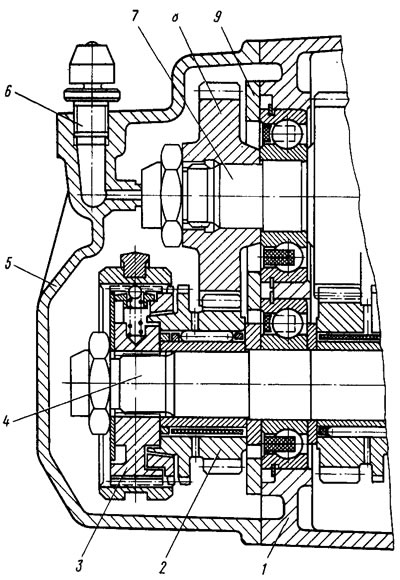
Figure 64. Rear of the five-speed gearbox
To distinguish gearboxes by final drive ratios, they are marked with paint. The marking is applied to the upper part of the crankcase: 01 — for a gear ratio of 3.94; 02 - for gear ratio 4.13.
Possible gearbox malfunctions, their causes and methods of elimination are given in table 7.