




2. Press on the belt with a force of 98 N (10 kgf) exactly in the middle between the generator pulley and the engine crankshaft pulley.
Helpful advice: If it is difficult to estimate the force created by hand, you can use a household spring balance with a maximum permissible load of 10 kg, as is done when checking the timing belt.
A properly adjusted alternator belt should deflect by 6-8 mm. If the belt deflection is not within the norm, then adjust the belt tension. To do this:
3. Using a 13 mm open-end or socket wrench, loosen the nut on the lower generator mounting bolt.
[The text is published on the portal: www.VazBook.ru]
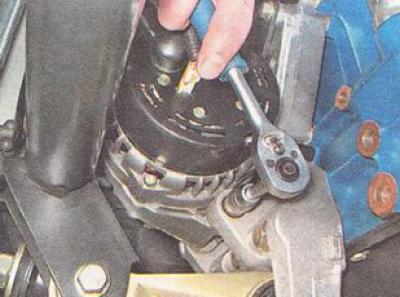
4. Using a 13 mm open-end wrench, loosen the tension bar nut of the generator.
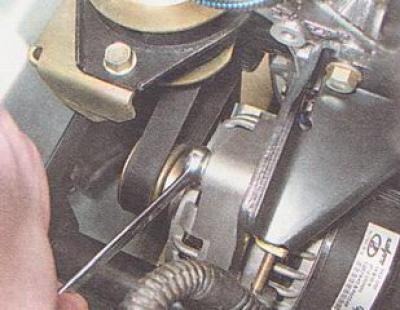
5. Using a 10 mm open-end wrench, turn the adjusting bolt to adjust the belt tension (clockwise - increases the tension of the alternator belt, and counterclockwise - decreases it).
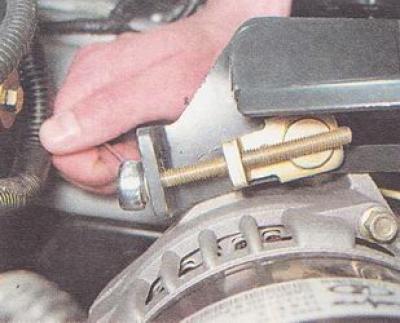
Warning: Excessive belt tension may cause failure of the alternator front bearing.
6. Check the tension of the regulator belt and repeat the adjustment if necessary.
7. After making sure that the alternator belt is tensioned correctly, tighten the tension bar nut using a 13 mm open-end wrench.
8. Using a 13 mm socket wrench, tighten the nut of the generator lower mounting bolt.