




Contents: Shock absorbers ↓ Springs and stabilizers ↓ Ball joints ↓ Wheels with increased diameter and…↓ Summer and winter tires ↓ Tire pressure ↓ Constant velocity joints ↓
The main purpose of the suspension is to ensure a smooth ride, make the control easy and obedient, while the movement of the car should be silent. Shock absorbers, springs, stabilizers, ball joints, silent blocks of levers, tires, tubes and wheel disks participate in providing these characteristics of the car. Well, and ultra-modern suspensions have a computer with sensors that coordinate the work of all these suspension elements and fulfill the driver's desire - what kind of suspension to be.
Unfortunately, the suspension now works in such a way that if you want to improve comfort and ride smoothness, then the handling will become worse. It turned out that the "ten" has a smooth ride, but "thinks" how to act when turning the steering wheel. And "nine" reacts instantly to any rotation of the steering wheel.
Let's consider the role of the main elements of the "ten" suspension in its comfort.
Shock absorbers
Shock absorbers increase the service life and improve the reliability of the following vehicle components: steering gear, gearbox, constant velocity joints, differential, wheel hub bearings, levers and ball joints, silent blocks and tires.
It is difficult to choose shock absorbers for a car on your own; you need to have extensive experience operating a car with different shock absorbers, and most importantly, determine what the driver wants for his car, good handling or a smooth ride.
The companies that develop shock absorbers for the "tens" are trying to "kill two birds with one stone". Based on the experience of using both domestic and imported shock absorbers from various companies, we can give them certain characteristics. During assembly, the "tens" are equipped with dual-pipe hydraulic shock absorbers from the domestic company "SAAZ". They hold small bumps well, and on large bumps the car rocks like on waves, but this is typical for a sedan, a hatchback behaves more stably, and a station wagon practically does not need to replace the shock absorbers. The standard shock absorbers, combined with the shape of the body, cope with their task well.
Shock absorbers from the St. Petersburg company Plaza are quite popular; with these shock absorbers, the sedan feels more stable on undulating roads and holds the car well on turns.
Shock absorbers from the Dutch company "Koni", which specializes in sports shock absorbers, produces shock absorbers that are suitable for the family of "tenth" models. The smoothness of the ride has improved, and this is especially noticeable on turns. "Ten" is becoming even more sporty, and most importantly, it "thinks" less after turning the steering wheel, i.e., controllability becomes better. But passengers, especially in the front seat, feel all the unevenness of the road. For better comfort and better controllability, you need to pay more than twice as much money for a set of these shock absorbers.
The Plaza shock absorbers are single-tube, high-pressure gas-filled. Their main advantage is a faster response to road irregularities, to its condition, they are less thoughtful than the Zhiguli ones. But it is advisable to install them on a car with sagging springs or if it is necessary to increase the car's ground clearance. The car with these shock absorbers becomes higher. To reduce the rigidity of the suspension with gas-filled shock absorbers, it is better to install them with low-profile tires and light-alloy wheels.
Each driver, based on his character, wants to see his "friend" obedient, comfortable, hard or soft, and depending on the availability of money can choose the shock absorbers he needs. Their choice is large.
Springs and stabilizers
For the family of "tenth" models, several variants of springs are manufactured. Black springs with index 2108 and with a technical mark for VAZ-2110 and VAZ-2111 cars are installed in front. For the VAZ-2112 car, springs with index 2112 are installed. They are distinguished by a white mark on the spring. It is intended for heavier power units.
Light grey springs are installed at the rear: for VAZ-2110 cars with index 2110 without a mark; for the VAZ-2111 and VAZ-2112 vehicles with index 2111 and an orange mark.
For export versions, shorter, less rigid springs are produced. With such springs, the ground clearance is lower.
The stabilizers of the "tenth" models perform the same functions and are made of the same material as those of the "nines", they just have different fastenings.
Ball joints
One of the important suspension parts is the lower and upper suspension arms. They are made of steel and hold the entire car. Car enthusiasts have probably noticed a car that is parked in the middle of the road, and its front wheel is lying on its side. How many times has the "friend" on every bump reminded the careless owner with its knocking: it's time to change the ball joints, and maybe the levers. But there was no worthy answer, and the "friend's" support could no longer withstand.
The mobility of the levers is ensured by rubber-metal bushings, silent blocks, which also need to be monitored.
The connection between the car body and the wheel, which rotates on the wheel hub, is carried out through the upper and lower levers and the ball joints that are attached to them. This is a responsible unit, every driver should remember this and regularly monitor its condition. It fails no more often than other parts of the car suspension wear out, and of course, first of all, the ball joints.
If the ball joints need to be replaced, which you have seen for yourself or have been told at a service station, it is best to replace them with quality ones. The company that makes them should be well-known and best of all provide a guarantee. Ball joints manufactured by the company "BelMag" from the city of Magnitogorsk have proven themselves to be good.
Wheels with increased diameter and width
Another element of the suspension that affects the comfort of the car is its wheel. The theory of the car says: the lighter the suspension elements that perceive the unevenness, the softer the car moves on them. A light, durable wheel tracks and perceives the unevenness of the road better, relieves the work of shock absorbers and springs, increases their service life.
Another main advantage of a light, but of course durable wheel is that it is easier to accelerate and brake faster. And designers have developed and continue to work on a wheel that is durable, light, with an excellent design, but also - no less important - not very expensive. Currently, wheels are made of cast aluminum alloys with a good design and providing a smooth ride, they are more expensive than metal ones installed on a car. Forged wheels can satisfy athletes, they can withstand heavy loads, and those who are able to pay a lot of money for comfort can install the best ones on their car.
The wheel consists of a disk and a rim. On standard wheels they are welded together, and on cast and forged wheels they are cast and forged together.
The "ten" and "eleven" models have wheels with the index 2108, with six oval holes. In appearance, they differ from other VAZ models in the number and shape of the holes. They have different sizes in the design. Therefore, they are not interchangeable with other wheels. The mounting diameter of the wheel is the distance between the planes on which the tire rests, equal to 13 inches. It is advisable for the driver to know whether his wheel is tubed or tubeless. They differ in the protrusion on the flat surface of the wheel.
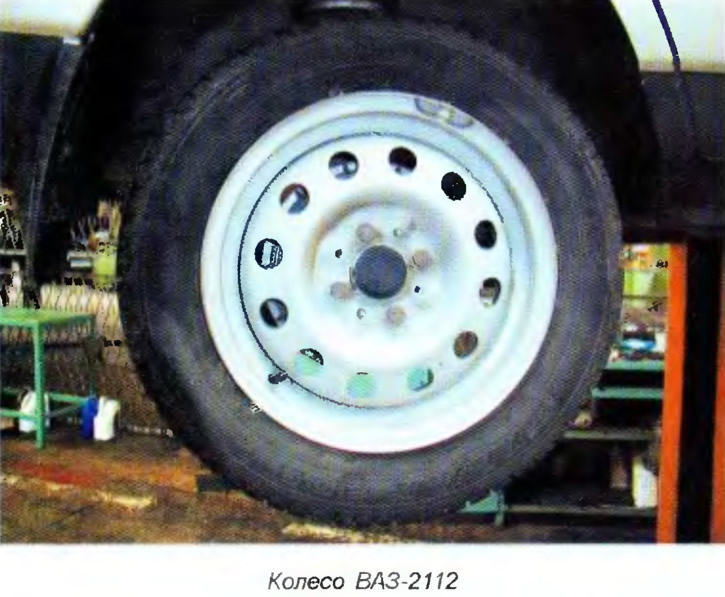
The wheel for cars with the VAZ-2112 engine differs from other wheels of the VAZ family, it has the index 2112. It has 12 round holes, and on the "troika" there were 16, and the mounting diameter is 14 inches. Wheel 2108 cannot be replaced with 2112, but instead of 2108 you can put 2112.
Summer and winter tires
On VAZ-2110 and VAZ-2111 cars, tires with the size - 175/70 R13 and on 2112 cars with the size 175/65 K14. Every driver should know the shoe size of his "friend". We know what the numbers 14 and 13 mean, and the letter R means the mounting diameter. The numbers 175 indicate the width of the tire profile in millimeters, and the numbers 70 and 65 indicate the height of the tire profile, its side part. 65 is a low-profile tire, and there are also high-profile ones, which have a profile height of 82. It is necessary to install a wheel with your own tire with the index 2112 instead of 2110, but the reverse replacement is not allowed.
Externally, they differ little. The size of the rectangular blocks of the tire tread on the R13 is larger than on the R14. And the R14 tire has holes for studs. R14 is heavier, and we already know that the weight of the wheel affects the smoothness of the ride, but the car's handling is faster with 14-inch wheels, it responds better to changes in steering wheel rotation and holds the road better on turns, but at the same time the speed is worse, gas consumption is higher, and so on. The recommendations are as follows: if your "friend" has standard shoes, then it is better not to put standard shoes on another "ten". But at present, many companies produce a large number of different tires with different tasks for the car.
There are expressions in the traffic regulations that concern tires, and the driver should know their meaning: "Residual tread depth"; "The tires are not the correct size for this type of vehicle"; "Tires with different tread patterns or different cords". These expressions can be found when choosing a tire.
The sizes of tires for "tens" have already been discussed, but the rules prohibit the use of tires if they do not correspond to the given type of car, i.e. tires must be selected only by size, so as not to have any trouble when meeting with traffic police officers.
The tire consists of a tread, a carcass (cord) and a sidewall. The tread is the upper part of the tire with a specific pattern. The tread interacts directly with the road. The tread is soft and in the contact area with the road it is deformed and affects the unevenness of the road, as if clinging to the road with its protruding blocks. The more such blocks are in contact with the road at the same time, the harder it is to make the tread slide, the higher the friction force with the road, the shorter the braking distance and the higher the safety. Drivers say: "the tire grips the road well."
The grooves on the tread are mainly designed to drain water, snow, dirt and air from under the tread of the tire from the contact surface of the tire with the road, this reduces the possibility of aquaplaning, the floating of the car above the surface of the wet road. They significantly improve the control of the car on a slippery road. If you drive behind a car during the rain, then at a certain distance behind the wheel there is a dry trace on the road. This is how the tread pattern works, thanks to the slits it comes into contact with the dry surface of the road. Therefore, the rules require that the residual tread depth of a passenger car be at least 1.6 mm, otherwise it is necessary to change the tire.
The tread pattern also affects other performance characteristics. Thin sipes provide good traction on snow-covered roads. Correct sipe distribution promotes uniform tread wear. Different sizes of protruding blocks reduce noise levels, and the outer blocks provide reliable traction when changing direction.
But thin sipes cannot remove the layer of dirt on a dirt road from the contact area. The tread becomes clogged with dirt, and the tire turns into a smooth roller.
The universal tread pattern has wider sipes, and such a tire can be used on both asphalt and dirt roads.
Winter tires have large blocks and wide sipes. They are good not only for well-packed snow roads, but also for off-road use.
The protectors can have a directional pattern (herringbone). They are easy to clean from snow and dirt and should be installed strictly according to the arrow, which is applied to the sidewall of the tire.
Another element of the tire is the cord, or carcass. Cord is a German word, in Russian it is a carcass, a power element of the tire. It takes internal air pressure and external loads. During production, a specially prepared mass is poured onto the carcass, and the biggest secret of each company is the composition of this mass and the technology of its preparation. For example, the inclusion of natural rubber in the mixture allows the tire to retain its softness, and accordingly, its grip on the road.
Cords can be: cotton, viscose or metal. They provide smoothness and comfort. They increase the stability of the car when transporting heavy loads, especially on bad roads, gravel roads with a large number of potholes, bumps, i.e. on our domestic roads, mainly far from large cities.
Metal cord - such a frame is assembled from very thin metal wire. It increases durability when used on good roads, and most importantly - reduces rolling resistance. Such a tire has "Steel" written on the sidewall.
If the threads or wires are assembled into a frame so that the intersection is a square when they intersect at a right angle, then such a tire is called a radial tire. On the sidewall it says "Radial".
If the threads or wires are assembled into a frame so that the intersection is a rhombus when they intersect at a certain angle, then such a bus is called a diagonal bus.
Diagonal and radial tires interact with the road differently to reduce the likelihood of skidding when braking and turning. The rules state: "Tires with different tread patterns and different cords are prohibited on the same axle." This means that your "friend" must have the same tires on the right and left axles. A radial tire distributes pressure evenly in the contact zone, therefore, the grip is better, especially on slippery roads, and the braking distance is reduced. But radial tires are delicate, they are afraid of punctures and rocky roads. They are worse for "heavy" roads.
Tires are winter and summer. Winter tires have thin sipes on the tread in the middle, wide and deep on the sides. In addition, almost any tire can be studded before winter. A tire with studs significantly increases traction, the car is easier to control and less likely to skid.
Recommendations: if your car has studded tires, attach a "studded tires" identification sign to the rear window. Your car will attract increased attention from all road users. And you will be in a more advantageous position. But the most important recommendation is that almost any tire becomes helpless on an icy road. Stay sensible, be on guard all the time, and be more careful in icy conditions. Remember, it is not the tire that is to blame for the car skidding, but the driver. Winter tires hold the road better, but they are also more expensive. You have to pay for comfort.
Summer tires have a large number of sipes of different sizes. There is also a different pattern of blocks. Summer tires, as a rule, have a narrow tread. Recommendation: if it is possible to have summer and winter tires, especially in areas where autumn-winter and spring-summer divide the year in half, then you should have summer and winter tires. Your friend will have excellent braking properties, a high level of comfort and fuel economy at any time of the year.
Tires are tubed and tubeless. A tubeless tire has a special material coating inside that acts as a tire. A tubeless tire has "Tubeless" written on the side. A tubeless tire is very comfortable and holds pressure well.
Tire pressure
The operating instructions for the "ten" state that the pressure in the 175/70 R13 front and rear tires should be the same and equal to 1.8 kg/cm³. Some drivers believe that the tire pressure should be kept lower in winter and higher in summer. If this were so, the instructions would have stated so.
Theory and practice say the following. Reducing tire pressure in winter increases braking distance, and in summer - slightly reduces it. At any time of year, handling worsens, acceleration time increases, coasting decreases, and gasoline consumption increases. If a tire is underinflated by 10%, its service life is reduced by 20%.
Increasing the pressure in winter worsens the stability of the car, at any time of the year the tire becomes hard, comfort worsens, skidding occurs earlier during lateral sliding. If you increase the pressure in the tire by 10%, the service life will decrease by 10%.
Conclusion: the tire pressure should be maintained according to the manufacturer's instructions. And if you know that the tire pressure in your car is decreasing, and it is difficult to determine by eye, then it is better to keep it slightly increased than to wait until it decreases slightly.
It is also significant that an under-inflated tire increases fuel consumption to a greater extent, while an over-inflated tire increases fuel consumption to a lesser extent.
When driving on a smooth asphalt road, you feel that the steering wheel is jerking at a constant frequency. There are many reasons, let's consider the main ones:
- dynamic imbalance, when in a wheel with a disk, rim, tire and tube, the materials of these parts of the wheel are unevenly distributed over the entire surface. When this wheel rotates, the heavy spot creates a centrifugal force in this place, which tries to overturn the rotating wheel;
- static imbalance, when the heavy part of the wheel tries to occupy the lower position. The mark on the wheel stops in the same place when freely rotating;
- the wheel with all its elements does not represent a geometrically correct circle, and radial or lateral runout of the wheel is observed.
Designers try to minimize the defects of wheel elements that cause these reasons. During the assembly of a new car, already tested balanced wheels are delivered to the conveyor. But during the operation of the car, especially after it has overcome bumps, curbs, etc., these phenomena increasingly make themselves known.
Balancing is important. A balanced wheel means increased suspension life, safety, comfort, acceleration and fuel economy.
Constant velocity joints
Constant velocity joints (CV joints), and drivers call them "grenade", are designed to transmit torque from the power unit to the drive and steered wheels at a large angle, while maintaining uniform wheel rotation. The design of CV joints is very complex and cannot be repaired.
On the "tens" the CV joint is slightly different in design from the nines, as we have already said that the engines of the "tens" are not located the same way, on the "tens" it is shifted to the left. They also differ in length: the right one is 7 mm longer, and the left one is shorter than the "eight". Both drives have a number of other differences. The drive shafts are not interchangeable. The main difference is that a more durable material is used.
If you have to buy new ones, you need to be careful. When choosing a drive, the main thing is the manufacturer. The manufacturer guarantees reliable operation only of drives manufactured at this plant. An important unit and a drive manufactured correctly at the plant is durable. Its service life is the same as that of a car. They are capable of turning wheels up to 150,000 km and more.
The protective covers are the same as the "eight" ones, and the service life of the drive mainly depends on the condition of these covers. It is necessary to inspect them regularly. They operate in a very aggressive environment. And the ingress of salt, dirt, dust is destructive for the drives. If there is a suspicion that dirt has gotten into the joint, then it is necessary to change it.
Worn joints characteristically crunch when turning and when starting off abruptly.