




The air entering the engine cylinders is cleaned of dust by the air filter. Air filter is installed in the engine compartment on three rubber supports. The filter element is replaceable and made of special paper. To prevent contaminated air from being sucked into the intake tract, there is a sealing edging at the top of the element. To replace the filter element, the filter cover is removable. Cleaned air passes through the mass air flow sensor through the air duct to the throttle valve.
Throttle valve regulates the amount of air entering the engine cylinders. The flap drive from the gas pedal is cable-operated. The flap rotates on an axis in the housing (pipe). The throttle housing is secured to the receiver flange on studs. A channel for coolant is made in the housing. The channel is connected to the cooling system by rubber hoses. Circulation of coolant through the throttle housing prevents freezing of the internal air cavities of the housing in winter. The housing has fittings for connection to the absorber and the engine crankcase ventilation system.
The throttle body, with the throttle position sensor and idle speed control valve mounted on it, form throttle assembly.
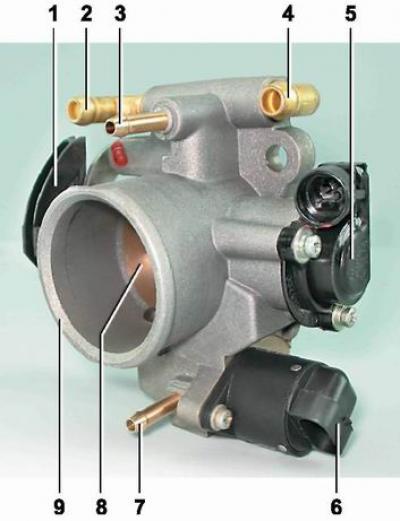
Throttle assembly: 1 - throttle actuator sector; 2, 4 - nipples for connection to the engine cooling system; 3 - crankcase gas outlet fitting; 5 - throttle position sensor; 6 - idle speed controller; 7 - nipple for connection to the adsorber; 8 - throttle valve; 9 - throttle body pipe
Air is supplied to the intake valves of the engine cylinders through receiver and intake manifold.
Fuel tank steel, welded from two stamped parts. The tank is suspended from the bottom of the car on two steel clamps. The filler neck of the fuel tank is brought out to the right side of the car and closed with a plug. Fuel from the tank is supplied by an electric fuel pump of the submersible type.
The pump is installed in the fuel tank. To access the pump, there is a hatch with a cover in the bottom of the car under the rear seat cushion. A mesh filter is installed on the inlet pipe of the fuel pump, which traps small solid particles of debris that have entered the fuel tank along with gasoline. The pump is activated by a command from the ECU.
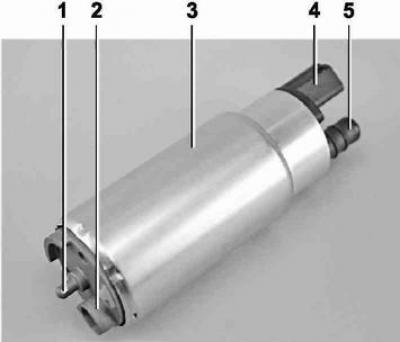
Fuel pump: 1 - protrusion for fastening the mesh filter; 2 - fuel intake pipe for connecting a mesh filter; 3 - body; 4 - Electrical connector block; 5 - day off (forcing) branch pipe for connection to the fuel module cover with a corrugated tube
The article is taken from the website VAZBOOK.ru
From the pump, through the corrugated tube of the fuel module (see below), gasoline enters the fuel line and then into the fuel filter, where the fuel undergoes more thorough cleaning.
The fuel filter is paper, installed in a metal non-separable housing. Cleaned fuel enters the fuel rail via the fuel line.
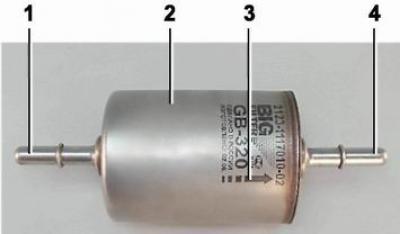
Fuel filter for engine 11183 (1.6i): 1 - inlet pipe; 2 - body; 3 - fuel flow direction arrow (painted on the filter body); 4 - outlet pipe
Note: The fuel filter of the 2111 engine (1.5i) has threaded connecting pipes.
The fuel rail holds four injectors and supplies fuel to them. The connection between the rail and the injectors is sealed with rubber rings.
The fuel pressure regulator is a bypass valve that maintains pressure in the system (fuel line) working pressure required for the correct operation of the injection system.
All cars of recent years of production are equipped with a fuel vapor recovery system (in accordance with environmental requirements EURO II), where the above-fuel space of the tank is connected to the atmosphere not directly, but through the elements of this system. The system consists of a separator, a safety valve, an adsorber, a gravity valve, an adsorber purge valve, a check valve, connecting tubes and hoses. The separator and gravity valve are fixed under the right rear wing of the car. In the separator, gasoline vapors partially condense and return back to the fuel tank. The gravity valve prevents fuel from leaking out of the tank when the car turns over. Safety (two-way) the valve prevents the formation of excess fuel vapor pressure in the tank, as well as the occurrence of a vacuum there caused by fuel consumption.
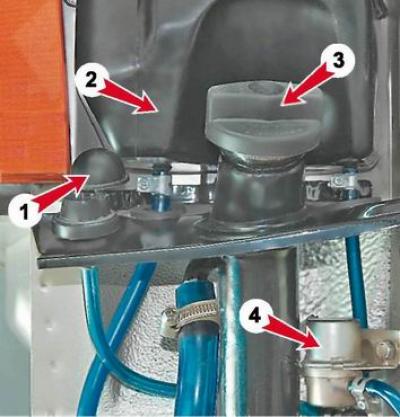
Location of fuel vapor recovery system components in the rear of the vehicle: 1 - safety valve; 2 - separator; 3 - fuel tank filler cap; 4 - gravity valve
Note: The photo shows the rear bumper.
From the separator, uncondensed gasoline vapors are fed through pipes and connecting hoses to the adsorber, which prevents the vapors from entering the atmosphere. The adsorber is a container where gasoline vapors are absorbed by activated carbon. When the engine is running at high crankshaft speed, the ECU signals the adsorber purge valve to open, and gasoline vapors are sucked into the receiver of the intake module.
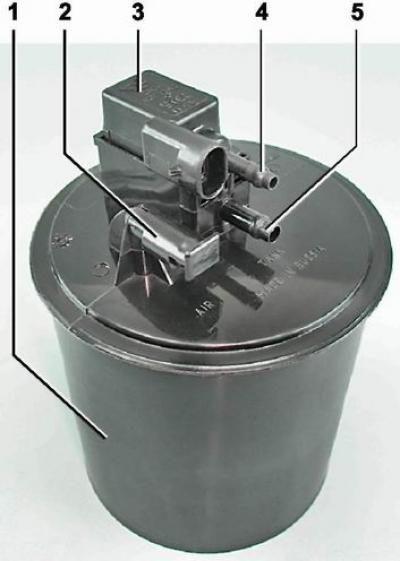
Adsorber: 1 - adsorber body; 2 - branch pipe for connecting the internal cavity of the adsorber with the atmosphere; 3 - purge valve of the adsorber; 4 - valve connecting pipe; 5 - adsorber connecting pipe
Features of the engine fuel system 2111 (1.5i)
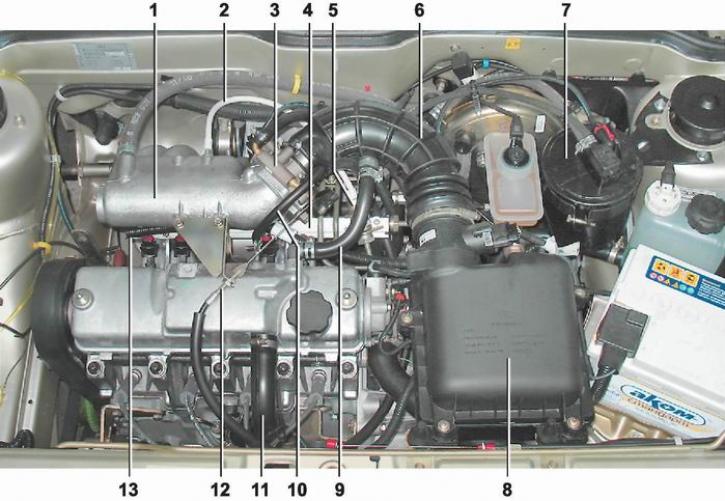
Location of the elements of the engine fuel system 2111 (1.5i) in the engine compartment: 1 - receiver; 2 - vacuum supply hose to the fuel pressure regulator; 3 - throttle assembly; 4 - fuel rail; 5 - fuel pressure regulator; 6 - air supply hose to the throttle valve; 7 - adsorber; 8 - air filter; 9, 10 and 11 - crankcase ventilation hoses; 12 - throttle cable; 13 - diagnostic connector
Fuel pump combined with the fuel level indicator sensor into a single unit - fuel module (often called an electric fuel pump). The pump delivers fuel under pressure from the tank through the fuel filter to the fuel rail.
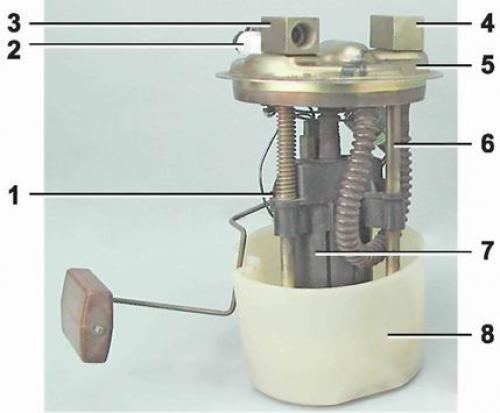
Fuel module of engine 2111 (1.5i): 1 - fuel level indicator sensor; 2 - connecting block; 3 - inlet pipe; 4 - day off (forcing) pipe branch; 5 - module cover; 6 - module cover guide; 7 - electric fuel pump in a plastic casing; 8 - intake chamber
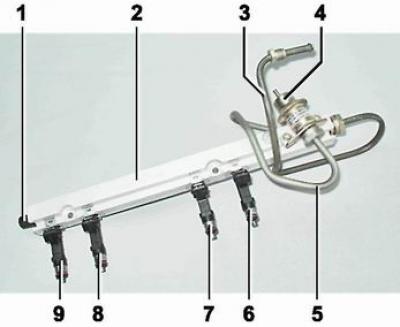
Fuel rail of engine 2111 (1.5i) complete with injectors: 1 - diagnostic nipple; 2 - fuel rail; 3 - fuel supply pipe to the fuel rail; 4 - fuel pressure regulator; 5 - fuel drain (drain) pipe into the tank; 6, 7, 8 and 9 - injectors
Fuel pressure regulator is installed on the fuel rail. Excess fuel is returned to the tank via the fuel drain line.
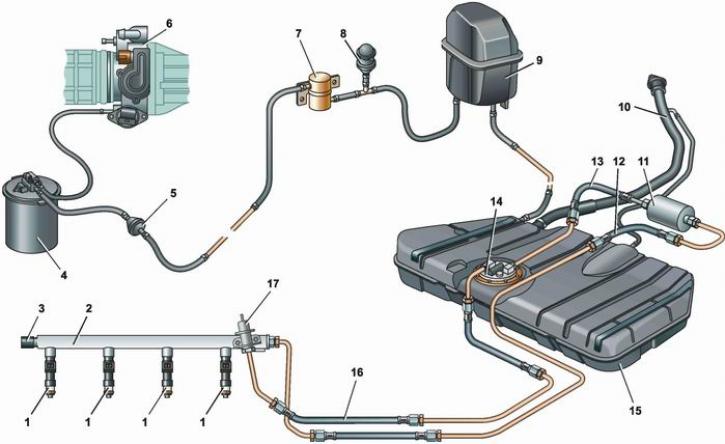
Engine fuel system diagram 2111 (1.5i): 1 - nozzle; 2 - fuel rail; 3 - diagnostic connector; 4 - adsorber; 5 - check valve; 6 - throttle assembly; 7 - gravity valve; 8 - safety (two-way) valve; 9 - separator; 10 - filler pipe; 11 - fuel filter; 12 - fuel drain line; 13 - fuel line hose connecting the outlet pipe of the fuel module with the fuel filter; 14 - fuel module; 15 - fuel tank; 16 - fuel line connecting the fuel filter to the fuel rail; 17 - fuel pressure regulator
Features of the engine fuel system 11183 (1.6i)
Receiver engine 11183 (1.6i) is made of plastic.
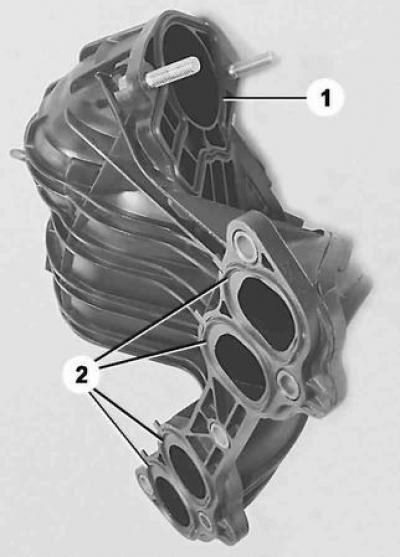
Engine intake module 11183 (1.6i): 1 - flange with sealing ring for fastening the throttle pipe; 2 - receiver with sealing rings for connection to the intake manifold
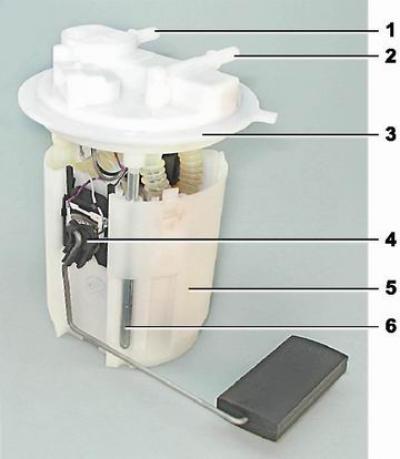
Fuel module engine 11183 (1.6i): 1 - inlet pipe (for supplying fuel to the pressure regulator); 2 - day off (forcing) pipe branch; 3 - module cover; 4 - fuel level indicator sensor; 5 - intake chamber; 6 - module cover guide
Fuel pump combined with the fuel level indicator sensor and fuel pressure regulator into a single unit - fuel module (often called - electric fuel pump). Fuel from the pump (through the outlet pipe of the fuel module) enters the fuel filter. The purified gasoline is again fed through the fuel line and through the tee to the inlet pipe of the fuel module, and then fed to the fuel rail.
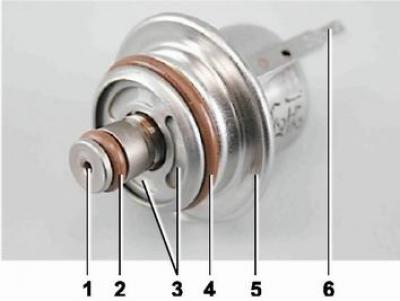
Fuel pressure regulator engine 11183 (1.6i): 1 - hole for draining excess fuel; 2, 4 - sealing rings; 3 - holes for supplying fuel to the regulator; 5 - body; 6-output for connecting the regulator to the "ground"
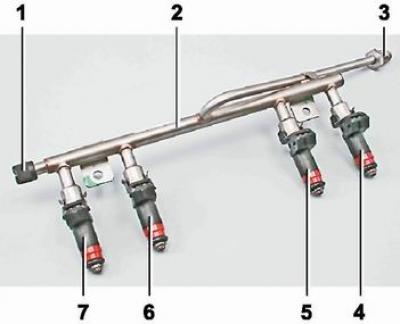
Fuel rail for engine 11183 (1.6i) complete with injectors: 1 - diagnostic nipple; 2 - fuel rail; 3 - nipple for connection to the fuel line; 4, 5, 6 and 7 - injectors
Excess fuel is released through the pressure regulator into the tank. The fuel pressure regulator is installed in the fuel module cover.
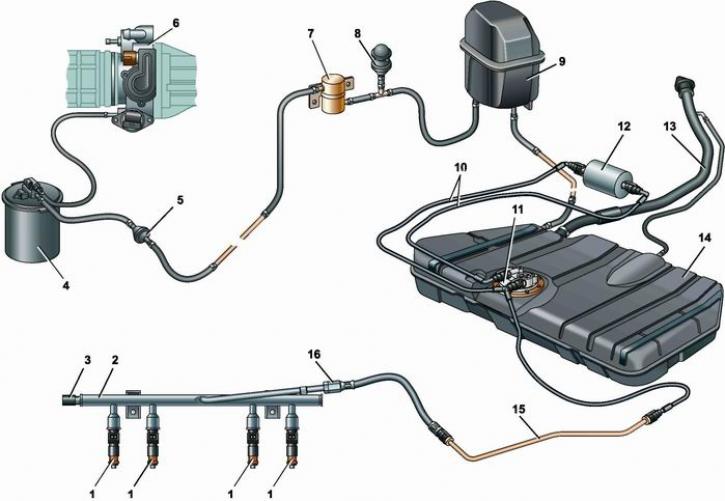
Engine fuel system diagram 11183 (1.6i): 1 - nozzle; 2 - fuel rail; 3 - diagnostic connector; 4 - adsorber; 5 - check valve; 6 - throttle assembly; 7 - gravity valve; 8 - safety (two-way) valve; 9 - separator; 10 - fuel line tubes connecting the fuel module to the fuel filter; 11 - fuel module; 12 - fuel filter; 13 - filler pipe; 14 - fuel tank; 15 - fuel line connecting the fuel module to the fuel rail; 16 - metal fuel line tube; 17 - connecting hose; 16 - nipple for connecting the fuel rail to the fuel line