




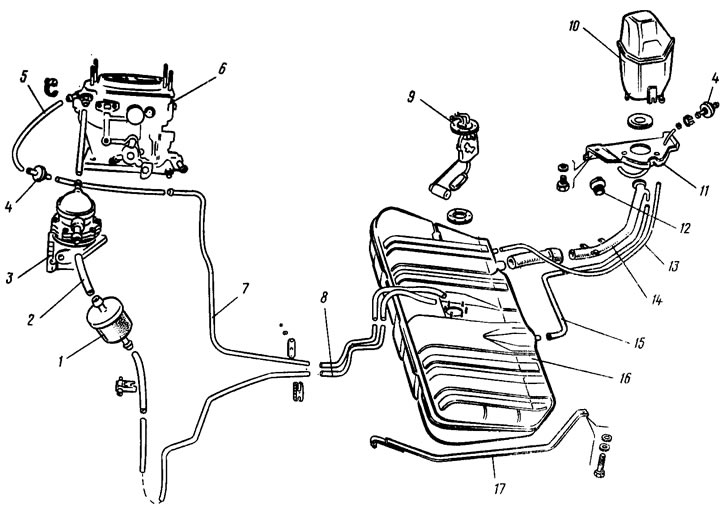
Figure 13. Fuel tank and fuel lines: 1 - fine fuel filter; 2 - fuel supply hose to the fuel pump; 3 - fuel pump; 4 - check valves; 5 - fuel drain hose from the carburetor; 6 - carburetor; 7 - fuel drain pipe into the tank; 8 - fuel supply pipe from the tank; 9 - fuel level sensor in the tank; 10 - separator; 11 - separator mounting bracket; 12 - Fuel tank cap; 13 - separator hose; 14 - filling pipe; 15 - filler pipe hose; 16 - fuel tank; 17 - tank mounting clamp
The fuel tank is stamped and welded and consists of two steel half-bodies. The tank is connected to a non-separable separator of 10 gasoline vapors by drainage pipes. To prevent fuel from leaking out of the tank through the separator, it has a non-separable double-action check valve on the outlet hose. As the fuel is consumed from the tank, the valve lets atmospheric air into the tank, and when the pressure in the tank increases, it releases fuel vapors from the tank.
Fine filter 1 is installed in front of the fuel pump on the hoses. The filter is of a non-separable design, with a paper filter element in a plastic housing.
Air is supplied to the engine cylinders through a thermostat, air filter, carburetor and intake manifold.
The exhaust gases are released into the atmosphere through the exhaust manifold, the inlet pipe, the additional and main mufflers.