




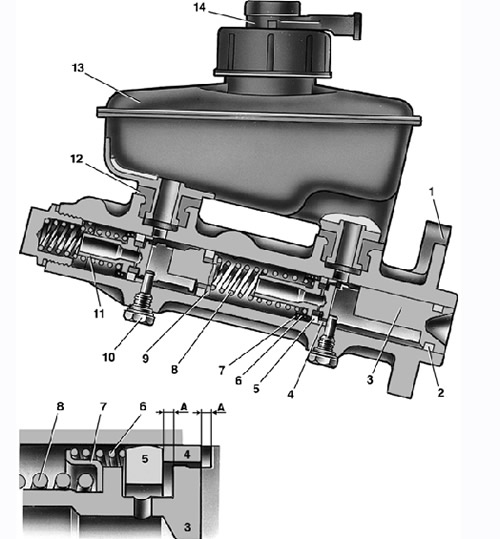
Fig. 8.5. Master cylinder with reservoir: A - gap; 1 – master cylinder body; 2 – low pressure sealing ring; 3 – piston drive circuit left front – right rear brake; 4 – spacer ring; 5 – high pressure sealing ring; 6 – sealing ring pressure spring; 7 – spring plate; 8 – piston return spring; 9 – washer; 10 – locking screw; 11 – piston of the drive circuit right front – left rear brake; 12 – connecting sleeve; 13 – tank; 14 – brake fluid emergency level sensor
1. Remove the brake master cylinder from the vehicle (see "Removal and installation the master brake cylinder").
2. Using a wooden spatula as a lever, remove the tank 13 (see fig. 8.5) from the cylinder.
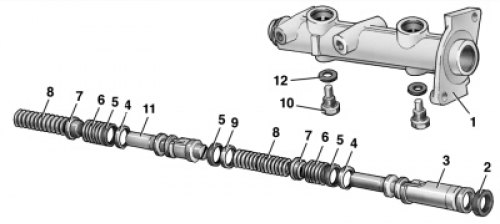
8.11. Master cylinder parts: 1 – cylinder body; 2 – low pressure sealing ring; 3 – piston drive circuit left front – right rear brake; 4 – spacer ring; 5 – high pressure sealing ring; 6 – sealing ring pressure spring; 7 – spring plate; 8 – piston return spring; 9 – washer; 10 – locking screw; 11 – piston of the drive circuit right front – left rear brake; 12 – sealing gasket
3. Remove connecting bushings 12 from the master cylinder housing.
4. Unscrew the two locking screws 10 (Fig. 8.11).
5. Using your hand, remove the pistons of the first and second chambers with the seals, washers and springs from the housing. Piston 11 of the second chamber may not come out freely. To remove it with the remaining parts, push it through the first chamber by hitting the end of the housing from the side of the first chamber on a clean board. To remove the piston, you can also use compressed air, which must be supplied to the outlet of the second chamber, closing the opening under the tank.
6. Carefully inspect and make sure that the cylinder mirror and the working surface of the pistons are completely clean, that there is no rust, scratches or other irregularities. Otherwise, replace the parts with new ones.
7. Replace torn, swollen or loose seals. It is recommended to replace seals with new ones every time the master cylinder is disassembled, regardless of their condition.
8. Check the elasticity of the piston springs, the length of which should be 41 mm under a load of 38.26–46.1 N (3.9–4.7 kgf), 21 mm under a load of 81.81–99.47 N (8.34–10.14 kgf), 59.7 mm in a free state. Replace springs that have lost elasticity.
[Information copied from the portal: VAZBOOK.ru]
9. It is recommended to replace the gaskets 12 under the locking screws with new ones.
10. Before assembly, wash all parts with clean brake fluid. Do not allow mineral oils, gasoline, kerosene or diesel fuel to come into contact with the parts, as even residual traces of these liquids can lead to the destruction of the rubber seals.
Warning! Wash the sealing rings in isopropyl alcohol for no more than 20 seconds, then blow them with air.
11. Assemble the cylinder in the reverse order of disassembly. Lubricate all parts with brake fluid.