




Contents: Vacuum booster ↓ Master cylinder ↓ Front wheel brake mechanism ↓ Rear wheel brake mechanism ↓ Parking brake ↓
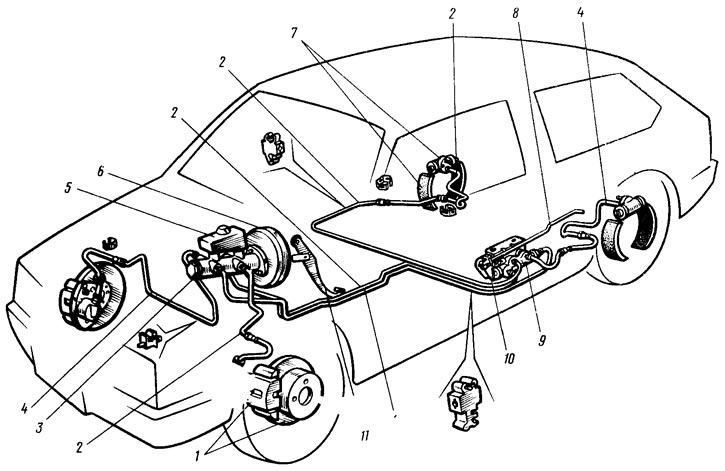
Figure 104. Hydraulic brake drive diagram: 1 - front wheel brake mechanism; 2 - pipeline of the circuit "left front - right rear brakes"; 3 - master cylinder of the brake hydraulic drive; 4 - pipeline of the circuit "right front - left rear brakes"; 5 - master cylinder reservoir; 6 - vacuum booster; 7- rear wheel brake mechanism; 8 - elastic lever of pressure regulator drive; 9 - pressure regulator; 10 - pressure regulator drive lever; 11 - brake pedal
The car is equipped with service and parking brake systems. The service brake system consists of four brake mechanisms and a hydraulic drive, which has a diagonal division of the circuits (figure 104). One hydraulic drive circuit ensures the operation of the right front and left rear brake mechanisms, the other - the left front and right rear. This significantly increases the safety of driving the car.
The hydraulic drive includes a vacuum booster 6 and a dual-circuit regulator 9 of the rear brake pressure.
The first reduces the force on the brake pedal, the second increases the safety of the car. In addition to the hydraulic drive, the brake mechanisms of the rear wheels have a mechanical drive from the parking brake lever installed on the floor of the body.
Vacuum booster
Rubber diaphragm 10 (figure 105) together with the body, 21 valves divide the vacuum booster cavity into two chambers: vacuum A and atmospheric B. Chamber A is connected to the engine intake pipe.
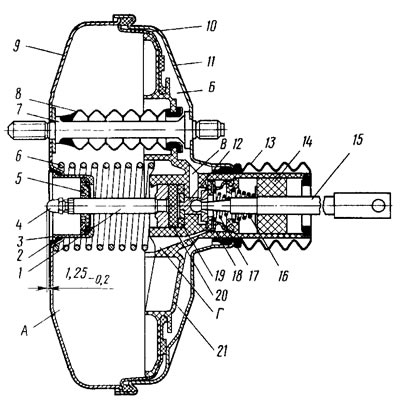
Figure 105. Vacuum amplifier: 1 - rod; 2 - master cylinder flange sealing ring, 3 - booster housing cup; 4 - adjusting screw; 5 rod seal; 6 - diaphragm return spring; 7 - amplifier pin; 8 - sealing cover; 9 - amplifier body, 10 - diaphragm; 11 - amplifier housing cover; 12 - piston; 13 - valve body protective cover; 14 - air filter; 15 - pusher; 16 - pusher return spring; 17- valve spring; 18 - valve; 19 - valve body bushing; 20 - rod buffer; 21 - valve body; A - vacuum chamber; B - atmospheric chamber; B, G - channels
The valve body 21 is made of plastic. At the outlet from the cover it is sealed with a corrugated protective cover 13. The valve body contains the main cylinder drive rod 1 with a support sleeve, the rod buffer 20, the valve body piston 12, the valve assembly 18, the return springs 16 and 17 of the pusher and valve, the air filter 14, the pusher 15.
When the pedal is pressed, the pusher 15 moves, the piston 12 and the valve body 21, and then the valve 18 until it hits the valve body seat. When atom chambers A and B are disconnected. With further movement of the piston, its seat moves away from the valve and through the resulting gap, chamber B is connected to the atmosphere. Air entering through filter 14, the gap between the piston and the valve and channel B, presses on diaphragm 10. Due to the difference in pressure in chambers A and B, the valve body moves together with rod 1, which acts on the piston of the master cylinder. When the pedal is released, the valve moves away from its body and through the resulting gap and channels B and G, chambers A and B communicate with each other. Pressure regulator. This device regulates the pressure in the hydraulic drive of the rear wheel brake mechanisms depending on the load on the rear axle of the car (figure 106). It is included in both circuits of the brake system, and through it the brake fluid is supplied to both rear brake mechanisms.
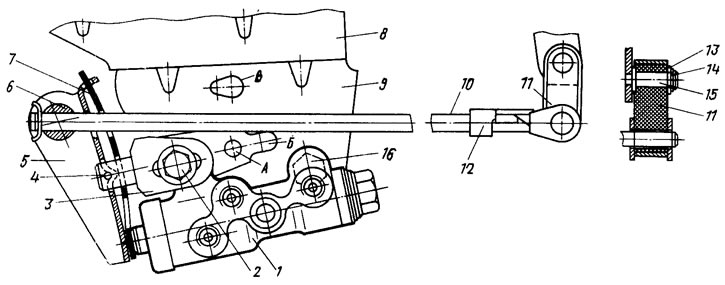
Figure 106. Pressure regulator drive
The pressure regulator 1 is attached to the bracket 9 by two bolts 2 and 16. In this case, the front bolt 2 simultaneously attaches the forked bracket 3 of the lever 5 of the pressure regulator drive. The two-arm lever 5 is pivotally attached to the finger of this lever by the pin 4. Its upper arm is connected via the axle 6 to the elastic lever 10, the other end of which is pivotally connected via the earring 11 to the bracket of the rear suspension lever. The bracket 3 together with the lever 5 can be moved relative to the pressure regulator due to the oval holes for the fastening bolt. This regulates the force with which the lever 5 acts on the piston of the regulator (see section. "Adjusting the pressure regulator drive").
The regulator has four chambers: A and G (figure 107) are connected to the master cylinder, B - to the right, and B - to the left wheel cylinders of the rear brakes.
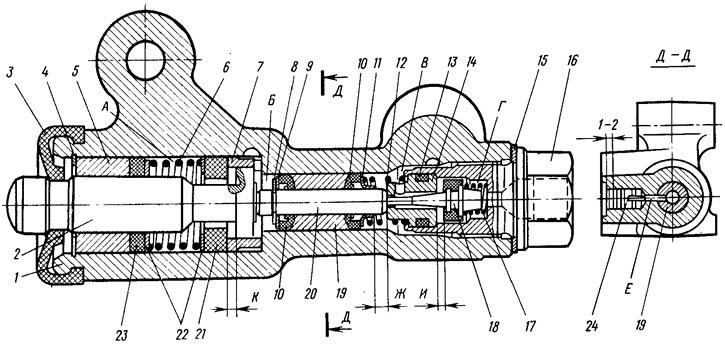
Figure 107. Pressure regulator
In the initial position of the brake pedal, piston 2 is pressed by lever 5 (see figure 106) through the leaf spring 7 to the pusher 20 (see figure 107), which under this force is pressed against the seat 14 of the valve 18. In this case, the valve 18 is pressed away from the seat and a gap I is formed, as well as a gap K between the piston head and the seal 21. Through these gaps, chambers A and G communicate with chambers B and C.
When the brake pedal is pressed, the liquid enters the wheel cylinders of the brake mechanisms through the gaps K and I and the chambers D and B. As the fluid pressure increases, the force on the piston increases, which tends to push it out of the housing. When the force from the pressure exceeds the force from the elastic lever, the piston begins to move out of the housing, and after it, under the action of springs 12 and 17, the pusher 20 moves together with the sleeve 19 and rings 10. In this case, the gap increases, and the gaps And and K decrease. When the gap And is completely removed and the valve 18 isolates the chamber D from the chamber B, the pusher 20, together with the parts located on it, stops moving after the piston. Now the pressure in chamber B will change depending on the pressure in chamber B. With a further increase in the brake pedal force, the pressure in chambers A and A increases, the piston 2 continues to move out of the housing, and the sleeve 19 together with the sealing rings 10 and the plate 11 under increasing pressure in chamber B moves towards the plug 16. In this case, the gap W begins to decrease. By reducing the volume of chamber B, the pressure in it, and therefore in the brake drive, will increase and will practically be equal to the pressure in chamber B. When the gap A is completely selected, the pressure in chamber B. and therefore in chamber B, will increase to a lesser extent than the pressure in chamber A due to liquid throttling between the piston head and the seal 21. The relationship between the pressure in chambers B and A is determined by the ratio of the difference in the area of the head and the piston rod to the area of the head.
There is a hole in the regulator body, closed by plug 24. Liquid leaking from under the plug when it is squeezed out indicates a leak in knees 10.
Master cylinder
A reservoir 13 is attached to the body of the master cylinder (figure 108), in the filler neck of which the brake fluid emergency level sensor 14 is installed. High pressure sealing rings 5 are used from the rear wheel cylinder.
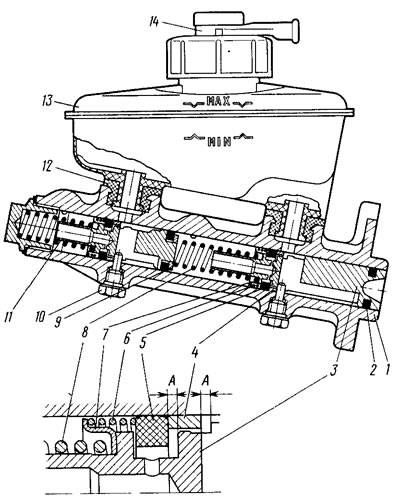
Figure 108. Master brake cylinder: 1 - body; 2 - sealing ring; 3 - piston of the drive circuit "left front - right rear brakes"; 4 - spacer ring; 5 - high pressure sealing ring; 6 - sealing ring pressure spring; 7 - spring plate; 8 - piston return spring; 9 - washer; 10 - lock screw; 11 - piston of the drive circuit "right front - left rear brakes"; 12 connecting sleeve; 13 - tank; 14 - liquid level alarm sensor; A - compensation gaps
Front wheel brake mechanism
Disc with automatic adjustment of the gap between the pads and the disc, with a floating bracket. The bracket is formed by a support 3 (figure 109) and wheel cylinder 5, which are tightened with bolts. The movable bracket is fastened with bolts to guide pins 9, which are installed in the holes of the guide 2 of the shoes. Grease is placed in these holes. Rubber covers 8 are installed between the pins and the guide of the shoes. Brake shoes 4 are pressed against the grooves of the guide by springs. Piston 6 with sealing ring 7 is installed in the cavity of the wheel cylinder. Due to the elasticity of this ring, an optimal gap is maintained between the shoes and disk 1, the surface of which is protected by casing 10.
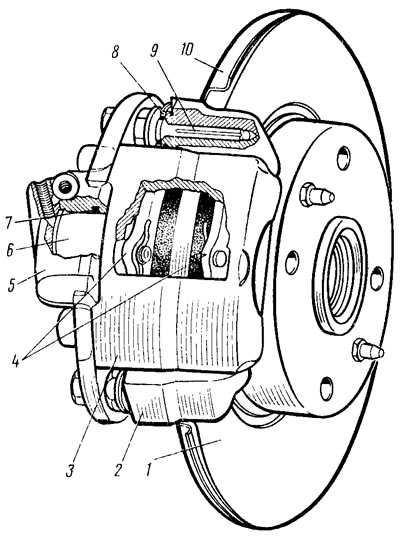
Figure 109. Front wheel brake mechanism
When braking under fluid pressure, piston 6 presses the inner shoe to the disk, after which, due to the reaction force, the movable bracket moves on the pins 9 and the outer shoe is also pressed to the disk. In this case, the pressing force of the shoes will be the same. When releasing the brake, due to the elasticity of the sealing ring 7, the piston is moved away from the shoe and a small gap is formed between the shoes and the disk.
Rear wheel brake mechanism
Drum, with automatic adjustment of the gap between the pads and the drum (figure 110). The automatic clearance adjustment device is located in the wheel cylinder 3 (figure 111). Its main element is a split thrust ring 9, installed on the piston 4 between the flange of the thrust screw 10 and two crackers 8 with a gap of 1.25-1.65 mm. The thrust rings 9 are installed in the cylinder with an interference fit, providing a ring shear force along the cylinder mirror of at least 35 kgf, which exceeds the force on the piston from the tension springs 3 and 7 (see figure 110) brake pads. When the linings wear out, the gap of 1.25-1.65 mm is completely eliminated, the flange on the stop screw 10 (see figure 111) is pressed against the flange of ring 9. As a result, the thrust ring, under the pressure of the brake fluid, moves after the piston by the amount of wear. When braking stops, the pistons are moved by the force of the tension springs until the crackers stop against the flange of the thrust ring. This maintains an optimal gap between the shoes and the drum.
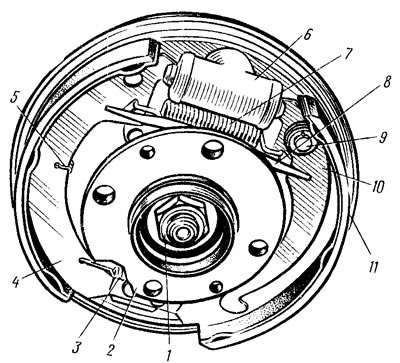
Figure 110. Rear wheel brake mechanism: 1 - hub mounting nut; 2 - wheel hub; 3 - lower brake shoe tension spring; 4 - brake shoe; 5 - guide spring; 6 - wheel cylinder; 7 - upper tension spring; 8 - expansion bar; 9 - parking brake lever finger; 10 - parking brake lever; 11 - brake shield
(The original is available on the website: «www.VAZbook.ru»)
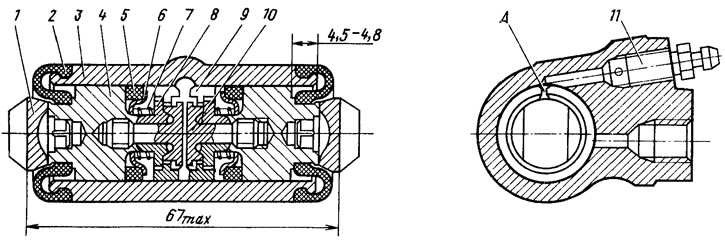
Figure 111. Wheel cylinder
The stops 1 of the pads are pressed into the pistons, and the nipple 11 for bleeding the brake is screwed into the cylinder.
Parking brake
It has a mechanical drive. It acts on the brake mechanisms of the rear wheels. It consists of a lever 1 (figure 112), adjusting rod 5, equalizer B, cable 10, lever 13 of the manual drive of the shoes and expansion bar 15. The corresponding parts (10-14) are installed in the brake drive of the right wheel.
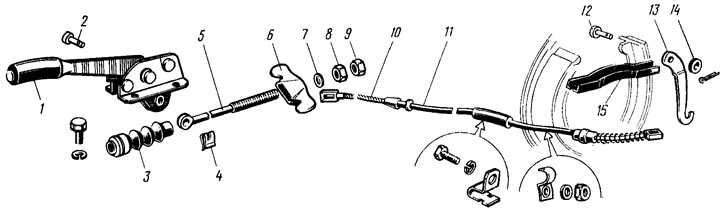
Figure 112. Parking brake parts
Possible malfunctions of the brake system, their causes and methods of elimination are given in table 15.